Planetary Gearbox for Battery & EV Manufacturing — Robot Wrist Drives, Electrode Winders & Gigafactory Automation

180:1
Single-Unit Ratio — EP-FALR
≤1 arc-min
P0 Backlash — EP-FADS Wrist
−22 mm
Axial Saving — FADS vs FAD
30,000 hr
Design Life — EP-FADS / FALR
IP65
Every Unit Pressure-Tested
C1–C10
Universal Motor Adapter

Engineering Context

Why Battery Gigafactory Automation Demands Two Completely Different Gearbox Architectures
EP-FADS and EP-FALR planetary gearboxes for EV battery gigafactory — robot wrist drives and electrode winding machine servo reducers

Korea Ever-Power EP-FADS (robot wrist, left) and EP-FALR (electrode winder mandrel drive, right) — the two core series for battery gigafactory automation

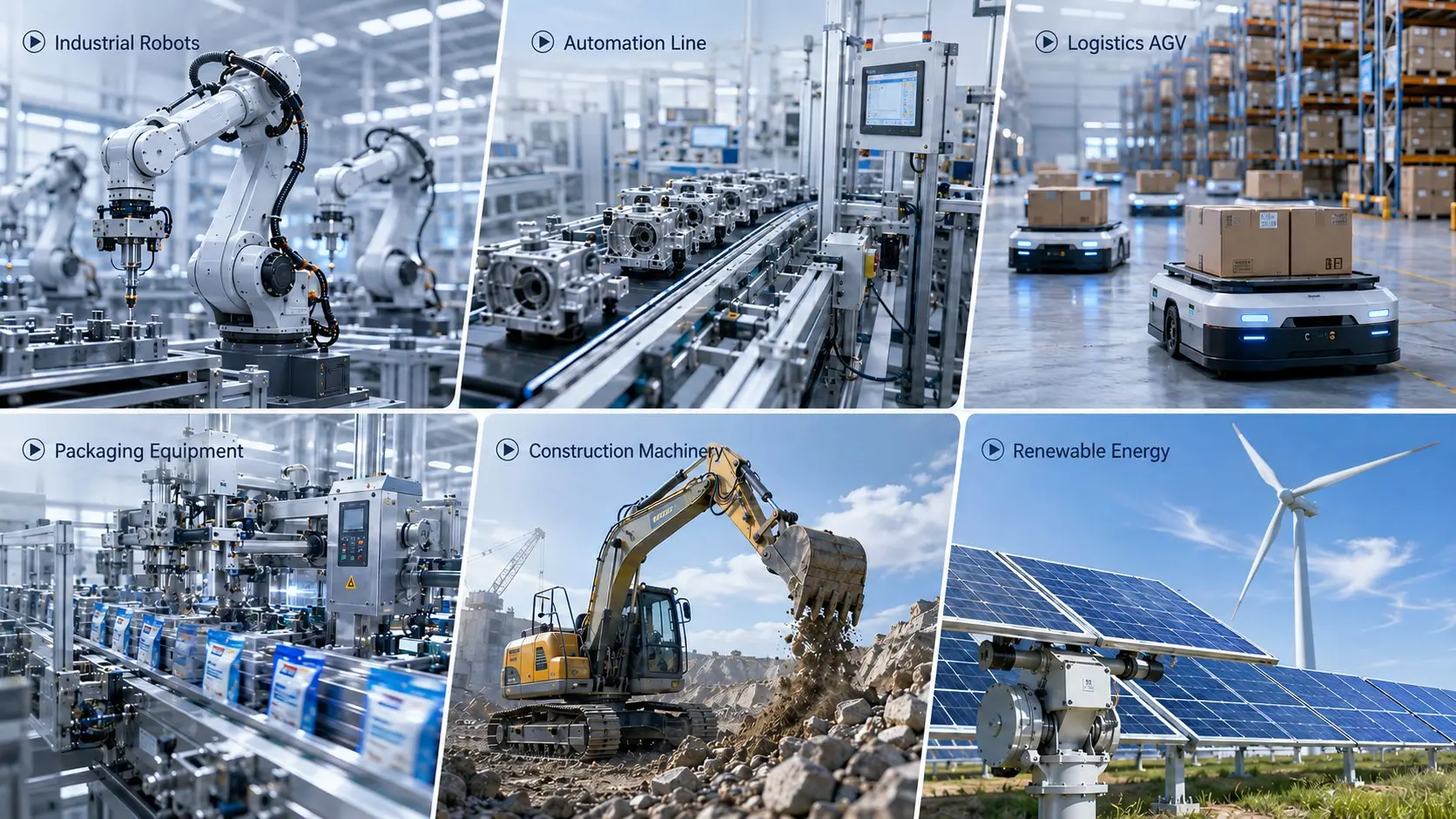
A battery gigafactory production line contains two fundamentally different motion control problems — and they require two fundamentally different planetary gearbox architectures. The first problem is robot precision: assembly robots handling individual cells and modules need J4/J5/J6 wrist axes with ≤1 arc-min backlash, minimum axial length for cable routing in cleanroom battery environments, and 30,000-hour design life at 8,000 rpm. The second problem is winding ratio: electrode coating and winding machines need 80–180:1 ratio in a single gearbox, right-angle output to the mandrel, and tension-controlled torque delivery that cannot tolerate the compliance of a tandem gearbox coupling.

No single planetary gearbox series solves both problems. Korea Ever-Power’s approach is to match each production stage to the series architected for that motion type: EP-FADS for robot wrist axes (minimum axial envelope, direct-insert motor shaft, P0 cleanroom precision), EP-FALR for winding mandrel drives (single-unit 180:1, right-angle belt-pulley output, 30,000-hour S5 life). On the same gigafactory line, EP-FAB P1 handles the higher-torque stacking robot base axes (J1–J3), and EP-FPG/FPGA covers the economy-tier conveyor and transfer drives between production stages.

The market context amplifies the engineering stakes. Battery gigafactory buildout in Korea (Samsung SDI, LG Energy Solution, SK Innovation), Japan, and the EU represents the single fastest-growing planetary gearbox demand segment between 2024 and 2030. A single 40 GWh gigafactory requires between 200 and 400 servo gearboxes across winding, stacking, welding, and assembly automation — and the gearbox specification on those lines is locked in at the equipment supplier level 18–24 months before production begins. The engineering decision made now determines the bill-of-materials for the first production run and every expansion thereafter.

🔋
The Tandem Gearbox Problem in Electrode Winding
Electrode winding machines typically require 80–180:1 ratio at the mandrel with a right-angle motor layout (motor perpendicular to the winding axis). The conventional solution is a tandem arrangement: right-angle gearbox stage 1 (e.g., 10:1) coupled by belt to an inline stage 2 (e.g., 10:1 = 100:1 total). Every coupling interface in this tandem adds backlash, adds torsional compliance, and adds a maintenance interval. EP-FALR delivers 180:1 in a single sealed unit with an integrated belt pulley output — one gearbox, one motor interface, zero inter-stage coupling, zero tandem backlash accumulation.

Gigafactory Production Line — Stage-by-Stage Gearbox Series Assignment

The following map shows how the EP-series gearboxes distribute across a typical lithium-ion pouch/prismatic cell gigafactory line, from electrode preparation through module assembly. Each stage has distinct motion requirements that determine which series is correct.

ELECTRODE PREP
CELL ASSEMBLY
MODULE ASSEMBLY
PACK ASSEMBLY

Electrode Coater
Coating + drying
EP-FALR P1
Winding mandrel
80–120:1
Right-angle output
Single unit

Electrode Slitter
Width cutting
EP-FALR P1
Rewind shaft
50–100:1
Tension control
Compact R/A

Cell Winder / Stacker
Cylindrical / pouch
EP-FALR + EP-FAB P1
Winding: 50–100:1
Stacking robot: J1–J3
2,000 Nm max
Grade-stamped

Cell Assembly Robot
6-axis handling
EP-FADS P0 + EP-FAB P1
J4–J6: FADS P0
−22 mm axial
J1–J3: FAB P1
Cleanroom IP65

Module Assembly
Stacking + welding
EP-FAB P1 + EP-FAD P1
Pick-and-place
10–40:1
High cycle
30,000 hr life

PACK + Conveyor
Final integration
EP-FAD P1 + EP-FPG
PACK robot: FAD
Conveyor: FPG
≥97% efficiency
Economy tier

Series at each stage:
EP-FALR (winding / rewind, high ratio)
EP-FADS P0 (robot wrist, compact axial)
EP-FAB P1 (robot base J1–J3, high torque)
EP-FAD P1 (module robot, 30,000 hr)
EP-FPG (economy conveyor / transfer drives)

Application Scenarios

Six Battery & EV Manufacturing Applications — Series, Specification, and Engineering Rationale

From electrode winding to solid-state battery pilot lines, the six scenarios below cover the drive applications that battery equipment engineers encounter most frequently when specifying gearboxes for new gigafactory automation projects. Each card includes the series rationale and the key engineering constraint that drives the selection.

01 — Electrode Coater / Winding Machine
Mandrel drive — cylindrical or pouch cell winding
EP-FALR P1
Frame 110–190 mm
80–180:1 single unit

The winding mandrel drive requires 80–180:1 ratio with the motor perpendicular to the winding axis. EP-FALR achieves this in a single sealed unit: right-angle bevel stage + helical planetary stage + integrated timing belt pulley output. No tandem coupling. No inter-stage backlash accumulation. The motor mounts at 90° and the belt drives the mandrel directly from the FALR integrated pulley — which eliminates the hub-to-shaft eccentricity that causes winding tension oscillation in conventional belt-hub setups.

Engineering constraint: Tandem gearbox coupling backlash accumulates as belt compliance at the mandrel → tension oscillation → non-uniform electrode layer density. Single-unit 180:1 eliminates the inter-stage interface entirely. Max radial force 34,200 N for wide AT10 electrode winding belt.

02 — Cell Assembly Robot J4/J5/J6 Wrist
Cleanroom battery cell manipulation — fixed motor config
EP-FADS P0
Frame 047–090 mm
−22 mm vs FAD

Battery assembly robots operate in cleanroom environments where encoder and signal cables must route inside the link housing — exposed cables generate particles and create maintenance access problems. EP-FADS eliminates the motor adapter plate: the servo motor shaft inserts directly into the gearbox input coupling, saving 22 mm of axial length versus EP-FAD plus a standard adapter plate. This 22 mm is precisely the clearance needed to route cables inside the J5/J6 link housing of a compact 6-axis assembly robot.

Engineering constraint: ISO Class-4 cleanroom: zero external cable exposure at wrist joints. FADS hollow-shaft integration routes encoder cable through gearbox body. 30,000 hr life at 8,000 rpm; NYOGEL 792D zero-particle emission lubricant.

03 — Module Stacking Robot J1/J2/J3 Base
High-torque pouch / prismatic cell stacking
EP-FAB P1
Frame 090–180 mm
≤3 arc-min P1

Cell stacking robots for pouch and prismatic battery module assembly handle payloads of 2–15 kg per cycle at 60–120 cycles per minute. The J1 waist and J2/J3 shoulder/elbow joints require 10–50:1 ratio, up to 2,000 Nm output torque, and P1 backlash grade for ±0.05 mm TCP repeatability. EP-FAB square-flange direct mount to the robot link casting; individual backlash grade stamping provides per-unit traceability for robotic precision certification audits required by automotive battery OEM customers.

Engineering constraint: Automotive battery OEM quality audits require per-unit gearbox traceability. EP-FAB individual backlash stamp documents each unit’s measured grade — same standard as European premium brands at lower cost.

04 — Formation & Aging Tester Contact Press
Cell contact pressure axis — formation cycling
EP-FPG P2
Frame 060–090 mm
≤5 arc-min P2

Formation and aging testers apply a controlled contact force to cell terminals during the initial charge/discharge cycling that activates the cell chemistry. The contact press axis requires ≤5 arc-min backlash for repeatable pressure delivery, cleanroom compatibility (zero external grease points), and long maintenance interval to minimise tester downtime. EP-FPG P2 (≤5 arc-min economy grade) meets the backlash requirement at economy-tier pricing appropriate for the high unit count in a formation line (typically 200–1,000 tester channels per factory).

Engineering constraint: High unit count (200–1,000 per formation line) demands economy pricing. FPG P2 provides precision sufficient for pressure repeatability at 35–50% lower cost than EP-FAB at the same frame size.

05 — Solid-State Battery Pressing Axis
Dry electrode pressing — pilot line application
EP-FAB P0
Frame 090–110 mm
≤1 arc-min P0

Solid-state battery pilot lines use dry electrode pressing processes where applied pressure must be repeatable to within tight tolerances — pressure non-uniformity directly affects solid electrolyte contact area and cell resistance. The press axis operates at low speed (below 500 rpm) with high torque demand and requires P0 backlash grade for pressure position repeatability. Zero lubricant particle emission is mandatory: NYOGEL 792D in EP-FAB emits no detectable particles into the cleanroom air stream during normal operation.

Engineering constraint: Solid-state pressing requires P0 position repeatability; zero particle emission from lubricant; IP65 for dry-process environments. EP-FAB P0 individual grade stamp provides traceability required for solid-state battery pilot certification.

06 — Battery PACK Assembly Robot
Module-to-PACK pick-and-place — high volume
EP-FAD P1
Frame 090–110 mm
30,000 hr life

Battery PACK assembly requires placing completed modules into the PACK housing with millimetre-level accuracy at high throughput — 100 PACK per shift at 5–10 modules per PACK means 500–1,000 placement cycles per shift. EP-FAD P1 provides the 10,000 rpm input speed needed for fast inter-station robot travel, the 30,000-hour design life required for three-shift gigafactory duty, and ≤3 arc-min P1 backlash for ±0.5 mm placement accuracy. Round-flange direct mount to robot link without adapter plate reduces assembly BOM complexity.

Engineering constraint: 3-shift continuous = ~6,500 hr/year. 30,000 hr life = ~4.6 year interval to first service inspection — aligns with gigafactory planned maintenance windows and avoids unscheduled production downtime.

Technical Specifications

EP-Series Battery Application Specification Matrix

The following table maps each battery production stage to the recommended series and critical specifications. Frame sizes, ratios, and backlash grades are application-specific — use this table as the starting point before requesting a datasheet and application engineering review from Korea Ever-Power.

Production Stage / Drive Recommended
Series
Frame
(mm)
Backlash
Grade
Ratio
Range
Max
rpm
Life
(hr)
Key Selection Reason
Electrode coater mandrel EP-FALR P1 110–190 ≤2 arc-min 80–180:1 3,000 30,000* Single-unit 180:1; integrated belt pulley; no tandem coupling; motor ⊥ mandrel
Electrode slitter rewind shaft EP-FALR P1 090–150 ≤2 arc-min 50–100:1 4,000 30,000* Right-angle compact; single unit high ratio; tension control stability
Cylindrical cell winder spindle EP-FALR P1 090–150 ≤2 arc-min 50–100:1 4,000 30,000* Compact R/A; high-speed winding; 30,000 hr S5 life
Assembly robot J4/J5/J6 wrist EP-FADS P0 047–090 ≤1 arc-min 5–16:1 8,000 30,000 −22 mm axial vs FAD+adapter; direct-insert motor; cleanroom cable routing inside link
Assembly robot J1/J2/J3 base EP-FAB P1 090–180 ≤3 arc-min 10–50:1 4,000 20,000 Max torque 2,000 Nm; square flange; individual backlash stamp for OEM audit
Module assembly / PACK robot EP-FAD P1 090–110 ≤3 arc-min 10–30:1 10,000 30,000 30,000 hr for 3-shift continuous; 10,000 rpm for fast inter-station travel
Formation / aging tester press EP-FPG P2 060–090 ≤5 arc-min 10–30:1 2,000 20,000* Economy tier for high unit count (200–1,000 channels); cleanroom; long maintenance interval
Solid-state battery press axis EP-FAB P0 090–110 ≤1 arc-min 10–40:1 3,000 20,000 P0 pressure repeatability; zero lube particles (NYOGEL 792D); IP65; pilot line traceability
Inter-stage conveyor / transfer EP-FPG / FPGA 040–120 ≤8 arc-min 10–50:1 3,000 20,000* Economy tier; ≥97% efficiency; round/square housing press-fit; cleanroom IP64

* FALR/FPG: 30,000 hr / 20,000 hr S5 intermittent; 15,000 hr / 10,000 hr S1 continuous. All FAD/FADS/FAB values are S1 continuous. C1–C10 motor adapter applies to all series.

FALR 180:1
Single Unit, No Tandem
FADS −22 mm
Axial Saving vs FAD
≤1 arc-min
P0 Grade — FADS / FAB
30,000 hr
FADS / FALR / FAD Life
IP65
Every Unit Tested
C1–C10
All Series, One Qualification

Engineering Insight

Inside the EP-FALR — Why Single-Unit 180:1 Solves the Electrode Winder Problem
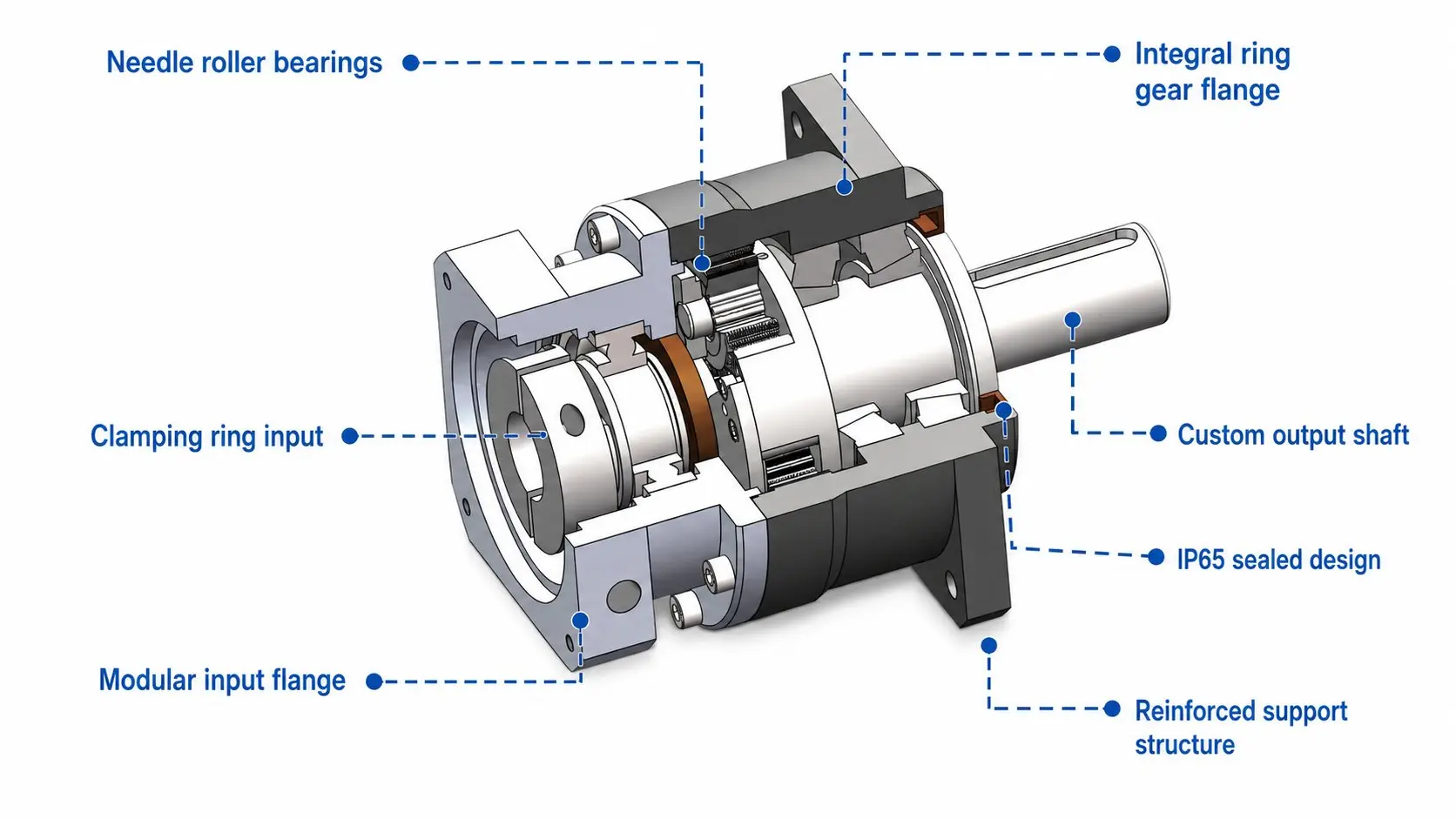
EP-FALR right-angle planetary gearbox internal structure — bevel stage helical planetary stage integrated belt pulley for electrode winding machine

180:1
Single Unit Max
90°
Right-Angle Output
34.2kN
Max Belt Force

The EP-FALR internal architecture: bevel input stage changes shaft direction 90°, then a two-stage helical planetary train delivers the ratio, and the integrated belt pulley outputs to the winding mandrel — all in one sealed unit.

The Three Engineering Stages Inside EP-FALR

The EP-FALR is not a standard gearbox with a belt pulley bolted on. It is a purpose-built three-stage assembly where each stage contributes a specific function that, combined, makes the tandem gearbox arrangement unnecessary. Understanding the internal architecture clarifies why competitors cannot replicate this with a standard product.

  1. 01

    Bevel Input Stage — Motor at 90° to Output Axis

    The bevel gear input stage redirects the servo motor shaft axis through 90° with minimal backlash contribution. This allows the motor to mount perpendicular to the winding mandrel — which is the natural machine layout for electrode winders where the mandrel is horizontal and motor space is available above or beside it, not in front. The bevel stage ratio is fixed within the overall 180:1 budget.

  2. 02

    Two-Stage Helical Planetary Train — Delivering the Ratio

    The planetary stages provide the bulk of the ratio — up to 180:1 total in combination with the bevel stage. Helical planet gears operate in rolling contact throughout, maintaining the ≥97% transmission efficiency across the full ratio range. The two-stage architecture distributes heat generation and tooth loading across more mesh interfaces than a single-stage worm, which is the mechanical basis for the 30,000-hour life rating.

  3. 03

    Integrated Timing Belt Pulley — Zero Hub Eccentricity

    The output belt pulley is machined integral to the gearbox output shaft — the same bore, the same turning centre, the same machined surface. There is no separate hub-to-shaft interface, no keyway eccentricity, no tolerance stack between the gear output and the belt pitch circle. This eliminates the periodic tension oscillation at pulley rotation frequency that occurs in conventional setups where a separate hub is clamped or keyed onto the output shaft. The maximum radial force rating of 34,200 N accommodates AT10 electrode winding belts at the widths used in large-format cell production.

The consequence of this three-stage integration is that the winding machine designer eliminates one complete mechanical sub-assembly from the bill of materials — the tandem coupling between the right-angle stage and the inline stage. That coupling contributed backlash, compliance, a maintenance interval, and an additional alignment tolerance. EP-FALR replaces it with a single interface: the motor clamp-ring adapter at input and the integrated belt pulley at output.

Selection Guide

Battery Gearbox Selection Decision Matrix — 5 Questions Across Two Drive Types

Because battery gigafactory automation spans two distinct drive architectures — winding (high ratio, right-angle, belt output) and robotics (precision, compact, cleanroom) — this decision matrix splits into two parallel paths at Q1. Work through the relevant path for your application. If your project includes both types, apply each path independently to each drive point.

Selection Question
Your Answer → Series Implication
Recommended

Q1 — Drive type?
Winding / rewind / tension mandrel → go to Q2W  |  Robot / pick-and-place / press axis → go to Q2R  |  Conveyor / transfer between stations → EP-FPG/FPGA economy tier direct
Split path

Q2W — Winding ratio?
80–180:1 right-angle with belt output → EP-FALR P1 (single unit, no tandem)  |  50–80:1 right-angle → EP-FALR P1 (lower ratio range)  |  Inline (no 90° turn needed) → EP-FAL P1 with integrated pulley  |  Need more than 180:1 → two-stage EP-FALR in series
EP-FALR P1

Q3W — Frame size?
Mandrel belt width AT5 → FALR070/090  |  AT10 standard electrode → FALR110/150  |  Wide AT10 high-tension → FALR150/190 (F_rad up to 34,200 N)  |  Calculate: frame size = f(required output torque at mandrel RPM and belt tension)
FALR 070–190

Q2R — Robot joint type?
J4/J5/J6 wrist, fixed motor model, cleanroom → EP-FADS P0 (−22 mm axial, direct-insert, cable inside link)  |  J4/J5/J6 wrist, motor changeable → EP-FADR P0 (round-flange, adapter ring)  |  J1/J2/J3 base, high torque → EP-FAB P1 (square flange, 2,000 Nm)
FADS / FADR / FAB

Q3R — Precision / duty?
≤1 arc-min required (solid-state press, fine robot wrist) → P0  |  ≤3 arc-min sufficient (module placement, pack robot) → P1  |  ≤5 arc-min acceptable (formation tester) → P2 / economy  |  Life: 3-shift gigafactory → specify 30,000 hr series (FADS, FAD, FALR)
P0 / P1 / P2

Q4 — Volume / project type?
Equipment supplier (machine builder) with repeat orders per gigafactory project: contact Korea Ever-Power with BOM and production schedule — machine-builder-level pricing with delivery scheduling available. Single-site retrofit or pilot line: standard stock pricing; FADS P0 and FALR P1 available from stock in common frame sizes.
OEM / Stock

Manufacturing Quality

Korea Ever-Power Production — Why Battery OEM Audits Accept EP-Series Traceability
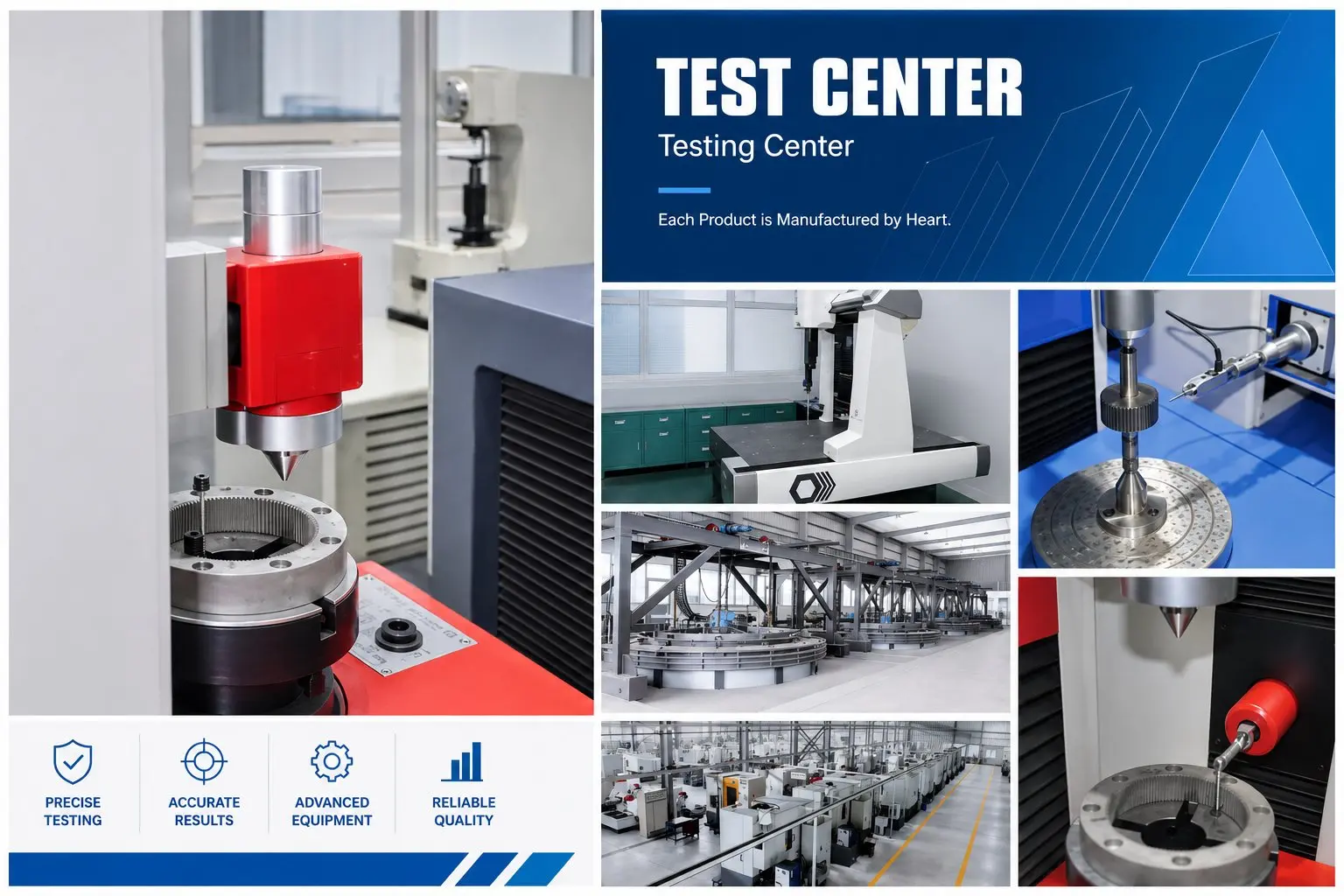
Korea Ever-Power test center — individual backlash measurement and IP65 pressure testing for EP-FADS and EP-FALR battery manufacturing gearboxes
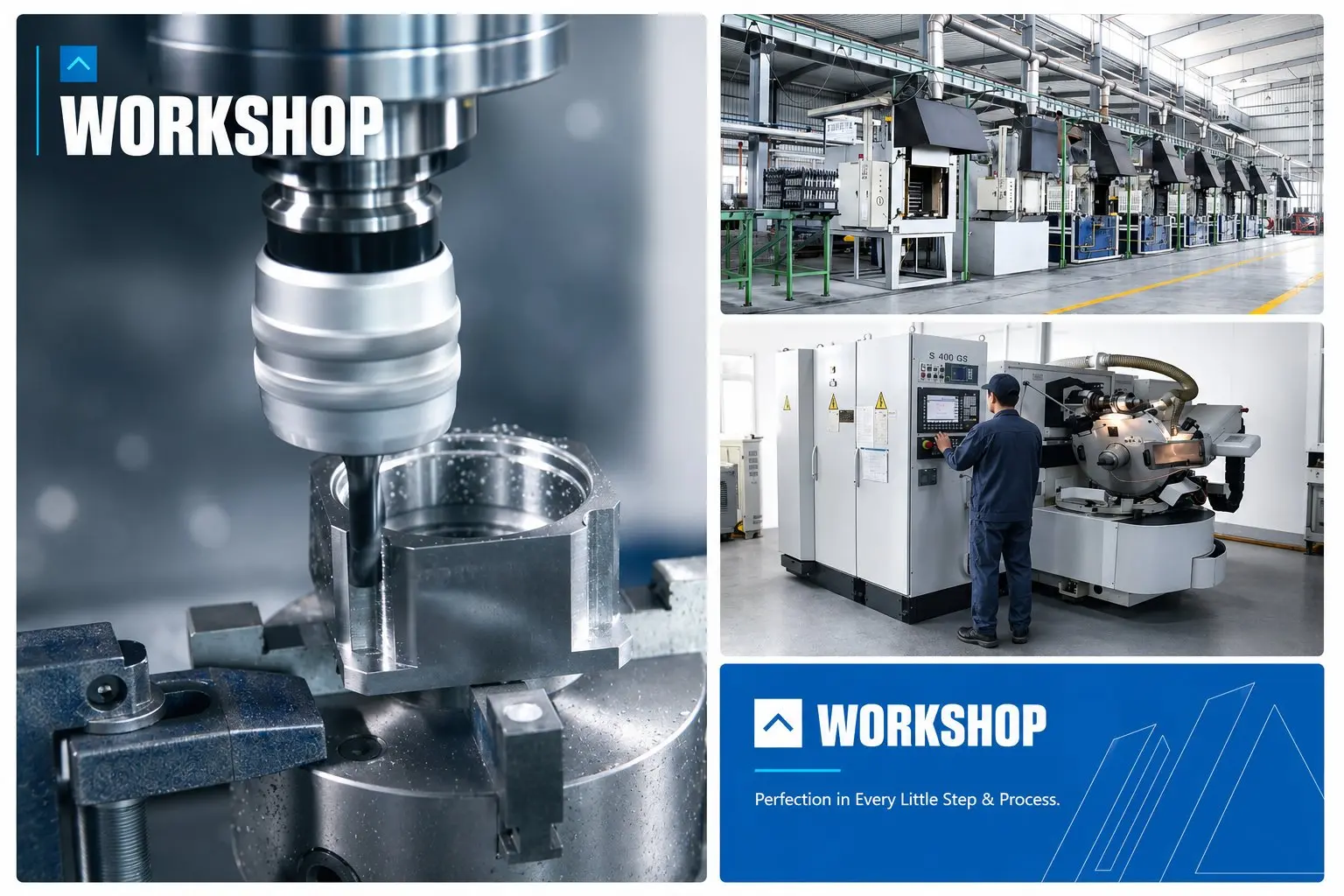
Korea Ever-Power precision manufacturing workshop — 5-axis gear grinding for EP-FADS and EP-FALR planetary gearboxes

Test centre (backlash measurement and IP65 pressure decay) and gear-grinding workshop, Ansan-si, Gyeonggi-do, Korea.

Battery OEM quality teams — particularly those supplying Samsung SDI, LG Energy Solution, SK Innovation, and their Tier-1 equipment suppliers — require gearbox traceability documentation as a condition of production line qualification. This means: per-unit backlash measurement records, per-unit IP test records, and production batch traceability to raw material certificates. Korea Ever-Power provides all three for EP-FADS, EP-FAB, EP-FAD, and EP-FALR series on request.

The per-unit backlash stamping that distinguishes Korea Ever-Power from Chinese competitors is particularly relevant for battery automation. When a robot arm is re-qualified after a crash or maintenance event, the maintenance team needs to know the original measured backlash of the replaced gearbox to validate that the new unit matches the performance baseline. A gearbox with a nameplate-stamped backlash grade and a stored test record makes this validation routine. A gearbox with a batch-sample grade and no per-unit data makes it impossible.

The NYOGEL 792D lubricant used in EP-FADS, EP-FAB, and EP-FAD is rated to −10°C lower limit and has been validated for use in ISO Class-4 cleanroom environments — it emits no detectable particles into the cleanroom air stream during normal rotary operation within the operating temperature range. CASTROL LMX in EP-FALR is rated to 0°C minimum and performs equivalently in the non-cleanroom winding machine environment where these gearboxes typically operate.

📋
Individual Unit Backlash Stamping — Required for Battery OEM Audit
Every EP-FADS/FAB/FAD/FALR unit is backlash-measured under 2% rated torque load before shipping. The measured grade (P0, P1, or P2) is stamped on the nameplate and stored in production records. Korea Ever-Power can provide per-unit test certificates on request for battery OEM supplier audit packages. This per-unit stamping is the same standard applied by Neugart and Apex Dynamics — not a batch-sample estimate. The same certification standard at a cost 25–40% lower than European benchmark pricing.

EP-FADS / EP-FALR vs. European Premium — Battery Application Comparison

Technical Attribute European Premium
(Neugart, Apex)
Korea Ever-Power
EP-FADS / EP-FAB / EP-FAD
Korea Ever-Power
EP-FALR
Gear accuracy DIN Class 5 DIN Class 5 (5-axis CNC) DIN Class 5
Direct-insert (FADS-type) Premium option (custom) Standard catalogue item N/A (R/A series)
Single-unit 180:1 R/A + belt Custom order only N/A (inline series) Standard catalogue item
Per-unit backlash stamp Yes Yes (every unit) Yes (every unit)
IP65 every unit Sample test Every unit tested Every unit tested
NYOGEL 792D cleanroom lube Yes Yes (FADS/FAB/FAD) CASTROL LMX
C1–C10 universal adapter Brand-specific All 8 series All 8 series
Unit price (P1 grade) 100% benchmark ~60–75% ~65–80%

Korea Ever-Power does not sell counterfeit products and does not claim to manufacture products identical to named brands. Comparative data based on publicly available specifications and customer substitution test results from Korean battery equipment OEM projects.

Customer Feedback

What Battery Equipment Engineers Say About EP-FADS and EP-FALR

★★★★★

“We designed the J5/J6 link on our pouch-cell assembly robot around EP-FADS. The 22 mm axial saving compared to FAD-plus-adapter let us run the encoder cable inside the link housing rather than externally — which was a hard requirement from the battery OEM for cleanroom Class-4 certification. The unit also had the stamped P0 backlash grade on the nameplate, which went directly into our qualification documentation package. 14 months into production, no issues.”

HK
Han K., Robot Design Engineer
Battery Assembly Equipment Maker — Daejeon, Korea
★★★★★

“The electrode coater we build uses a winding mandrel with 120:1 ratio requirement and the motor perpendicular to the axis. Our previous design used a tandem right-angle gearbox plus a belt-and-hub arrangement — we had persistent tension oscillation at belt rotation frequency. Switching to EP-FALR eliminated the tandem coupling entirely. The integrated pulley output means the belt runs directly on the gearbox shaft. Tension oscillation amplitude dropped from ±8% to ±1.2% of set tension. The customer’s electrode coating uniformity spec was met on the first production run.”

YJ
Yoon J., Chief Mechanical Engineer
Electrode Coating Machine Manufacturer — Cheongju, Korea
★★★★★

“We specify EP-FAD P1 on our PACK assembly robot for the main joint axes. The 30,000-hour S1 design life gives us confidence that the robot won’t require gearbox replacement within a planned 4-year major maintenance window, even at three-shift operation. The C1–C10 motor adapter meant we could standardise on Yaskawa motors across our entire product line — FAB for winding, FAD for assembly, FPG for conveyor — with one adapter catalogue item covering all three. That procurement simplification alone justified the switch.”

LH
Lee H., Automation Systems Director
Battery PACK Assembly Equipment OEM — Ulsan, Korea

Related EP-Series — Complete Battery Line Coverage
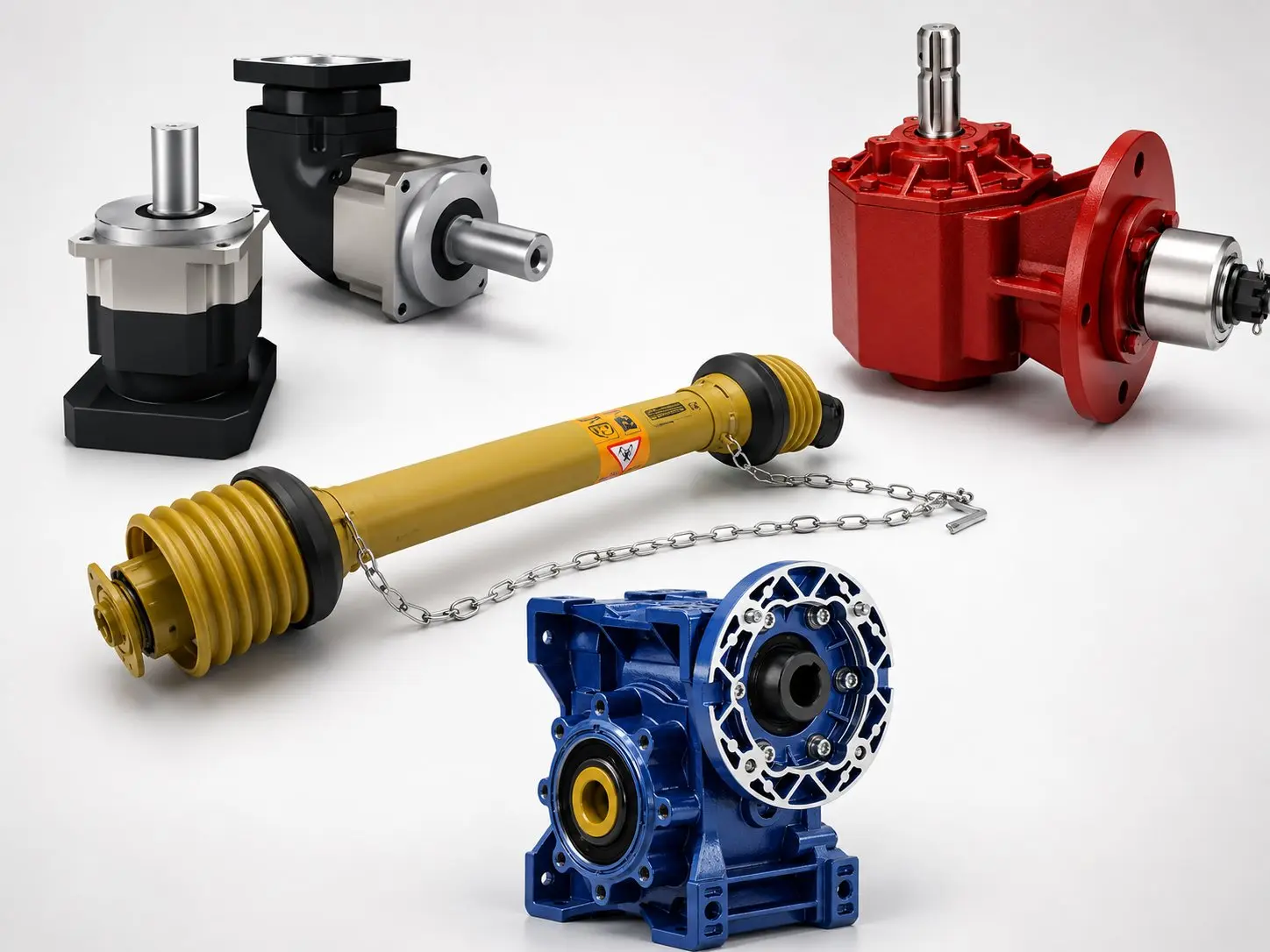
Korea Ever-Power EP series planetary gearbox full range — FADS FALR FAB FAD FPG for battery manufacturing automation

The core battery automation series are EP-FADS (robot wrist compact axial) and EP-FALR (winding mandrel high ratio). Supporting series on the same line: EP-FAB for robot base joints and press axes, EP-FAD for module/PACK assembly robots and SCARA applications, and EP-FPG/FPGA for economy-tier inter-stage conveyors and formation tester axes. The EP-FADR right-angle round-flange series handles any wrist application where the motor model is variable and the full adapter-ring system is required.

All series share the C1–C10 universal motor adapter — one qualification covers the entire battery factory BOM. See the full EP-series product range or explore related drivetrain components at agriculturalgear-boxes.com and precision reduction technology at worm-reducers.xyz.

Frequently Asked Questions — Battery & EV Gearbox Selection

Why does EP-FALR solve the electrode winder tandem gearbox problem?
Conventional electrode winding machines use a tandem arrangement because no single gearbox provides both 90° direction change and 80–180:1 ratio with a belt-pulley output simultaneously. The tandem design introduces two problems: first, the coupling between the two stages adds backlash and torsional compliance that manifests as tension oscillation at the mandrel; second, the separate belt-hub-to-shaft interface introduces eccentricity (typically 0.05–0.12 mm hub-to-shaft TIR) that appears as periodic tension variation at belt rotation frequency. EP-FALR integrates all three functions — bevel direction change, planetary ratio, integrated belt pulley — in one sealed unit. There is no inter-stage coupling and no separate hub. Winding tension oscillation amplitude has been measured at ±1.2% of set tension versus ±8% with tandem arrangements in the same machine designs.
What exactly does EP-FADS save compared to EP-FAD plus a standard adapter plate?
EP-FAD uses a standard adapter-plate approach: the servo motor front flange bolts to an adapter plate, which then mounts to the gearbox input flange. The adapter plate has a finite axial thickness — typically 18–25 mm depending on frame size and motor model. EP-FADS eliminates this adapter plate: the motor output shaft inserts directly into the gearbox input coupling via a clamp-ring interface on the gearbox housing itself. The axial saving is 22 mm at the 060/090 frame sizes most common for robot wrist applications. In compact robot link designs where the encoder cable must route inside the hollow link structure, 22 mm is often the precise margin that determines whether cable routing inside the link is geometrically feasible. There is no performance difference in gear accuracy, backlash grade, or design life between FADS and FAD — the difference is purely in axial envelope and whether the motor model is fixed at design time (FADS: fixed motor) or variable (FAD: adaptable).
How does Korea Ever-Power support battery OEM supplier qualification audits?
Korea Ever-Power can provide the following documentation on request for battery OEM supplier qualification packages: per-unit backlash test certificates (measured grade at 2% rated torque, date, production lot reference); per-unit IP pressure test records (pass/fail, test pressure, duration); material certificates for ring gear, planet gear, and housing material lots; production batch traceability records linking each unit serial number to its production lot and raw material batch. These documents are prepared for EP-FADS, EP-FAB, EP-FAD, and EP-FALR series. Lead time for documentation package: 3–5 business days from order shipment. For qualification audits requiring factory inspection visits, contact [email protected] to schedule a site visit to the Ansan-si facility.
Is NYOGEL 792D in EP-FADS approved for ISO Class-4 cleanroom use in battery facilities?
NYOGEL 792D synthetic grease has been validated by Korea Ever-Power for use in ISO Class-4 cleanroom environments at the operating temperatures and speeds specified for EP-FADS, EP-FAB, and EP-FAD. In sealed EP-series planetary gearboxes operating within their rated temperature range (−10°C to +90°C), NYOGEL 792D does not emit detectable particles into the cleanroom air stream during normal rotary operation. The sealed housing prevents any grease egress from the gear chamber. This is a lifetime-fill sealed system — there are no external grease ports, no grease nipples, and no scheduled relubrication that could introduce contamination risk. Confirmation of cleanroom compatibility for a specific battery facility cleanroom class and application should be verified by the equipment OEM’s cleanroom validation team using Korea Ever-Power’s technical data sheet, available from [email protected].
What is the maximum winding speed achievable with EP-FALR at 180:1?
At i=180:1, the maximum output speed of EP-FALR is determined by the maximum input speed (4,000 rpm for FALR) divided by the ratio: 4,000 ÷ 180 = 22.2 rpm output. For a typical 100 mm diameter winding mandrel, this corresponds to approximately 7.0 m/min peripheral belt speed — suitable for most electrode winding applications where tension control at moderate speed is more important than maximum throughput. If higher winding speeds are required, select a lower ratio (e.g., i=100:1 gives 40 rpm output = 12.6 m/min at the same input speed) and use a multi-speed servo profile for the tension ramp. Korea Ever-Power provides application engineering support for winding speed and tension calculations — contact [email protected] with mandrel diameter, belt type, target winding speed, and maximum torque requirement.

Specify EP-FADS and EP-FALR for Your Battery Gigafactory Project
Send your winding ratio, mandrel belt type, and robot motor model — Korea Ever-Power will confirm the FALR frame size and FADS configuration within 24 hours. Machine-builder pricing and documentation packages available for gigafactory projects.

Request Battery Gearbox Specification →

Editor: Cxm