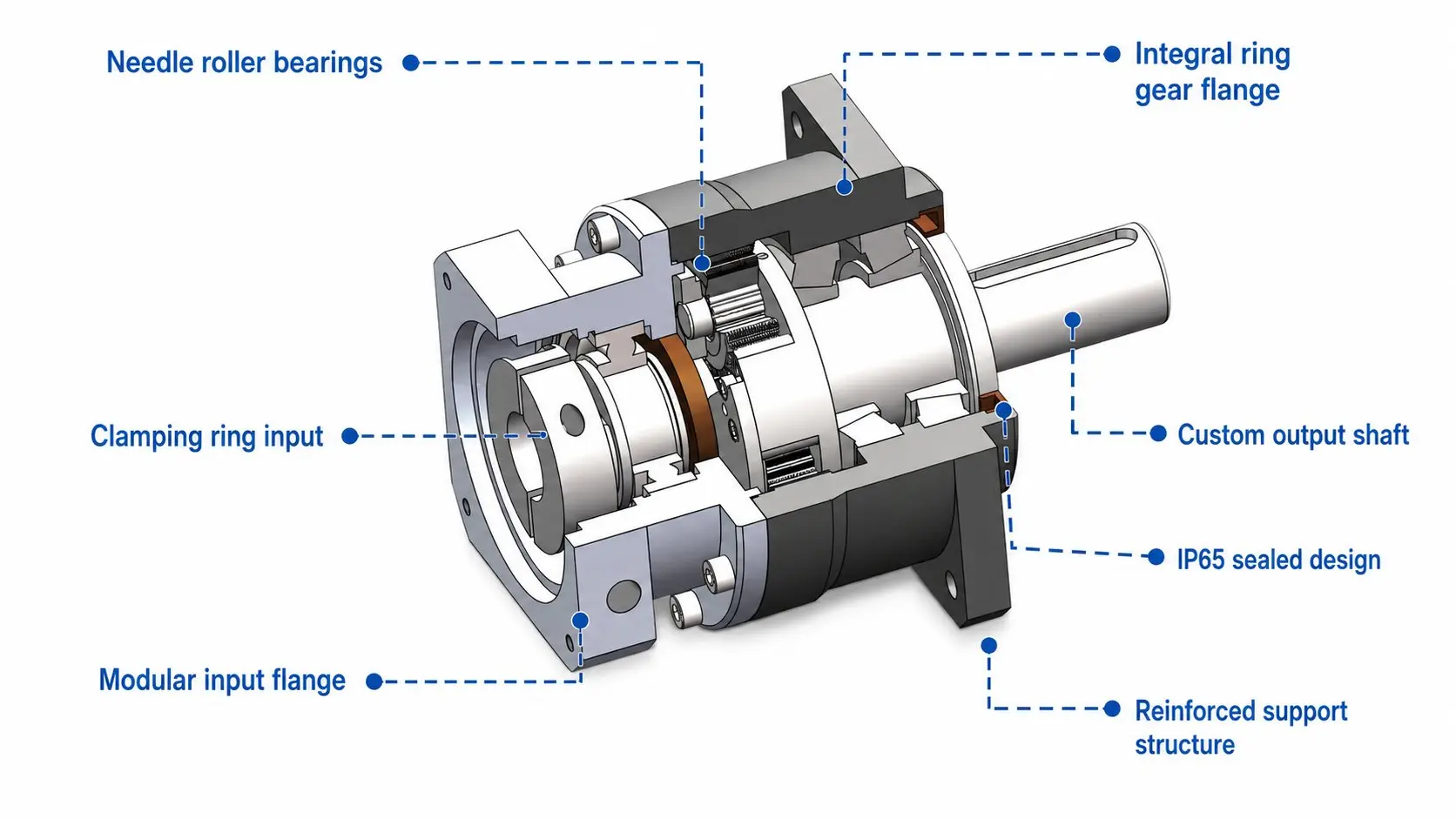
Backlash — The Gap Between Gear Teeth
Backlash in a planetary gearbox is the small angular dead zone between the input and output shafts. When the input shaft reverses direction, the output shaft does not respond instantly — it pauses for a fraction of a degree while the gear teeth cross the clearance gap to re-engage on the opposite tooth flank. That pause is backlash, and it is measured in arcminutes.
For a conveyor or fan that rotates in one direction only, backlash is functionally invisible. For a servo-driven robot arm or CNC axis that reverses direction hundreds of times per minute, backlash creates measurable positional error at every reversal point. This is why backlash is the most scrutinised parameter on every planetary gearbox datasheet — and why understanding what the number actually means in your specific application prevents both under-specification (leading to poor accuracy) and over-specification (leading to unnecessary cost).
Some clearance between gear teeth is structurally necessary. Without it, gears would bind under thermal expansion, lubricant film could not form between the contact surfaces, and assembly of the planetary gear train would be mechanically impossible. The engineering challenge is to make this clearance as small as possible without eliminating it entirely.
In a planetary gearbox, backlash accumulates from three sources: the clearance between sun gear and planet gear teeth, the clearance between planet gear and ring gear teeth, and the bearing play in the planet carrier. Each planetary stage adds its own backlash contribution, which is why multi-stage units have wider total backlash than single-stage units of the same precision grade.
① Sun ↔ Planet tooth clearance
② Planet ↔ Ring tooth clearance
③ Planet carrier bearing play
What Is an Arcminute?
Backlash is measured in arcminutes (symbol: ′ or arcmin). One arcminute is 1/60 of a degree — a unit small enough to describe the precision of astronomical telescopes and surveying instruments. It became the standard measurement unit for planetary gearbox backlash because the angular errors involved are too small to express meaningfully in degrees.
The last conversion — arcminutes to linear displacement — is the most practically useful. When you know the radius from the gearbox output shaft to the point where positioning accuracy matters (the tool tip, the robot end-effector, the laser focal point), you can convert backlash directly into millimetres of positional uncertainty.
From Arcmin to Millimetres — Real-World Positioning Impact
The formula to convert backlash (in arcminutes) to linear positional error (in millimetres) at a given arm radius is:
The table below pre-calculates the positional error for common backlash grades and working radii. Find your gearbox backlash specification in the left column and your application’s working radius across the top to read the expected positional uncertainty in millimetres.
| Backlash | @ 100 mm | @ 200 mm | @ 500 mm | @ 1,000 mm | Typical Series |
|---|---|---|---|---|---|
| ≤3 arcmin | 0.09 mm | 0.17 mm | 0.44 mm | 0.87 mm | EP-HAB |
| ≤5 arcmin | 0.15 mm | 0.29 mm | 0.73 mm | 1.45 mm | EP-PBL/PBF |
| ≤8 arcmin | 0.23 mm | 0.47 mm | 1.16 mm | 2.33 mm | EP-PL/PF, EP-WPBL |
| ≤15 arcmin | 0.44 mm | 0.87 mm | 2.18 mm | 4.36 mm | EP-PL/PF (2-stg) |
Positional error = maximum arc-length displacement at the working radius during a torque direction reversal. Actual positioning repeatability also depends on servo loop stiffness, load compliance, and mechanical assembly tolerances.
How Is Backlash Measured in a Planetary Gearbox?
Backlash is measured by locking the input shaft stationary and applying a controlled torque to the output shaft in alternating clockwise and counter-clockwise directions. The angular displacement of the output shaft between the two contact positions is the total backlash, measured in arcminutes.
The measurement protocol matters. Industry standard practice (used by Korea Ever-Power and most reputable manufacturers) specifies:
◆ Measurement instrument: Precision angle encoder or dial indicator at the output flange face
◆ Condition: Gearbox at room temperature (20±5°C) with standard factory lubrication
◆ Direction: Measured at multiple angular positions of the output shaft; the maximum reading is reported
Some manufacturers test at higher loads (5% or 10% of rated torque), which compresses the backlash and produces a flattering but misleading lower number. Always verify the test load percentage when comparing backlash specifications between different brands.
Choosing the Right Backlash Grade for Your Application
Not every application needs the tightest backlash available. Over-specifying precision is the most common source of unnecessary cost in servo reducer procurement. A ≤3 arcmin unit typically costs 3–5 times more than a ≤8 arcmin unit of the same frame size. The guide below maps common applications to the appropriate backlash grade.
Robot base joints
Optical stages
Chip shooters
Laser cutting
AOI inspection
Medical devices
Packaging lines
Printing presses
AGV drives
Winding machines
Mixers
Non-positioning
Korea Ever-Power covers all four tiers: the EP-PBL/PBF high precision series delivers ≤5 arcmin with IP65 sealing, while the EP-PL/PF standard series provides ≤8 arcmin at the most competitive cost per N.m of output torque. For the most demanding applications, the EP-HAB flagship reaches ≤3 arcmin with 50 N.m/arcmin torsional stiffness.
Does Backlash Increase Over the Gearbox Lifespan?
Yes — but the rate of increase depends heavily on gear quality, load level, operating temperature, and lubrication maintenance. In a well-made planetary gearbox with case-hardened steel gears (HRC 58–62), backlash growth over the rated 2,000-hour service life is typically less than 1 arcmin under proper loading conditions. Over an extended service life of 10,000+ hours at derated torque (80% of rated), cumulative backlash growth may reach 2–3 arcmin.
This is one of the key advantages of a planetary design over a worm drive. In a worm reducer, the softer bronze wheel wears measurably faster against the hardened steel worm, and backlash can double from the original specification within 5,000–8,000 operating hours. A planetary gear train with all-hardened-steel components maintains its original precision far longer, making it the preferred choice for applications where consistent accuracy over years of service is essential.
◆ Frequent high-impact direction reversals
◆ Contaminated or degraded lubricant
◆ Excessive operating temperature (>90°C ambient)
◆ Misalignment between motor and reducer
◆ Maintaining ambient temperature within spec
◆ Using the manufacturer’s specified lubricant grade
◆ Ensuring correct motor-to-reducer concentricity
◆ Periodic re-lubrication per maintenance schedule
How Manufacturers Achieve Low Backlash
The difference between a ≤15 arcmin economy unit and a ≤3 arcmin ultra-precision unit is not just tighter quality control — it requires fundamentally different manufacturing processes at every stage. Understanding these processes helps explain the cost differential between precision grades.
Standard units use DIN/JIS Class 6–7 gear teeth (hobbed and shaved). Precision units require Class 4–5 (profile-ground after hardening). The grinding step removes heat-treatment distortion and achieves tooth profile errors below 3–5 μm, which directly reduces the clearance between mating teeth.
In a standard unit, planet gears are assembled from general production stock. In a precision unit, all three or four planet gears are individually measured and assembled as a matched set with total pitch variation below 2 μm, ensuring equal load sharing and minimum cumulative backlash.
Radial play in the planet carrier bearings contributes directly to output shaft backlash. Precision units use preloaded angular-contact or tapered-roller bearings that eliminate radial play, at the cost of slightly higher friction and bearing heat. This preloading alone can reduce total backlash by 1–2 arcmin compared to standard bearings with clearance.
The internal bore of the gearbox housing must be concentric with the output shaft centreline to within a few micrometres. In precision units, the housing bore is finish-ground in a single clamping operation to eliminate setup error between bearing seats. Any eccentricity here translates directly into uneven planet gear loading and increased effective backlash.
Standard units may be batch-tested with statistical sampling. Precision units are 100% individually tested under load, with the measured backlash value recorded on a unit-specific test certificate. Any unit exceeding the specification is rejected — not regraded to a lower tier. This is the final quality gate that ensures the datasheet specification is met on every delivered unit.

When Backlash Does Not Affect Your Application
Not every servo drive application is sensitive to backlash in a planetary gearbox. Understanding when backlash is irrelevant prevents you from over-specifying and overpaying for precision that delivers no functional improvement to your machine.
Many engineers default to specifying the tightest available backlash grade on every planetary gearbox they purchase, reasoning that “lower backlash is always better.” In absolute engineering terms this is true, but in cost-benefit terms it is often wasteful. A ≤3 arcmin unit on a continuous-rotation conveyor drive delivers zero positioning advantage over a ≤15 arcmin unit — because the conveyor never reverses direction. The premium paid for that unnecessary precision is pure waste.
Backlash Comparison Across Korea Ever-Power Series
Korea Ever-Power offers five inline and right-angle planetary gearbox series spanning the full backlash range from ≤3 arcmin (ultra-precision) to ≤16 arcmin (standard right-angle). The table below consolidates the backlash specification for each series at single-stage and two-stage configurations, along with the output direction and IP protection grade, so you can identify the correct product family at a glance.
| Series | 1-Stage | 2-Stage | Output | IP | Tier |
|---|---|---|---|---|---|
| EP-HAB | ≤3′ | ≤5′ | Inline | 65 | Flagship |
| EP-PBL/PBF | ≤5′ | ≤8′ | Inline | 65 | Precision |
| EP-WPBL/WPBF | ≤8′ | ≤10′ | 90° | 65 | Precision |
| EP-PL/PF | ≤8′ | ≤12′ | Inline | 54 | Standard |
| EP-WPL/WPF | ≤13–16′ | ≤16–20′ | 90° | 54 | Standard |
Frequently Asked Questions
Send us your working radius, positional tolerance requirement, and application description. Our engineers will calculate the required backlash grade and recommend the most cost-effective series within one business day.
Get a Free Backlash Grade Recommendation →
Editor: Cxm