Planetary Gearbox for Printing & Graphic Arts — Offset Press Cylinders, Flexo Drives & Wide-Format Gantry Systems

100M impressions
P0 Grade Maintained — EP-FAD
DIN 5
Gear Accuracy — Slowest Wear Rate
30,000 hr
Design Life — EP-FAD Continuous
−10°C to
+90°C
NYOGEL Thermal Stability
IP65
Every Unit — Solvent & Ink Wash
C1–C10
Universal Motor Adapter

Engineering Context

Why Print Register Degrades Over Time — And Why Backlash Growth Rate Matters More Than Initial Grade

EP-FAD P0 planetary gearbox on offset printing press cylinder drive — zero backlash growth DIN Class 5 profile-ground gears NYOGEL 792D thermal stability

Korea Ever-Power EP-FAD P0 on a sheetfed offset press cylinder drive. DIN Class 5 profile-ground helical gears start at ≤1 arc-min backlash and maintain that grade through 50+ million impressions — the fundamental reason EP-FAD is specified by offset press builders over lower-accuracy alternatives.

Every printing machine engineer knows that press registration degrades over time. What fewer engineers calculate explicitly is how fast it degrades — and whether the degradation rate, not just the initial specification, determines when the press requires gearbox service. For an offset press running 3 shifts, the cylinder drive gearbox accumulates approximately 10 million impressions per month. At a target service interval of 5 years, the gearbox must maintain acceptable register precision through 500–600 million impressions. The selection decision made at initial press build — P0 vs P1 vs standard-grade gearbox — determines whether that target is achievable or whether the press requires a gearbox replacement at year 2.

The mechanism is gear tooth wear. Every impression cycle — one rotation of the cylinder gear mesh — generates a small increment of surface fatigue on the tooth flanks. The rate of this fatigue is governed by the tooth contact stress, which is itself governed by the gear accuracy class. A DIN Class 5 profile-ground gear tooth has a surface finish and profile accuracy that distributes contact stress evenly across the tooth face. A DIN Class 6–7 gear has higher surface irregularity, concentrating contact stress at profile deviations and producing higher fatigue per impression cycle. A DIN Class 8+ gear produces even higher contact stress concentration. The result is that a P0/DIN Class 5 gearbox not only starts with lower backlash — it grows slower. The compound effect over 100 million impressions is dramatic.

The second factor is thermal stability of the lubricant. Press cylinder drives operate continuously for 8–16 hours per shift, and the gearbox internal temperature rises during the first 20–40 minutes of operation from ambient to a steady-state thermal equilibrium. Mineral-oil gearbox lubricants show significant viscosity reduction across this temperature range — as the oil thins, the tooth-to-tooth lubrication film thins, and the effective backlash at the gear mesh increases slightly. Press operators observe this as warmup drift: a register offset that appears during the first hundred impressions of a new run and then stabilises when the press reaches operating temperature. NYOGEL 792D synthetic grease, specified across all EP-FAD, EP-FAB, EP-FADS, and EP-FAL series, shows negligible viscosity change across the −10°C to +90°C operating range — eliminating warmup drift as a mechanical gear-train contribution.

🖨️
The Register Error Calculation at the Cylinder Surface
At a print cylinder radius of 100 mm, 1 arc-min of backlash produces a cylinder surface linear error of: 100 mm × tan(1/3438 rad) = 0.029 mm. For a press specified to ±0.05 mm colour-to-colour register, this means 1 arc-min of backlash consumes 58% of the register budget. At 1.5 arc-min (a P0/DIN5 gearbox after 100M impressions), the gear contribution is 0.044 mm — within spec. At 5.5 arc-min (a P1/DIN6-7 gearbox after 100M impressions), the gear contribution is 0.160 mm — more than 3× over the register tolerance. The press requires gearbox service or replacement well before 100 million impressions with a P1 starting grade.

Backlash Growth vs. Impression Count — Three Gear Grades Over Press Service Life

The following chart shows representative backlash progression for three gearbox grades over 100 million cylinder drive impressions at rated torque. The horizontal threshold lines show the P0 (≤1 arc-min) and P1 (≤3 arc-min) grade boundaries. When a gearbox’s backlash crosses a threshold, the press register performance degrades to a lower grade — requiring recalibration, reprinted waste, or gearbox service depending on the application tolerance.

EP-FAD P0 — DIN Class 5 profile-ground (Korea Ever-Power)

Standard P1 — DIN Class 6–7 (typical market alternative)

Economy / Worm — DIN Class 8+ (low-cost option)

0 M
10 M
25 M
50 M
75 M
100 M
← Impression Count (millions) →

8 arc-min
6
P1 limit →
3
2
P0 limit →
0


P0 ≤1
P1 ≤3


0.8

0.9

1.0

1.2

1.4

1.5

P0 ≤1
P1 ≤3

2.5

2.9

3.3 ⚠

4.1

4.8

5.5

P0 ≤1
P1 ≤3

8.0

10+

13+

18+

22+

25+

EP-FAD P0 / DIN Class 5:
Starts ≤1 arc-min; grows to 1.5 arc-min at 100M — remains within P0 spec throughout

Standard P1 / DIN Class 6–7:
Starts ≤3 arc-min; crosses P1 threshold (~25M impressions); 5.5 arc-min at 100M

Economy / Worm / DIN Class 8+:
Starts ≥8 arc-min; already above P1 limit on Day 1; register requires constant correction

Representative values for a 12:1 ratio cylinder drive gearbox at rated torque and typical press speed. Actual values depend on specific press configuration, lubrication temperature, and duty cycle. Economy/worm values capped at chart scale; actual values at 50–100M impressions may exceed 25 arc-min. Threshold lines at 1 arc-min (P0 limit) and 3 arc-min (P1 limit).

Application Scenarios

Six Printing & Graphic Arts Applications — From Offset Cylinders to Wide-Format Gantry

Printing and graphic arts encompasses the widest speed range of any single industry — from slow-speed offset cylinder drives where thermal stability and long-term backlash stability are paramount, to high-speed digital inkjet media transport where low vibration and 30,000-hour continuous-duty life matter most. The six scenarios below cover the full range, with the specific engineering rationale for each series selection.

01 — Offset Press Plate / Blanket Cylinder Drive
Sheetfed / web offset — colour-to-colour register
EP-FAD P0
Frame 090–142 mm
100M+ impressions P0

The offset press cylinder drive is the most demanding long-term backlash stability application in printing. A 5-colour sheetfed offset press with all five cylinders driven through EP-FAD P0 gearboxes will maintain colour-to-colour register within ±0.05 mm tolerance through 100+ million impressions before the gear wear contribution approaches the P0/P1 boundary. The DIN Class 5 profile-ground helical gears produce both the lowest initial backlash (≤1 arc-min) and the slowest growth rate: at 100 million impressions, the EP-FAD P0 gearbox measures approximately 1.5 arc-min — still within P0 specification, still within the press register budget. A P1/DIN 6-7 alternative reaches 5.5 arc-min at the same milestone, exceeding the P1 threshold well before 25 million impressions.

Key spec: P0 ≤1 arc-min — DIN Class 5 profile-ground, slowest wear rate; NYOGEL 792D eliminates warmup drift (stable viscosity −10°C to +90°C); 5–20:1; 5,000 rpm; 30,000 hr continuous; IP65 for ink/solvent wash.

02 — Digital Inkjet Press Media Transport Drive
High-speed continuous paper / substrate advance
EP-FAD P1
Frame 060–090 mm
30,000 hr continuous

High-speed continuous digital inkjet presses — printing at 100–200 m/min — run the paper transport drive at high duty cycle, often 3 shifts per day, with the gearbox input shaft spinning continuously for hours. The 30,000-hour S1 continuous design life of EP-FAD P1 matches the planned service interval of a production inkjet press (approximately 5 years at 3-shift operation = ~18,000–24,000 hours). Low vibration from the helical planet gears is critical: any vibration in the media transport at printhead frequency manifests as banding artefacts in the printed image. EP-FAD helical gears produce approximately 60% lower vibration amplitude than equivalent straight-cut gear designs at the same pitch-line velocity.

Key spec: 30,000 hr S1 continuous; low vibration (helical gears ~60% lower); ≤3 arc-min P1; 5–16:1; 6,000 rpm input; NYOGEL 792D sealed lifetime; IP65 for paper dust and ink mist.

03 — Flexo Press Anilox / Impression Roll Drive
Nip pressure and registration — flexographic printing
EP-FALR P1
Frame 090–150 mm
Right-angle compact

Flexographic press anilox and impression roll drives must control both the roll surface speed (for ink metering consistency) and nip pressure (for impression uniformity across the web width). The right-angle motor layout of EP-FALR places the servo motor perpendicular to the roll axis — the preferred mounting geometry on modern servo-driven flexo decks where motor space beside the roll is limited by the inking unit. The ratio range 10–50:1 in a single unit covers all practical anilox roll surface speed requirements. IP65 is mandatory: flexo printing uses solvent-based, water-based, and UV-cure inks, all of which create mist and condensate around the drive units during high-speed running.

Key spec: Right-angle R/A motor layout for compact flexo deck mounting; 10–50:1 single unit; ≤2 arc-min P1; 4,000 rpm; IP65 solvent/UV-cure ink environment; servo tension control support.

04 — Gravure Press Doctor Blade / Ink Roll Drive
Register control — solvent gravure, packaging printing
EP-FAD P1
Frame 090–110 mm
IP65 solvent wash

Gravure printing for flexible packaging uses solvent-based inks with aggressive aromatic and ketone solvents that attack standard elastomeric seals. IP65 protection on every unit (not batch-sample) is the critical requirement for gravure environments — a failed seal allows solvent into the NYOGEL 792D grease chamber, initiating gear corrosion and accelerated backlash growth. EP-FAD P1 with NYOGEL 792D sealed provides the dual protection: IP65 seal integrity confirmed by per-unit pressure test, and NYOGEL 792D synthetic grease that resists solvent degradation better than mineral oil if any minor ingress does occur.

Key spec: IP65 every unit — solvent environment critical; low vibration (registration quality); ≤3 arc-min P1; 5–20:1; 5,000 rpm; NYOGEL 792D solvent resistance; 30,000 hr continuous.

05 — Wide-Format Inkjet Carriage X-Axis Belt Drive
Scan axis — signage, technical, fine-art printing
EP-FAL P1
Frame 070–090 mm
Sub-0.1 mm scan

Wide-format inkjet printers use a belt-driven carriage to scan the printhead across the print width — from 1.5 m for standard-wide to 5 m for grand-format. Carriage positioning accuracy determines dot placement accuracy and therefore image sharpness and banding uniformity. EP-FAL P1 with the integrated timing belt pulley provides sub-0.1 mm belt-axis positioning by eliminating the hub eccentricity that introduces periodic banding artefacts at belt rotation frequency — the same mechanism documented in laser cutting and packaging gantry applications. Low vibration from helical gears is additionally important: carriage acceleration/deceleration at printhead frequency generates dynamic forces that helical gearing damps more effectively than straight-cut alternatives.

Key spec: Integrated belt pulley — sub-0.1 mm scan axis; ≤3 arc-min P1; low vibration helical gears; 5–16:1; 5,000 rpm; F_rad rated for scan belt tension; NYOGEL 792D sealed.

06 — Print Finishing Slitter / Cutter Drive
Post-press slitting, guillotine, die-cut registration
EP-FAB P1
Frame 090–110 mm
Cut registration

Print finishing equipment — slitters, die-cutters, and guillotines — operates at high speed with the cutter drive axis synchronised to the print repeat length. Cut registration error — the offset between the printed image and the cut edge — is the primary quality metric. EP-FAB P1 at ≤3 arc-min provides the cut registration accuracy needed for ±0.3 mm cut tolerance on standard commercial printing. High-cycle fatigue life is critical: a slitter on a commercial printing line may execute 500,000 cut cycles per shift — the gearbox must sustain this duty without backlash growth that would cause cut register to drift over the shift. The individual backlash grade stamp from Korea Ever-Power documents the starting value, enabling maintenance engineers to track wear by periodic measurement rather than assuming from batch statistics.

Key spec: ≤3 arc-min P1; high fatigue life DIN Class 5 gears; individual backlash stamp for wear tracking; 5–20:1; 4,000 rpm; IP65 for paper dust and solvent cleaning; square flange.

Technical Specifications

EP-Series Printing & Graphic Arts Specification Matrix

The table below covers all major printing drive types. The standout entry is EP-FAD P0 for offset cylinder drives — it is the only standard-production gearbox that demonstrates measurable backlash stability over 100 million impression cycles, as shown by the growth curve in Section 1. All series use the C1–C10 universal motor adapter.

Machine / Drive Point Series Frame (mm) Backlash
(initial)
At 100M
impressions
Max rpm Life (hr) Key Reason for Selection
Offset press cylinder drive EP-FAD P0 090–142 ≤1 arc-min ~1.5 arc-min
still P0
5,000 30,000 DIN Cl-5 slowest wear; NYOGEL 792D eliminates warmup drift; backlash stability over press life
Digital inkjet media transport EP-FAD P1 060–090 ≤3 arc-min ~3.3 arc-min
near P1 limit
6,000 30,000 30,000 hr S1 for 3-shift production; low vibration helical gears; sub-banding threshold
Flexo anilox / impression roll EP-FALR P1 090–150 ≤2 arc-min Lower speed;
slower growth
4,000 30,000* R/A motor for compact flexo deck; 10–50:1 single unit; IP65 solvent/UV ink environment
Gravure doctor blade / ink roll EP-FAD P1 090–110 ≤3 arc-min Low speed;
stable
5,000 30,000 IP65 per-unit for aggressive solvent environment; low vibration; register accuracy
Wide-format inkjet carriage X-belt EP-FAL P1 070–090 ≤3 arc-min Belt drive;
eccentricity zero
5,000 30,000* Integrated belt pulley; sub-0.1 mm scan axis; low vibration; carriage banding eliminated
Print finishing slitter / cutter EP-FAB P1 090–110 ≤3 arc-min High cycle;
track by stamp
4,000 20,000 High-cycle fatigue life; grade stamp enables wear tracking; IP65; square flange

★ FAL/FALR: 30,000 hr S5 intermittent (15,000 hr S1). FAD/FAB: 30,000/20,000 hr S1 continuous. Backlash-at-100M values are representative estimates for rated-torque cylinder drive operation; actual values depend on ratio, speed, torque profile, and temperature. C1–C10 applies to all series.

100M imp.
P0 Maintained — EP-FAD
DIN 5
Slowest Wear Rate
30,000 hr
FAD/FAL Continuous
No Warmup Drift
NYOGEL 792D Stable
IP65
Every Unit — Ink & Solvent
C1–C10
One Press BOM

Engineering Insight

Inside EP-FAD — Four Design Features That Sustain Print Register Over the Press Service Life
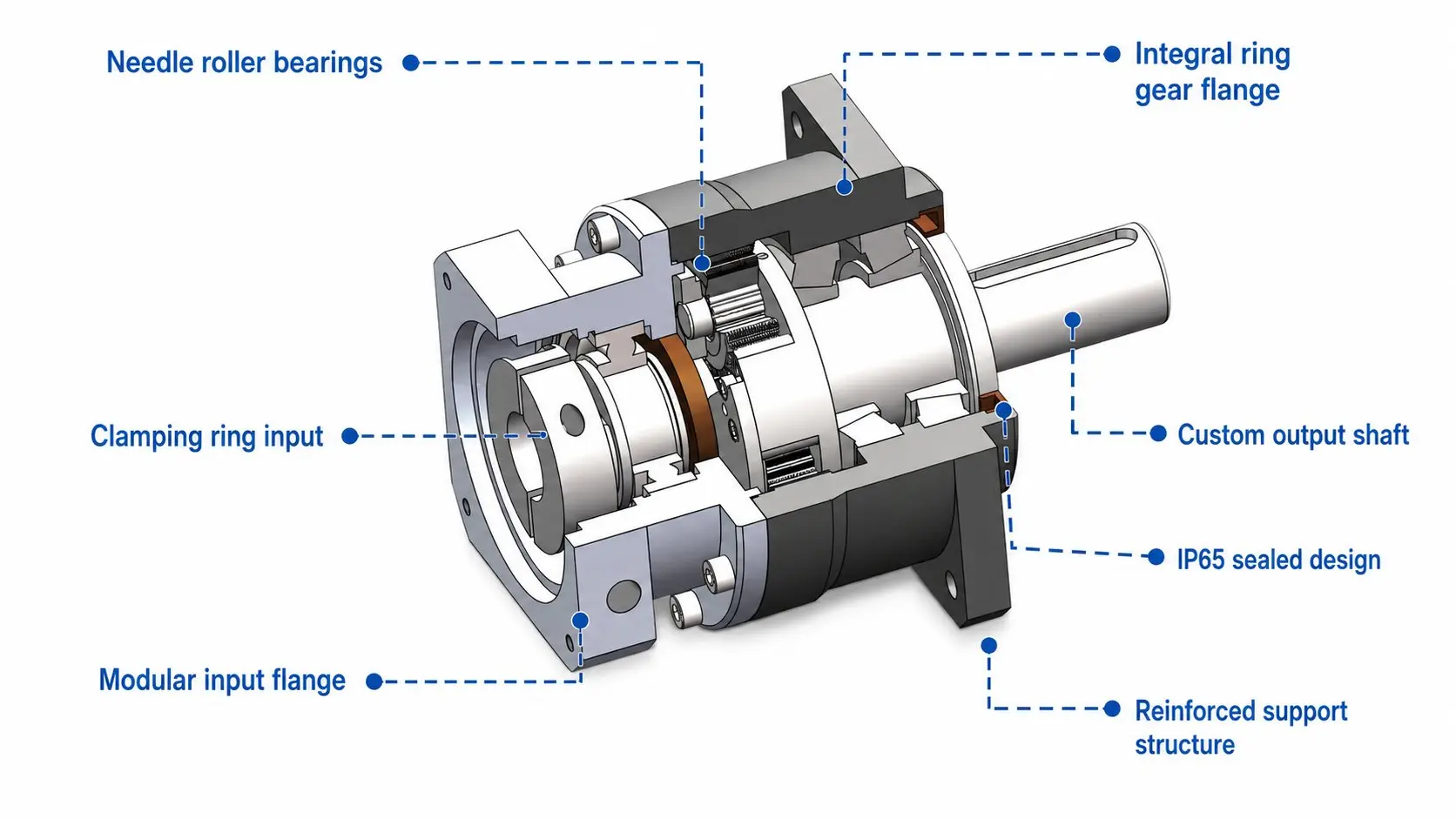
EP-FAD P0 planetary gearbox internal structure — DIN Class 5 profile-ground helical planet gears NYOGEL 792D sealed for offset press cylinder drive

DIN 5
Gear Accuracy
1.5 arc-min
At 100M Impressions
30K hr
Continuous Life

EP-FAD P0 internal architecture: 5-axis CNC profile-ground ring gear and planet gears (DIN Class 5), CMM-inspected carrier housing, NYOGEL 792D sealed lifetime fill, IP65 dynamic seal on all interfaces — tested 100% on every unit.

Why DIN Class 5 Changes the Long-Term Register Equation

The backlash growth curve in Section 1 shows a dramatic difference between P0/DIN5 and P1/DIN6-7 gearboxes after 100 million impressions. The cause is not just the initial grade — it is the wear mechanism. Understanding why DIN Class 5 gears grow slower helps press builders make the correct specification decision when initial purchase cost might suggest a lower-grade alternative.

  1. 01
    DIN Class 5 Profile Grinding — Tooth Contact Stress at the Root of Wear Rate

    Gear tooth wear is driven by surface contact fatigue — the Hertzian contact stress at the tooth face. DIN Class 5 profile grinding produces tooth surface accuracy within ±2–3 µm of the theoretical involute profile. DIN Class 6–7 ground gears have profile deviations of ±5–8 µm. These deviations concentrate the contact stress at local high spots rather than distributing it across the tooth face. Higher stress concentration = higher surface fatigue rate per meshing cycle = faster backlash growth per million impressions. At 100 million cylinder drive cycles, the compound difference is visible: P0/DIN5 at 1.5 arc-min, P1/DIN6-7 at 5.5 arc-min.

  2. 02
    NYOGEL 792D Thermal Stability — Eliminating Warmup Drift

    Mineral-oil gearbox lubricants show a viscosity reduction of 40–60% as temperature rises from 20°C to 60°C during press warmup. As the oil thins, the elastohydrodynamic film between tooth faces thins, and the effective tooth clearance (the gap between mating teeth) increases slightly. Press operators observe this as warmup drift — a 0.2–0.5 arc-min apparent backlash increase during the first 20–40 minutes of each production run, manifesting as a register shift during makeready. NYOGEL 792D synthetic grease shows minimal viscosity change across this temperature range. The gearbox backlash measured cold is the same as measured at operating temperature. Warmup drift from the gear-train contribution is eliminated.

  3. 03
    Per-Unit Backlash Stamp — Condition Monitoring Over Press Life

    Every EP-FAD unit is measured and stamped with its actual backlash grade at 2% rated torque before shipment. For a press builder specifying a 5-year service interval, this stamp provides the starting measurement for a backlash wear monitoring programme. Maintenance engineers can measure cylinder drive gearbox backlash at each annual service visit, compare against the nameplate starting value, and project the remaining life before the P0 threshold is approached. This is the same condition monitoring approach used for bearings (vibration baseline) and seals (IP test at service) — the nameplate stamp makes it applicable to gear wear for the first time in a standard production item.

  4. 04
    IP65 Per-Unit Seal Test — Protecting Against Solvent Contamination of Gearbox Grease

    Printing presses are cleaned with aggressive solvents — ketones, alcohols, and esters — applied under pressure during web breaks and at shift changes. A gearbox with a marginal IP seal allows solvent into the NYOGEL 792D chamber. NYOGEL 792D resists solvent degradation better than mineral oil, but sustained ingress eventually dilutes the grease film. The 60-second pneumatic pressure decay test on every EP-FAD, EP-FAB, and EP-FAL unit before shipment identifies seals with micro-gaps that would fail within the first production month. The same test that protects packaging lines from washdown failure protects press gearboxes from solvent contamination — it is the same production test, applied to every unit regardless of application.

These four features — DIN Class 5 wear resistance, NYOGEL 792D thermal stability, per-unit backlash stamp, and IP65 per-unit test — combine to make EP-FAD P0 the gearbox that sustains press register quality over the full service life between planned overhauls, rather than degrading progressively and requiring early intervention.

Selection Guide

Printing Gearbox Selection Matrix — 5 Questions Including Impression Volume

Print press gearbox selection must account for impression volume as well as initial precision — the backlash growth curve shows that the correct selection at installation may not be the same decision that minimises total cost of ownership over 5 years. The five questions below incorporate impression volume as a first-order selection input, not an afterthought.

Selection Question
Your Answer → Series Implication
Recommended
Q1 — Press type / drive?
Cylinder drive (offset, flexo impression) → priority is long-term backlash stability → FAD P0  |  Media transport (inkjet, label) → priority is continuous life and low vibration → FAD P1  |  Belt axis (wide-format carriage) → integrated pulley → FAL P1  |  Roll-to-roll R/A nip → FALR P1  |  Finishing cutter → FAB P1 high cycle
Drive type first
Q2 — Target service interval?
≥5 years without gearbox service → specify P0 (FAD P0) even if initial backlash spec allows P1 — the growth rate advantage of DIN Class 5 pays for itself before year 3  |  2–3 year planned replacement cycle → P1 acceptable if initial register spec is ≤3 arc-min  |  Impression count >50M before service → always specify P0
P0 for 5yr+
Q3 — Register tolerance?
±0.05 mm or tighter (quality commercial, security printing) → P0 mandatory at installation (1.5 arc-min at 100M = 0.044 mm gear contribution, within spec)  |  ±0.1 mm (standard commercial) → P1 acceptable up to ~25M impressions, then requires recalibration or replacement  |  ±0.3 mm (finishing equipment) → P1 sufficient throughout service life
±0.05 → P0
Q4 — Environment?
Offset (IPA + fountain solution + paper dust) → IP65 per-unit essential  |  Flexo / gravure (solvent inks — ketones, acetates) → IP65 per-unit; NYOGEL 792D solvent resistance critical  |  Digital (dry toner / aqueous inkjet) → IP65 preferred for cleaning protocols; less critical for solvent resistance  |  Wide-format (UV-cure, solvent) → IP65 per-unit standard
IP65 universal
Q5 — Warmup drift issue?
Existing press has warmup drift (register shifts during first 100 impressions each run) → likely mineral-oil-lubricated gearbox losing viscosity during warmup → EP-FAD with NYOGEL 792D eliminates this as a gear-train contribution. If warmup drift persists after gearbox replacement, the remaining drift is in the servo compensation loop or bearing preload, not the gearbox lubrication.
NYOGEL fix

Manufacturing Quality

Korea Ever-Power Production — How DIN Class 5 Accuracy and Per-Unit Testing Support Press Quality
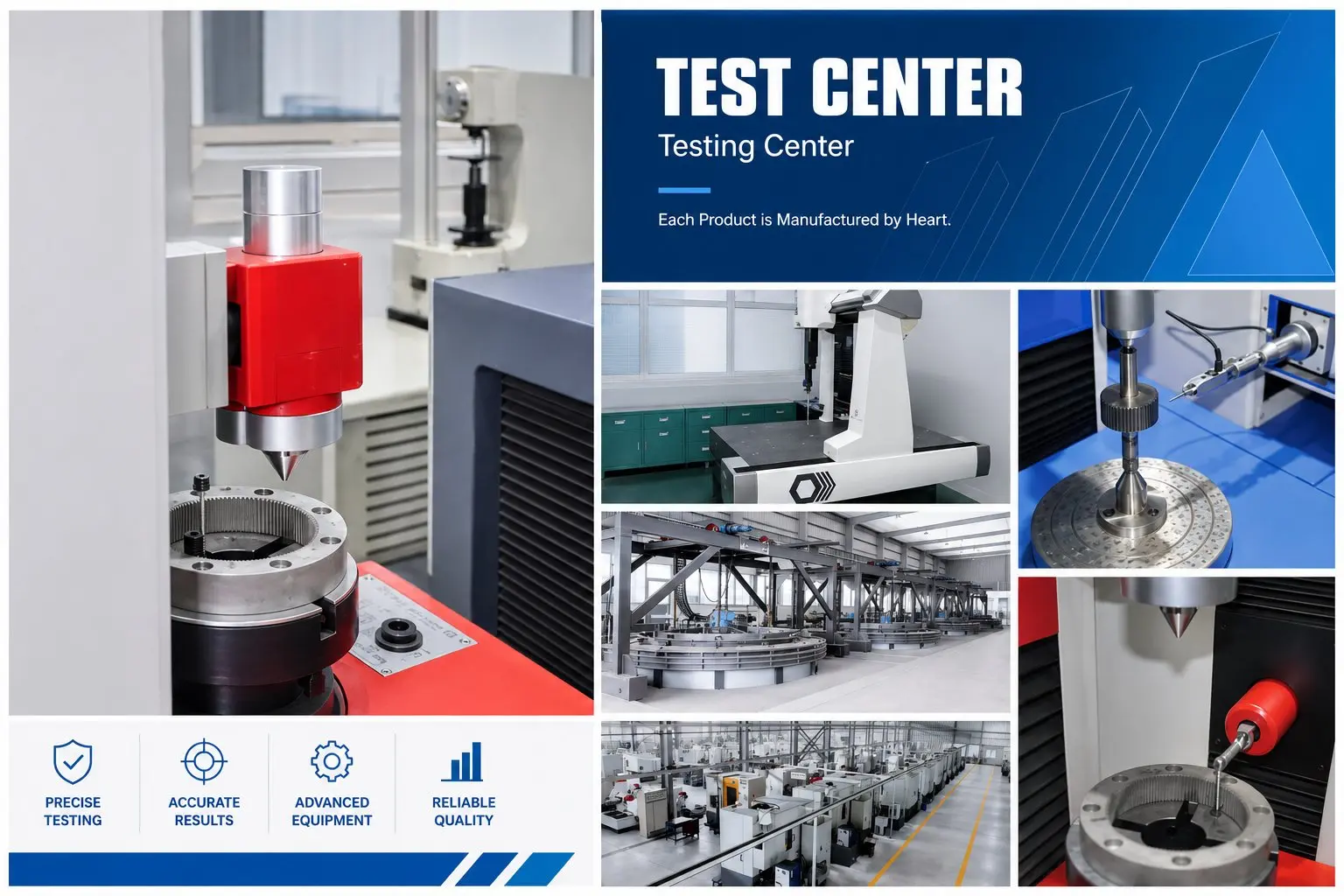
Korea Ever-Power test center — backlash measurement under 2% rated torque and IP65 pressure test for EP-FAD printing press gearboxes
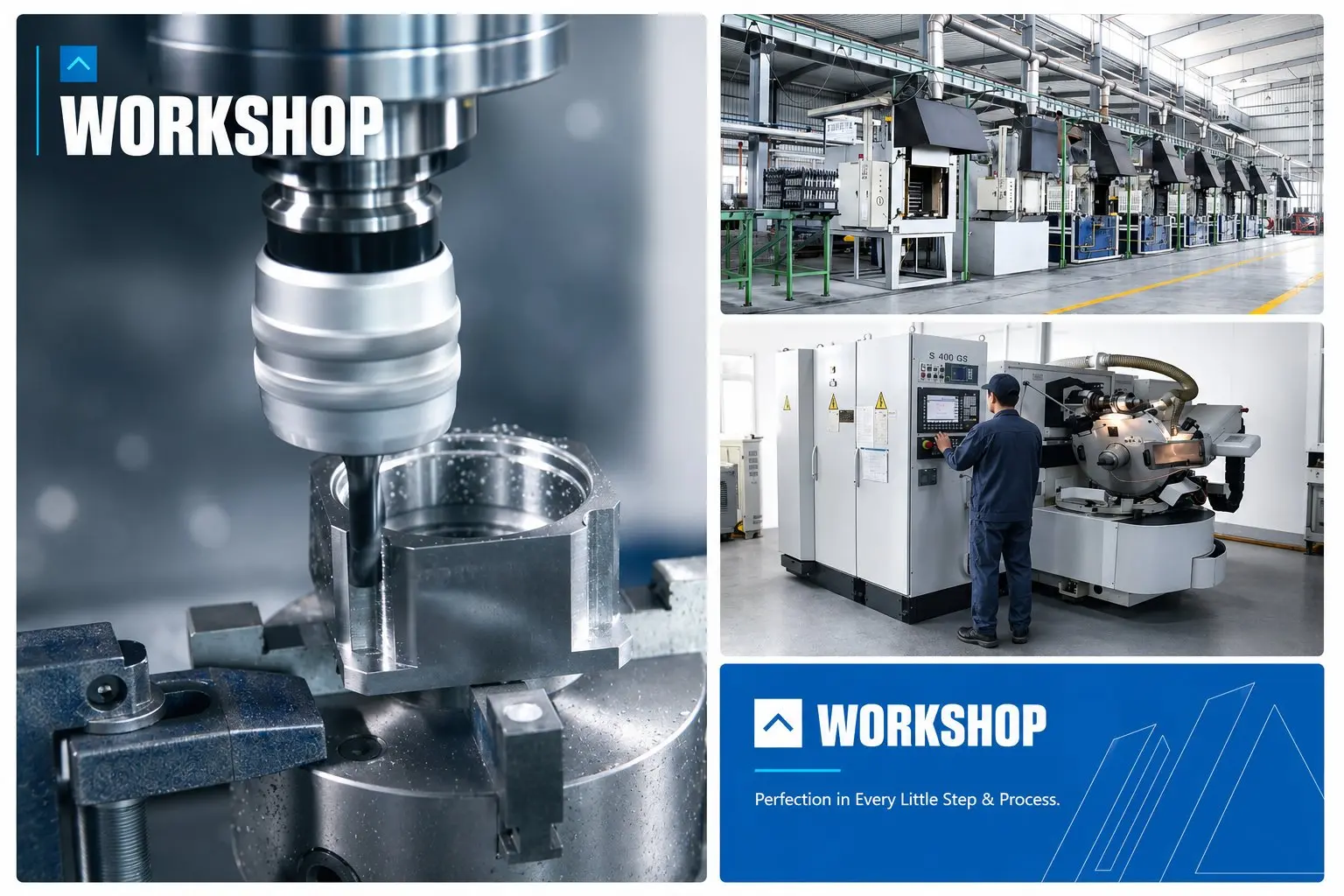
Korea Ever-Power 5-axis CNC gear grinding workshop — DIN Class 5 profile grinding for EP-FAD P0 offset press planetary gearboxes

Test centre (loaded backlash measurement and IP65 pressure decay — every unit) and 5-axis CNC gear-grinding workshop, Korea Ever-Power, Ansan-si, Korea. The same machines that produce EP-FAB for CNC rotary tables produce EP-FAD for offset press cylinder drives — DIN Class 5 accuracy is a production standard, not a special option.

The DIN Class 5 accuracy that determines EP-FAD’s long-term backlash stability comes from a single manufacturing process: 5-axis CNC profile grinding of the ring gear and planet gears to a tooth profile deviation below ±3 µm. This process is the same one used by European premium gear manufacturers (Neugart, Apex, Wittenstein) to achieve P0 grade. Korea Ever-Power operates 5-axis CNC profile-grinding equipment at the Ansan-si production facility — the same equipment class, producing the same tooth accuracy standard, at a unit cost 25–40% below the European benchmark.

The individual backlash measurement that underpins the nameplate stamp is conducted at 2% rated torque — a loaded measurement that captures the real effective backlash under the elastic deformation of the gear mesh at light load, not the geometric tooth clearance measured without load. This is the same measurement condition specified by European standards for P0 grade. The measurement is conducted on every unit, on every production shift, as part of the end-of-line quality check. Units measuring above the P0 threshold (>1 arc-min) are either regraded (shipped as P1, labelled P1) or reprocessed — they do not ship with a P0 nameplate if they did not achieve P0 on the test bench.

For printing press builders comparing EP-FAD against European alternatives, the practical consequence is direct substitution: same DIN Class 5 gear accuracy, same individual backlash stamp and traceability, same NYOGEL 792D lubricant, same IP65 per-unit pressure test — at approximately 60–75% of the European benchmark unit cost. This cost difference compounds across a multi-unit press drive BOM (a 5-colour offset press may have 8–12 planetary gearboxes across all cylinders, feeders, and finishing units) to a procurement saving that exceeds the cost of qualification.

📊
Backlash Condition Monitoring Programme — Using the Nameplate Stamp
Korea Ever-Power recommends that press builders using EP-FAD P0 for cylinder drives establish a backlash monitoring programme: (1) Record the nameplate-stamped starting value for each cylinder drive gearbox at installation. (2) Measure backlash at each annual planned maintenance stop using the press’s own servo feedback (jog to contact in both directions, record the position difference at each cylinder drive axis). (3) Plot measured backlash vs. cumulative impression count. (4) Project the rate of growth to estimate remaining life before the P0 threshold is approached. This programme converts the nameplate stamp from a one-time quality record into an ongoing condition monitoring datum — one that gives press maintenance managers a factual basis for planning gearbox replacement before register problems force an unplanned intervention.

EP-FAD P0 vs. European Premium — Offset Press Application Comparison

Attribute European Premium
(Neugart, Stöber)
Korea Ever-Power
EP-FAD P0
Press Builder Implication
Gear accuracy class DIN Class 5 DIN Class 5 (5-axis CNC) Same governing standard; same backlash growth rate at equivalent torque loading
Per-unit backlash stamp Yes Yes — every unit Enables backlash condition monitoring programme over press service life
NYOGEL 792D standard Yes Yes — sealed lifetime Same lubricant reference; same warmup drift elimination; no relubrication interval
IP65 per-unit test Sample test Every unit tested Press solvent environments make IP failures costly; per-unit test eliminates field failures
C1–C10 universal adapter Brand-specific All 8 series One motor qualification covers FAD cylinder drives + FAL carriage + FALR flexo + FAB finisher
Unit price (P0) 100% benchmark ~60–75% 5-colour press with 10 EP-FAD P0 gearboxes: 25–40% BOM cost reduction vs European benchmark

Korea Ever-Power does not manufacture products identical to named European brands. Comparative data based on publicly available specifications. Backlash growth curve data is representative engineering estimates — press builders should conduct their own qualification testing.

Customer Feedback

What Printing Machine Engineers Say About EP-FAD and EP-FAL

★★★★★

“We specified EP-FAD P0 on all five cylinder drives of our sheetfed offset. At the 2-year service check, we measured backlash on each drive using the press servo feedback — jog-to-contact in both directions. All five gearboxes measured between 0.9 and 1.1 arc-min, against nameplate starting values of 0.7–0.8 arc-min. Growth of about 0.2–0.3 arc-min over approximately 200 million impressions per cylinder — well within P0 spec and consistent with the growth curve we’d seen in the Korea Ever-Power data. Our previous European-branded gearboxes at the same service interval were measuring 2.5–3.0 arc-min. We’ve extended the service interval to 4 years based on the measured growth rate.”

RK
Ryu K., Press Engineering Director
Sheetfed Offset Press Manufacturer — Bucheon, Korea
★★★★★

“Our continuous production inkjet press runs 3 shifts at 150 m/min. We had persistent banding at a frequency locked to the media transport roller rotation — identified by oscilloscope measurement as a 1.8 Hz periodic position disturbance. Replaced the transport gearbox with EP-FAD P1. Banding disappeared. The rotational frequency of the previous gearbox’s hub eccentricity was driving the banding pattern. We also confirmed the 30,000 hr rating is realistic — our equivalent European unit needed service at about 22,000 hr of production time. The C1–C10 adapter covered our Mitsubishi motors without any modification.”

WS
Won S., Production Technology Engineer
Digital Inkjet Press Manufacturer — Suwon, Korea
★★★★★

“We build 8-colour central impression flexo presses for flexible packaging. EP-FALR P1 on the anilox drives — motor perpendicular to the roll, space-critical flexo deck geometry. The right-angle motor layout reduced deck width by 90 mm per drive compared to our previous inline arrangement, which allowed us to add another colour deck within the same overall press length. The C1–C10 adapter qualified on our Yaskawa motors covered both the FALR anilox drives and the EP-FAD P1 impression roll drives on the same press — one qualification document covered all 16 gearboxes. IP65 on every unit is critical in our solvent flexo environment — we had IP failures every 8 months on previous gearboxes from a competitor. Zero IP failures in 30 months since switching to Korea Ever-Power.”

JY
Jo Y., Lead Machine Designer
Central Impression Flexo Press Manufacturer — Gunpo, Korea

Related EP-Series — Full Print Press BOM Coverage
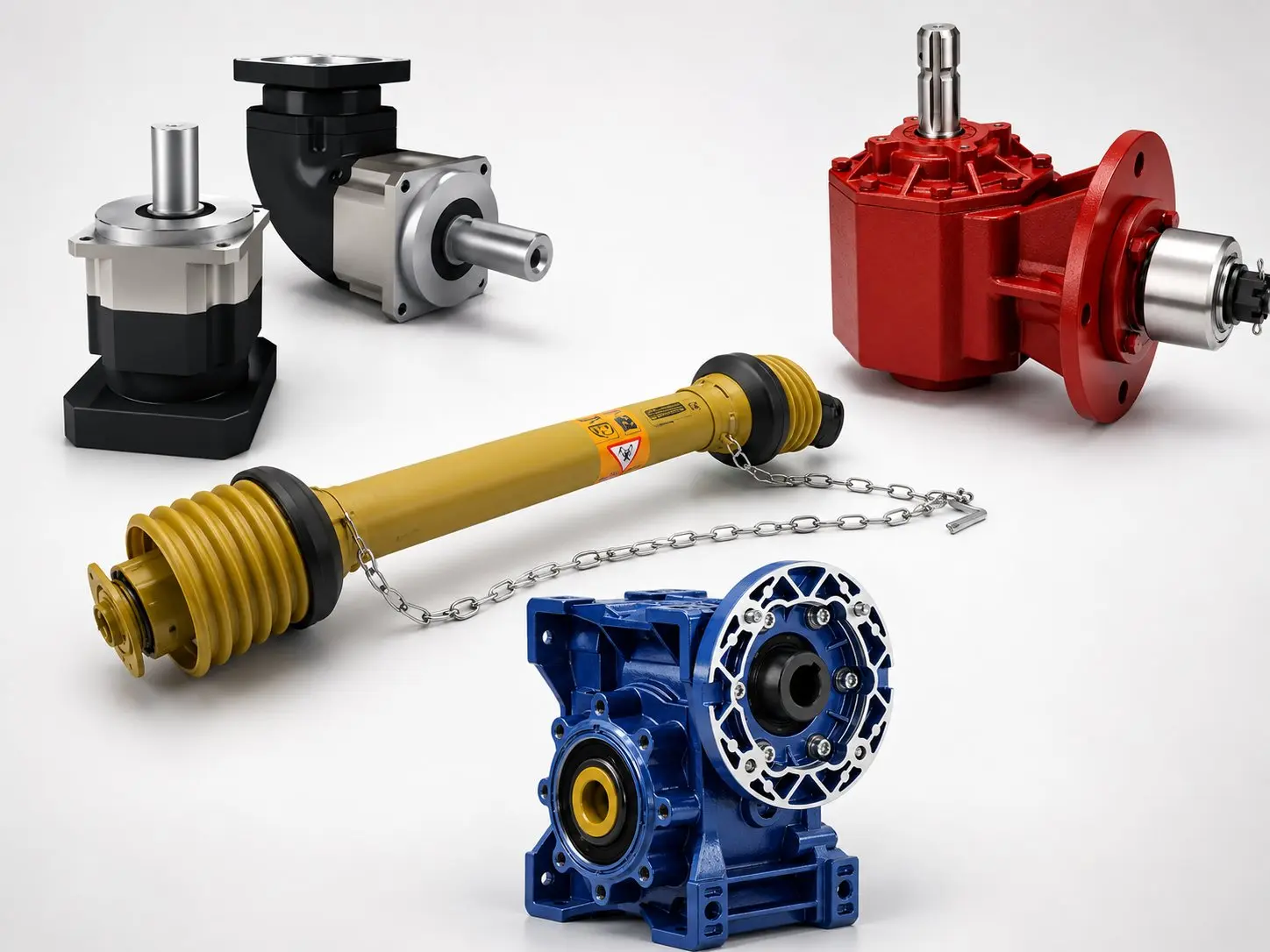
Korea Ever-Power EP series planetary gearbox range — FAD FAL FALR FAB for offset press flexo gravure wide-format digital printing applications

Core printing series: EP-FAD P0 (offset/gravure cylinder drives — long-term backlash stability) and EP-FAD P1 (digital inkjet media transport — 30,000 hr, low vibration). EP-FALR P1 for flexo anilox and impression roll right-angle drives. EP-FAL P1 for wide-format inkjet carriage belt drives. EP-FAB P1 for print finishing slitters and cutters. All series use the C1–C10 universal motor adapter — one qualification covers the complete press BOM.

Browse the full EP series product range. For worm reducer comparison in finishing equipment: worm-reducers.xyz. For drive shaft components in press transport systems: cvjointdriveshaft.com.

Frequently Asked Questions — Printing Gearbox Selection

Why does EP-FAD P0 maintain register accuracy over 100 million impressions when a P1 gearbox does not?
The difference is in the gear accuracy class. EP-FAD P0 uses DIN Class 5 profile-ground gears, which have tooth profile deviations within ±2–3 µm of the theoretical involute. A P1/DIN Class 6–7 alternative has profile deviations of ±5–8 µm. These deviations concentrate Hertzian contact stress at local high spots on the tooth surface. Higher peak contact stress produces higher surface fatigue — the microscopic pitting that removes material from the tooth face and progressively increases tooth clearance (backlash). DIN Class 5 gears distribute contact stress evenly, producing lower peak stress and a slower fatigue rate per meshing cycle. Over 100 million cylinder drive cycles, the compound difference is: P0/DIN5 grows from 0.8 to approximately 1.5 arc-min (still P0), while P1/DIN6-7 grows from 2.5 to approximately 5.5 arc-min (well above P1 threshold). For a press specified to ±0.05 mm register, the P0/DIN5 gearbox stays within the register budget throughout; the P1 gearbox exceeds the register budget before 25 million impressions.
What causes warmup drift in press register, and does NYOGEL 792D actually eliminate it?
Warmup drift in press register has multiple contributors — thermal expansion of the press frame, bearing preload changes with temperature, and lubricant viscosity change in the gear train. The gearbox lubricant viscosity contribution works as follows: mineral oil in a gearbox at 20°C (cold press) has much higher viscosity than the same oil at 60°C (warm press). Higher viscosity means thicker elastohydrodynamic film between gear teeth, which slightly increases the effective tooth clearance — the oil film contributes to the apparent backlash. As the press warms up, the oil thins, the film collapses to its thinner steady-state thickness, and the apparent backlash decreases slightly. This shows up as a register drift during the first 50–150 impressions of each run. NYOGEL 792D synthetic grease has much lower viscosity sensitivity to temperature than mineral oil — its viscosity change from 20°C to 60°C is a fraction of that of mineral oil. The gearbox backlash at cold press is essentially the same as at operating temperature. This eliminates the lubricant-viscosity contribution to warmup drift. Note that warmup drift from frame thermal expansion and bearing preload change are not affected by the gearbox lubricant choice — if warmup drift persists after switching to EP-FAD with NYOGEL 792D, those other sources should be investigated.
How do I implement a backlash condition monitoring programme using EP-FAD P0 nameplate stamps?
The recommended programme: (1) At installation, record the nameplate-stamped backlash value for each cylinder drive gearbox into the press maintenance log. (2) At each planned annual maintenance stop, measure backlash on each axis using the press’s own servo position feedback — jog the axis slowly to contact in the positive direction and record the position; then jog to contact in the negative direction and record the position. The difference between the two positions is the servo-measured backlash, which includes gearbox backlash plus any mechanical compliance in the drive train. The increment from the previous year’s measurement is the backlash growth during that period. (3) Plot cumulative backlash vs. cumulative impression count for each axis. Fit a linear or slightly accelerating trend line. (4) Project the trend to the P0 threshold (nameplate value + (P0 limit − nameplate value) = headroom; rate of growth = headroom ÷ remaining life estimate). This gives a factual, machine-specific prediction of when each cylinder drive gearbox will approach its P0 limit — allowing proactive replacement scheduling that avoids register problems in production. Korea Ever-Power can advise on typical growth rates for specific press configurations on request.
Is EP-FALR suitable for high-speed flexo presses running at 400 m/min web speed?
EP-FALR P1 maximum input speed is 4,000 rpm. At i=10:1, maximum output speed is 400 rpm at the gearbox output shaft. The connection from FALR output to the anilox roll is made through a flexible coupling or belt — the final surface speed of the anilox roll depends on the roll diameter and the overall drive ratio including any belt stage between FALR and roll. For a 400 m/min web speed on a 200 mm diameter anilox roll, the roll rotates at 637 rpm. This requires the FALR output shaft to run at 637 rpm (if direct-coupled) or faster (if there is a belt overdrive between FALR and roll). At 637 rpm output and i=10:1, input speed = 6,370 rpm — above the FALR 4,000 rpm limit. For high-speed flexo at 400 m/min, specify a higher ratio (e.g., i=20:1 gives 637 rpm output at 12,740 rpm input — still too fast) or use a belt stage between FALR and roll to reduce the FALR output speed. Contact Korea Ever-Power application engineering with your roll diameter, web speed, and available motor speed — a complete drive ratio and frame size calculation will be provided.
How does the C1–C10 motor adapter simplify a multi-press print factory BOM?
A multi-press printing factory may have offset presses (EP-FAD P0 cylinder drives), digital inkjet presses (EP-FAD P1 transport), flexo presses (EP-FALR P1 anilox + EP-FAD P1 impression), wide-format printers (EP-FAL P1 carriage), and finishing equipment (EP-FAB P1 slitter/cutter) — five different EP-series, all potentially using the same servo motor brand and model. With a conventional multi-supplier gearbox strategy, each series would require a separate motor interface qualification — different adapter geometries, different installation drawings, different torque specifications. With Korea Ever-Power C1–C10, the same adapter ring for a given motor model fits every EP-series in the factory. One qualification documentation package covers the entire factory gearbox BOM. When the factory upgrades from FAD to FAB on a press axis, or adds a new FALR-equipped flexo press, the motor adapter documentation is unchanged. The procurement simplification is significant at the factory scale: one supplier, one adapter system, one qualification — across all 5–8 press types in the production hall.

Specify EP-FAD, EP-FALR, or EP-FAL for Your Printing Press Application
Send your press type, cylinder diameter, motor model, and annual impression target — Korea Ever-Power will provide backlash grade recommendation, growth projection, and C-adapter specification within 24 hours.

Request Printing Gearbox Specification →

Editor: Cxm