Planetary Gearbox Backlash Grade Selection — P0 vs P1 vs P2 vs Standard: Engineering Guide

≤1 arc-min
P0 Grade — Precision
≤3 arc-min
P1 Grade — Standard Precision
≤5 arc-min
P2 Grade — Economy Precision
≤8 arc-min
Standard Grade — Economy
2%
Rated Torque — Measurement Load
Per Unit
Stamped — Every EP-Series

Engineering Fundamentals

What Backlash Is, How It Is Measured, and How to Calculate the Grade Your Application Requires
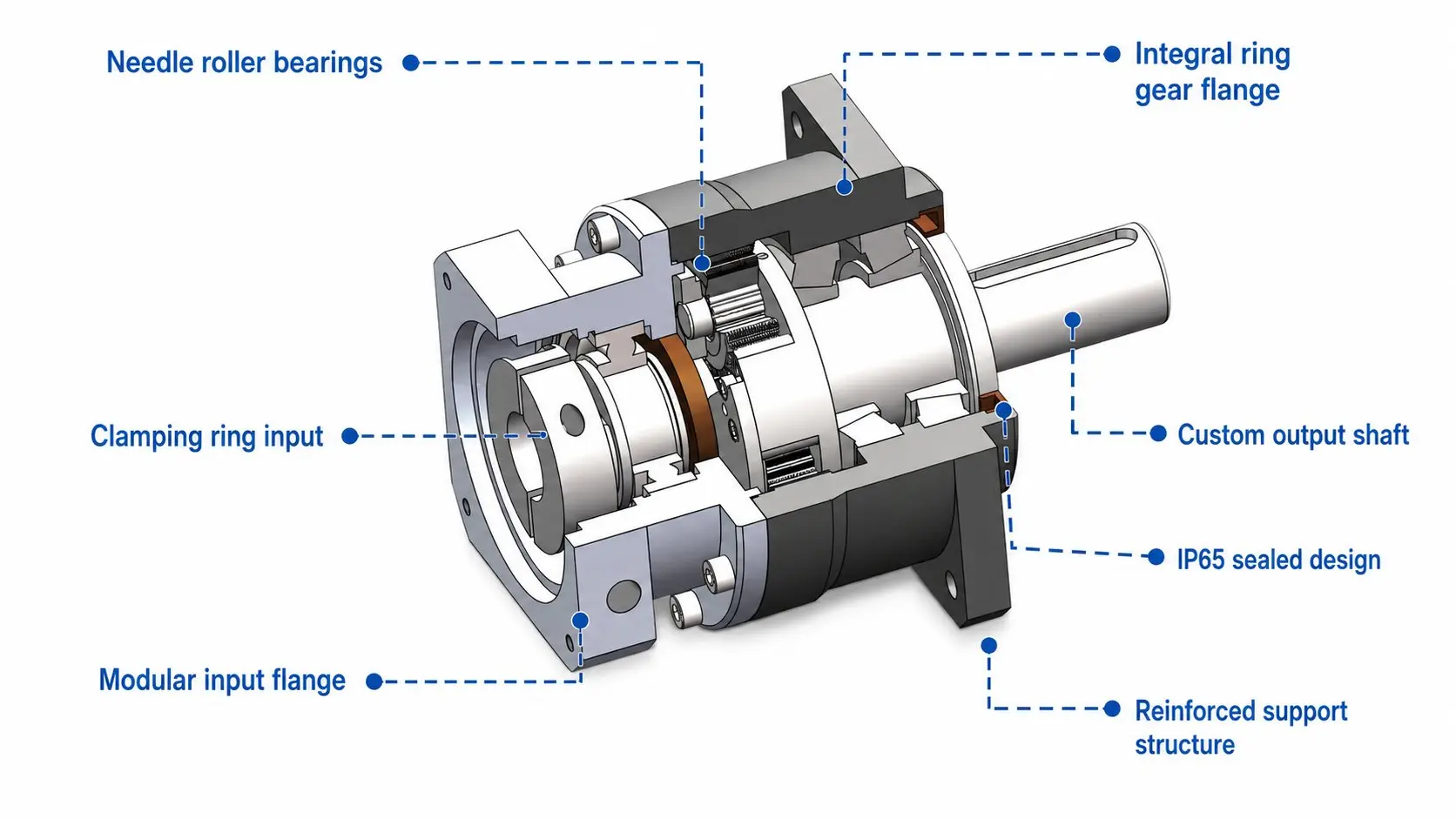
Planetary gearbox internal structure showing ring gear, planet gears, and sun gear — backlash is the angular play measured at the output shaft when the input is held fixed

Backlash originates in the clearance between meshing gear teeth. In a planetary gearbox, it is measured at the output shaft while the input shaft is held stationary — the angular displacement from full clockwise contact to full counterclockwise contact under 2% rated torque load.

Backlash in a planetary gearbox is the angular dead zone at the output shaft when the input shaft is held stationary. When the output shaft is rotated clockwise from a neutral position until the gear teeth make firm contact, and then counterclockwise until firm contact in the opposite direction, the total angular displacement between those two contact points — measured under a light preload of 2% rated torque — is the backlash. It is expressed in arc-minutes (1 arc-min = 1/60 of one degree = 0.000291 radians).

Backlash has one primary consequence in servo-driven machinery: it creates a positional dead zone at every direction reversal. When the servo motor reverses direction, the output shaft does not immediately follow — the motor must first traverse the backlash dead zone before the gear teeth re-engage and transmit torque. The servo controller sees this as a period where its position commands produce no output motion, followed by a sudden catch-up when contact re-establishes. The result at the driven axis is a brief positional overshoot or undershoot at each reversal — the amplitude of which is determined by the backlash magnitude and the servo’s tuning response.

The EP-series backlash grade designations — P0 (≤1 arc-min), P1 (≤3 arc-min), P2 (≤5 arc-min), and standard grade (≤8 arc-min) — define the maximum permissible backlash measured on the completed, assembled gearbox under 2% rated torque. Korea Ever-Power measures every EP-series unit individually under this standard and stamps the measured grade (not just the grade range, but the actual measured value for precision grades) on the nameplate. This per-unit measurement is the fundamental quality differentiator between EP-series gearboxes and products whose grade is determined by batch sampling.

🔬
The Standard Backlash Measurement Method
All Korea Ever-Power EP-series backlash measurements follow the same method: (1) Hold the input shaft stationary. (2) Apply a clockwise torque of 2% rated output torque to the output shaft. (3) Set the angular position reference to zero. (4) Apply the same torque counterclockwise and record the total angular displacement. (5) This displacement is the backlash in arc-minutes. The 2% torque preload ensures that the gear teeth are in firm contact on one side (eliminating bearing clearance from the measurement) while not deflecting the gear teeth under load. Measurements taken without this preload, or under higher loads, will produce different values — this is why quoting backlash requires specifying the measurement method.

Backlash Grade Selection Calculator — Required Grade from Axis Radius and Linear Accuracy

The required backlash grade for any rotary axis follows directly from two parameters: the radius from the output shaft centreline to the point where positioning accuracy is specified (r, in mm), and the maximum acceptable linear positional error at that point (δ, in mm). The relationship is:

θ (arc-min) = (δ ÷ r) × 3438
θ = required max backlash (arc-min)  |  δ = max linear error at axis (mm)  |  r = radius to measurement point (mm)  |  3438 = arc-min per radian

The table below pre-calculates this formula for eight common application configurations, showing the arc-min value that corresponds to different linear accuracy requirements, and which EP-series grade satisfies each requirement — before and after servo compensation (which typically reduces effective backlash impact by 60–70% through direction-reversal anticipation).

Application /
Drive Point
Radius r
(mm)
Required
Accuracy δ
Max Backlash
θ (arc-min)
no compensation
Max Backlash
θ (arc-min)
with compensation
Without
Compensation
→ Grade
With Servo
Compensation
→ Grade
EP-Series
Recommendation
CNC 5-axis
rotary table B/C
r = 315 mm
315 ±0.02 mm
H7 bore tolerance
0.22 arc-min
(0.02÷315)×3438
0.55 arc-min
÷ 0.4 (60% comp.)
Below P0
Not achievable
P0 ≤1
Satisfies requirement
EP-FAB/FAD P0
Servo compensation essential; P0 with compensation achieves ±0.02 mm
Industrial robot
TCP J4–J6 wrist
r = 400 mm reach
400 ±0.05 mm
Arc welding TCP
0.43 arc-min
(0.05÷400)×3438
1.07 arc-min
÷ 0.4
P0 ≤1
P0 required
P1 ≤3
P1 with comp. works
EP-FAB/FADS P0 or P1
P0 without compensation; P1 with servo compensation both satisfy ±0.05 mm
Offset press
cylinder drive
r = 200 mm
200 ±0.10 mm
Commercial offset register
1.72 arc-min
(0.10÷200)×3438
4.30 arc-min
÷ 0.4
P1 ≤3
P0 for service life
P2/Std ≤5–8
But backlash grows
EP-FAD P0 recommended
P1 adequate at start; P0 preferred for ≥5M impression service life wear budget
Laser cutting
gantry belt axis
r = 50 mm pulley
50 ±0.05 mm
Grade A kerf quality
3.44 arc-min
(0.05÷50)×3438
8.60 arc-min
÷ 0.4
P1 ≤3
P1 or better
Std ≤8
But hub eccentricity dominates
EP-FAL P0/P1
Note: hub eccentricity dominates vs. backlash here — FAL integrated pulley more important than P0 vs P1
Rotary indexing
carousel
r = 150 mm
150 ±0.10 mm
Station registration
2.29 arc-min
(0.10÷150)×3438
5.73 arc-min
÷ 0.4
P1 ≤3
P1 required
P2 ≤5
P2 with compensation
EP-FAB/FAD P1
P1 without compensation satisfies ±0.1 mm at 150 mm radius
AGV traction
drive wheel
r = 75 mm wheel
75 ±2.0 mm
Closed-loop speed only
91.7 arc-min
(2.0÷75)×3438
229 arc-min
÷ 0.4
Std ≤8
Economy grade adequate
Std ≤8
Economy grade
EP-FPG/FPGA Std
Precision is irrelevant here — select for efficiency (≥97%) and IP65, not grade
Precision seeder
metering disc
r = 30 mm disc
30 ±0.5 mm
Seed spacing
57.3 arc-min
(0.5÷30)×3438
143 arc-min
÷ 0.4
Std ≤8
Economy adequate
Std ≤8
EP-FPG P2
Grade is not the limiting factor; select for IP65, chemical resistance, efficiency
Semiconductor
wafer handler
r = 350 mm arm
350 ±0.01 mm
Slot alignment
0.098 arc-min
(0.01÷350)×3438
0.245 arc-min
÷ 0.4
Below P0
Harmonic drive
P0 ≤1
P0 + full comp.
EP-FAD P0 + special ratio
Requires full servo compensation; consider special ratio i=21 or i=31 for resolution

Formula: θ (arc-min) = (δ ÷ r) × 3438. Servo compensation factor 0.4 (60% effectiveness) is representative for well-tuned modern servo drives; actual compensation effectiveness depends on servo bandwidth, encoder resolution, and tuning. These calculations give the maximum permissible gearbox backlash — the actual application may have additional error sources (bearing clearance, lead screw pitch error, belt compliance) that must be subtracted from this budget before selecting grade. Use this table as a starting point, not a final specification.

Grade Specifications

P0, P1, P2, and Standard Grade — What Changes Between Grades and What Does Not

A common misconception is that a higher-grade gearbox is “better” in all respects than a lower-grade unit. In Korea Ever-Power’s EP-series, higher backlash grades reflect tighter manufacturing tolerances and more rigorous selection testing — but the gear accuracy class (DIN Class 5 across all precision grades), lubrication, IP rating, and design life are identical. What changes is the backlash specification and, at Korea Ever-Power, the depth of individual unit measurement documentation.

Parameter P0
≤1 arc-min
P1
≤3 arc-min
P2
≤5 arc-min
Standard
≤8 arc-min
Notes
Backlash (max) ≤1 arc-min ≤3 arc-min ≤5 arc-min ≤8 arc-min Measured at output shaft under 2% rated torque; all grades use same measurement method
Gear accuracy class DIN Class 5 DIN Class 5 DIN Class 5 DIN Cl. 6–7
(FPG/FPGA)
Same DIN Class 5 across P0/P1/P2 — gear accuracy does not change with grade; only the sorting/selection changes
Per-unit backlash
measurement
✓ Measured value
stamped
✓ Measured value
stamped
✓ Grade
stamped
Grade
stamped
P0/P1: exact measured value (e.g., 0.78 arc-min) stamped — enables wear tracking; P2/Std: grade only
IP rating IP65 (every unit) IP65 (every unit) IP65 (every unit)
FAB/FAD/FAL
IP64 (every unit)
IP65 option
IP rating is independent of backlash grade — all EP-series receive individual IP pressure test regardless of grade
Lubrication NYOGEL 792D NYOGEL 792D NYOGEL 792D CASTROL LMX
(FPG/FPGA)
Lubrication is determined by series (FAB/FAD/FAL/FALR = NYOGEL; FPG/FPGA = CASTROL LMX) — not by grade
Design life 20,000–30,000 hr
(by series)
20,000–30,000 hr
(by series)
20,000–30,000 hr 20,000 hr S5 Design life is determined by series and rated load — not by grade; P0 and P1 within the same series have identical life
Motor adapter C1–C10 Universal C1–C10 Universal C1–C10 Universal C1–C10 Universal Same C1–C10 adapter across all grades — upgrading from P1 to P0 requires only a gearbox swap, not motor re-qualification
Relative unit cost
(same series)
100% (reference) ~80–85% ~65–70% ~50–60% Within the same series and frame size; cost difference reflects tighter measurement selection, not different components
Typical applications CNC rotary table, surgical robot, semiconductor wafer Robot J1–J3, press cylinder, AS/RS crane, PACK robot Diagnostic instrument, knitting feed, formation tester AGV wheel, conveyor, seeder, stenter transport Grade is driven by application accuracy requirement from the calculator table above, not by general “quality” judgment

💡
The Most Important Fact About EP-Series Grade Differences
Upgrading from P1 to P0 within the same series and frame size is a gearbox swap — not a system redesign. The motor adapter (C1–C10), mounting interface, output shaft dimensions, gear ratio, IP rating, lubrication, and design life are all identical. Only the backlash grade changes. This means a machine designer can specify P1 for the initial design and upgrade specific axes to P0 if field results show the application needs tighter register — without any motor or mechanical re-engineering. The C1–C10 universal adapter is the engineering foundation that makes this grade upgrade path practical at zero additional qualification cost.

Servo Compensation

Servo Backlash Compensation — What It Achieves and Where It Fails
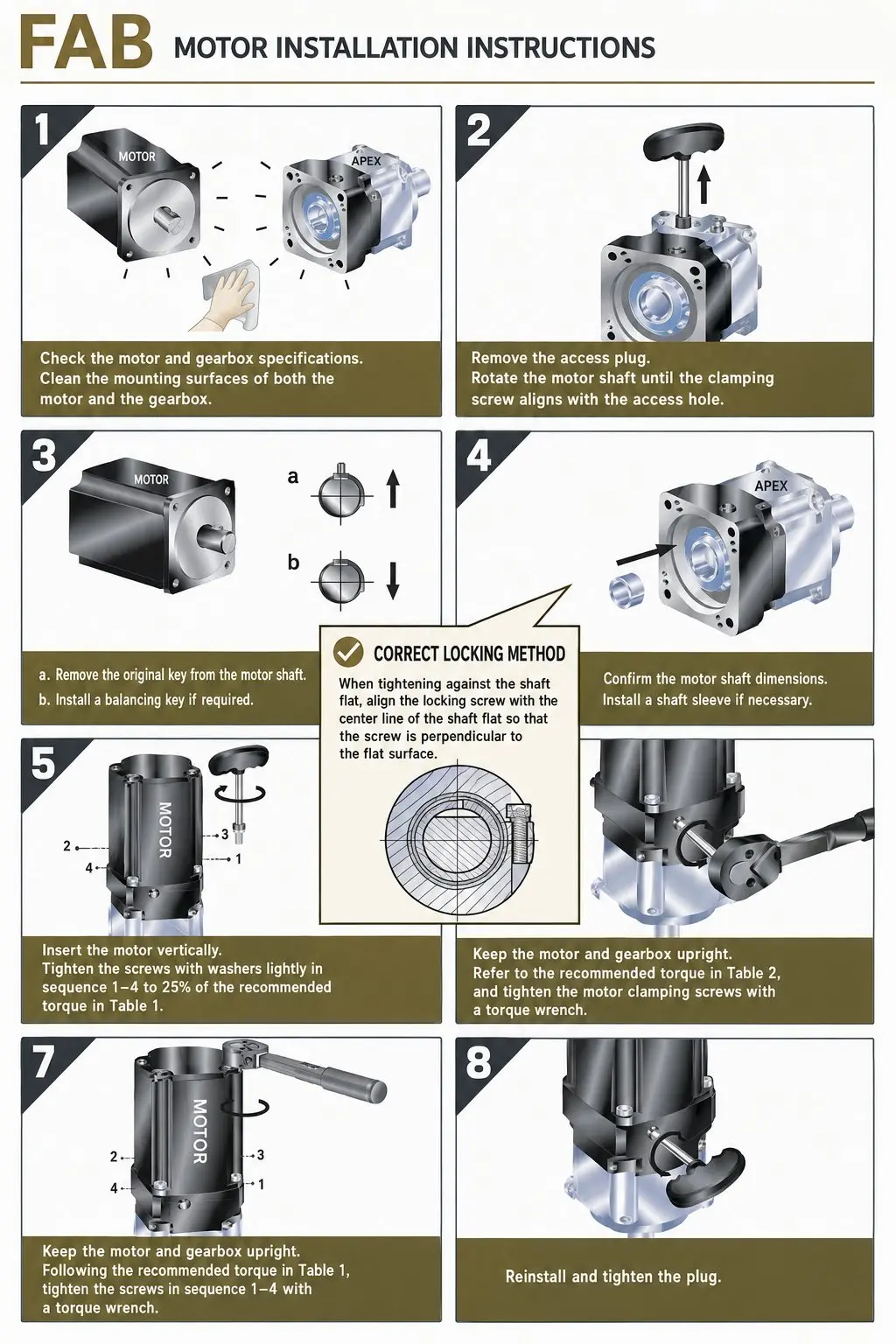
EP-FAB planetary gearbox installation showing motor adapter and output shaft — servo compensation requires knowing the backlash value stamped on the nameplate

60–70%
Compensation Effectiveness
0%
Against Periodic Error

Servo compensation works by commanding the motor to advance by the backlash value at each direction reversal. It requires knowing the current backlash — which is why Korea Ever-Power’s per-unit measured value stamp matters. A unit stamped “0.78 arc-min” allows the controller to compensate precisely; a unit stamped “P1” could be anywhere from 1.0 to 3.0 arc-min.

Five Things to Know About Servo Backlash Compensation

Modern servo drives include backlash compensation as a standard feature — a look-up or feed-forward correction that commands an additional position step at each direction reversal equal to the backlash value. Understanding what this compensation can and cannot do is essential for correct grade selection.

  1. What it can do: Reduce direction-reversal dead zone by 60–70%

    Standard servo backlash compensation advances the commanded position by the backlash value at each reversal, reducing the effective positional error from the full backlash to the residual compensation error (approximately 30–40% of the raw backlash, depending on controller bandwidth and mechanical response). At P0 (0.8 arc-min measured) with 60% effective compensation: effective position error ≈ 0.8 × 0.4 = 0.32 arc-min. At P1 (2.5 arc-min measured): effective error ≈ 2.5 × 0.4 = 1.0 arc-min.

  2. What it can do: Use the nameplate measured value for precise compensation

    Korea Ever-Power’s per-unit measured value stamp enables the servo controller to be programmed with the exact backlash of the installed unit — not an estimate from the grade range. A unit stamped “0.78 arc-min” allows the controller to compensate for exactly 0.78 arc-min at each reversal. A unit with batch-sample-grade documentation requires the engineer to assume a value within the grade range — typically the midpoint or worst case — introducing unnecessary conservatism or optimism depending on the choice.

  3. What it cannot do: Compensate for periodic position errors

    Servo backlash compensation is a step function at direction reversals — it does not compensate for continuous periodic position errors such as those caused by belt pulley hub eccentricity or gear mesh vibration. If a gantry drive has a 0.08 mm periodic error from hub eccentricity, servo compensation does nothing to reduce it. This is why EP-FAL’s integrated pulley matters independently of backlash grade — even a P0 gearbox with a separate eccentric pulley hub will have the periodic error.

  4. What it cannot do: Track backlash growth over service life

    Servo compensation uses a fixed backlash value programmed at commissioning. As the gearbox wears and backlash grows, the compensation value becomes increasingly incorrect — a unit that started at 0.78 arc-min and has grown to 1.4 arc-min is still compensating for 0.78, leaving 0.62 arc-min uncompensated. This is why Korea Ever-Power recommends periodic backlash re-measurement at service intervals and updating the servo compensation parameter when the measured value has increased by more than 0.3 arc-min from the last programmed value.

  5. What it cannot do: Fully compensate large backlash values

    Servo compensation effectiveness decreases as the backlash magnitude increases, because larger backlash dead zones produce larger impact transients when the gear teeth re-engage after crossing the dead zone. A 10 arc-min backlash (worm gearbox) produces a mechanical impact at re-engagement that the servo cannot fully absorb — the residual error after compensation may be 4–5 arc-min rather than the theoretical 40% of 10 = 4 arc-min, because the impact excites mechanical resonance. For practical servo systems, compensation is effective up to approximately 5–8 arc-min — which is why standard-grade (≤8 arc-min) gearboxes can work with compensation for low-precision applications, but not for precision ones.

Application Examples

Eight Grade Selection Examples — Applying the Calculator to Real Applications

The following examples apply the grade selection calculator from Section 1 to real drive applications across the industries covered in Korea Ever-Power’s application guide series. Each example shows the calculation, the grade decision, and the reasoning — including cases where grade is not the primary selection criterion.

01
CNC 5-axis machining centre B-axis (trunnion tilting axis)
Parameters: r = 200 mm (workpiece radius at table), δ = ±0.05 mm (H7 bore requirement). Calculation: θ = (0.05÷200)×3438 = 0.86 arc-min without compensation. With 60% compensation: needs ≤0.86÷0.4 = 2.15 arc-min raw backlash. Decision: P1 (≤3 arc-min) satisfies with compensation; P0 (≤1 arc-min) satisfies without compensation.
Grade selected: P0 — because the B-axis operates in both directions at every workpiece setup (compensation must be reliable at cold start and thermal equilibrium), and because backlash growth over the machine’s 20,000-hour life would reduce the P1 wear budget to zero within the design life. EP-FAB P0 or EP-FAD P0.

02
Industrial robot arc welding (J4/J5 wrist, ±0.05 mm TCP target)
Parameters: r = 350 mm (reach from wrist to TCP), δ = ±0.05 mm. Calculation: θ = (0.05÷350)×3438 = 0.49 arc-min without compensation. With compensation: needs ≤0.49÷0.4 = 1.22 arc-min. Decision: P0 without compensation; P1 with compensation (1.22 < 3.0, so P1 works with compensation).
Grade selected: P0 for J4/J5 wrist — because arc welding robots rarely use servo backlash compensation in their joint controllers (the TCP is computed from encoder positions, not corrected for backlash in real time), and the ±0.05 mm target must be met by the mechanical system. P1 for J1/J2/J3 base joints — because base joint errors contribute less to TCP error (shorter moment arm). EP-FADS P0 (J4/J5) + EP-FAB P1 (J1/J2/J3).

03
Press brake back-gauge X-axis (±0.1 mm gauge position)
Parameters: Back-gauge finger at 500 mm from pivot (leadscrew converts gearbox rotation to linear motion with 10:1 ratio); effective r in terms of gearbox output = (500/10) = 50 mm leadscrew pitch equivalent radius. δ = ±0.1 mm. Calculation: θ = (0.1÷50)×3438 = 6.88 arc-min without compensation. With compensation: ≤17.2 arc-min. Decision: Standard grade (≤8 arc-min) satisfies without compensation.
Grade selected: P1 (≤3 arc-min) — not because the calculation requires it, but because the IP65 requirement (metalworking lubricant environment) and the high-cycle press brake duty suggest a more conservative starting budget to allow for backlash growth. The additional cost of P1 vs standard grade is modest; the risk of backlash growth exceeding the tolerance limit mid-season is avoided. EP-FAB P1.

04
FFS packaging jaw drive (±0.15 mm heat-seal registration)
Parameters: Jaw cam radius r = 120 mm, δ = ±0.15 mm. Calculation: θ = (0.15÷120)×3438 = 4.30 arc-min without compensation. P1 (≤3 arc-min) satisfies this without compensation. Key insight: Backlash is not the primary selection driver here — hub eccentricity from a separate pulley hub produces ±0.08 mm periodic error that is worse than the P1 backlash contribution.
Grade selected: P1 — but more importantly, EP-FAL with integrated belt pulley is mandatory to eliminate hub eccentricity (the dominant error source). P0 with a separate hub pulley would perform worse than P1 with an integrated pulley. This is a case where the series choice (FAL) matters more than the grade choice.

05
AGV drive wheel (closed-loop speed control, ±2 mm stop accuracy)
Parameters: Wheel r = 75 mm, δ = ±2 mm. Calculation: θ = (2÷75)×3438 = 91.7 arc-min. Any grade satisfies this requirement. Key insight: Backlash grade is irrelevant — the AGV stop accuracy is dominated by inertia, encoder resolution, and controller response, not gearbox backlash.
Grade selected: Standard (economy) — select EP-FPG or EP-FPGA based on efficiency (≥97% vs ≤65% worm), IP65, round housing press-fit, and economy pricing. Do not pay for P0 or P1 where the application has no use for it.

06
Greenhouse harvest robot end-effector (±1 mm fruit positioning)
Parameters: End-effector reach r = 600 mm from last joint, δ = ±1 mm. Calculation: θ = (1÷600)×3438 = 5.73 arc-min without compensation. With compensation: ≤14.3 arc-min. P1 (≤3 arc-min) satisfies without compensation; even P2 (≤5 arc-min) satisfies without compensation.
Grade selected: P1 — marginally tighter than required, chosen for noise (≤58 dB EP-FAD P1 in greenhouse worker environment), vibration (helical gears reduce fruit drop from vibration), and long 30,000-hour duty life at continuous crop cycle operation. EP-FAD P1.

07
Radiotherapy gantry rotation (±0.1° angular, IEC 60601 compliance)
Parameters: Gantry directly driven — angular accuracy = gearbox backlash directly, no radius multiplication. Required: ±0.1° = ±6 arc-min. Calculation: P1 (≤3 arc-min) satisfies without compensation. P0 provides 3 arc-min safety margin for wear growth and IEC 60601-2-1 VMAT requirements (±0.5° for standard, ±0.1° for VMAT).
Grade selected: P0 — for service-life stability (backlash growth over 20,000 hours must not push the gantry out of VMAT specification), and for IEC 60601 traceable documentation (per-unit measured backlash stamp). EP-FAB P0. This is a long-service-life argument, not a time-zero accuracy argument.

08
Diagnostic analyser sample carousel (±5 mm tube positioning)
Parameters: Carousel r = 100 mm, δ = ±5 mm. Calculation: θ = (5÷100)×3438 = 171.9 arc-min. Any grade satisfies. Key insight: Noise (≤56 dB workstation), maintenance-free interval (5–7 year service life), and economy pricing for 100+ unit OEM production are the selection drivers.
Grade selected: P1 economy — not because P1 is needed for accuracy (standard grade ≤8 arc-min would work), but because the P1 production test documentation simplifies incoming quality inspection for the CE-marked in-vitro diagnostic device. EP-FPG P1. Noise and maintenance-free interval are the real selection criteria.

Selection Checklist

Grade Selection Checklist — Five Steps From Application Requirement to Final Grade

Apply these five steps in sequence for every axis that requires backlash grade specification. The most common engineering error is skipping Step 1 (the calculation) and defaulting to P0 “to be safe” on axes where P0 provides no benefit over P1 — and paying the cost premium unnecessarily. The second most common error is the reverse: specifying P2 on an axis where the application actually requires P1, then discovering the requirement is not met at customer acceptance.

Five-Step Grade Selection Checklist
1.
Calculate the required grade using the formula
Identify r (radius from output shaft to accuracy measurement point, mm) and δ (max acceptable linear error, mm). Calculate θ = (δ ÷ r) × 3438 arc-min. This is the maximum permissible backlash without any servo compensation. If servo compensation will be used, divide by 0.4 to get the maximum raw backlash the compensation system can handle.
2.
Check whether other error sources dominate
If the drive uses a belt, add a hub eccentricity check: is a separate pulley hub being used? If so, the 0.05–0.12 mm hub eccentricity likely dominates the backlash contribution. Solution: specify EP-FAL or EP-FALR with integrated pulley, regardless of grade. If other error sources (lead screw pitch error, encoder resolution, bearing clearance) together exceed the accuracy requirement, improving gearbox grade alone will not achieve the target — address all error sources.
3.
Consider service-life backlash growth
If the time-zero calculation gives P1 with a margin of only 0.5 arc-min before the tolerance limit, consider whether backlash growth over the service life will consume that margin. For applications with >5 million cycles or >10,000-hour duty, add a growth allowance of 0.5–1.0 arc-min to the required starting backlash, then re-select the grade. For long-service continuous-duty applications (press cylinders, medical gantries, radiotherapy gantries), this growth allowance often shifts the selection from P1 to P0.
4.
Check non-backlash selection criteria
Confirm: Is IP65 required (food, washdown, outdoor, solvent)? Is noise a constraint (medical, lab, human-collaborative)? Is lubricant temperature range constrained (cold climate: NYOGEL below 0°C)? Is non-magnetic housing required (MRI)? Are per-unit test certificates required for CE/MDR/IEC documentation? These factors may override the grade selection or impose a specific series — and they are independent of backlash grade. A P0 gearbox without IP65 certification fails in a washdown environment just as quickly as a standard-grade unit.
5.
Confirm with Korea Ever-Power application engineering
Send Korea Ever-Power: your application type, axis radius (r), required linear accuracy (δ), estimated annual cycle count, deployment environment (temperature range, chemical exposure, IP requirement), and servo motor model. Korea Ever-Power will confirm the grade selection, recommend the series, specify the C-adapter code, and confirm whether the cold-climate NYOGEL option applies. Contact: [email protected]. Response within 24 hours for standard applications; 48 hours for applications requiring detailed service-life calculation.

Production Quality

How Korea Ever-Power Produces and Verifies Backlash Grade — DIN Class 5 Grinding and Per-Unit Measurement
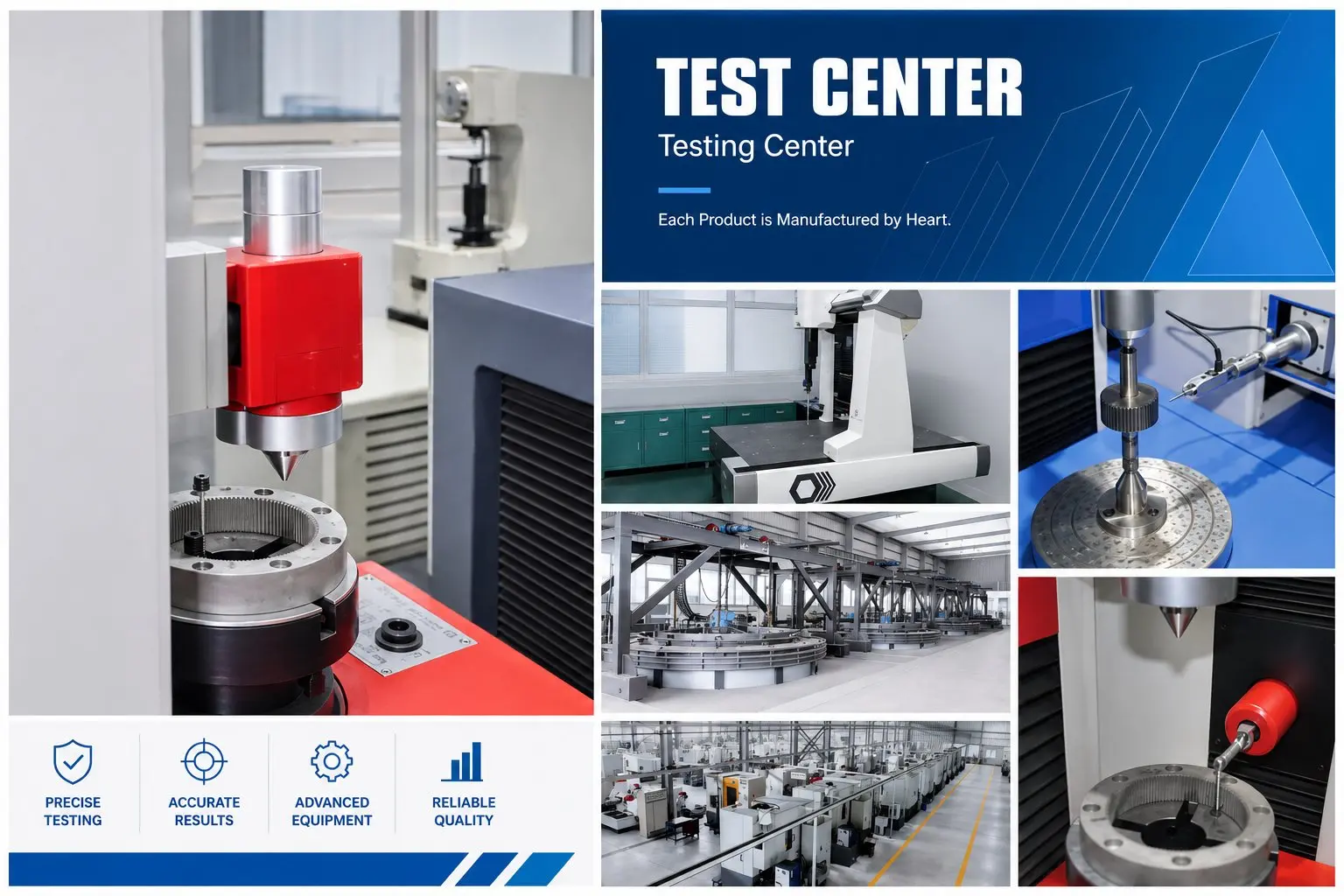
Korea Ever-Power test centre — individual backlash measurement at 2% rated torque for every EP-series planetary gearbox before shipment
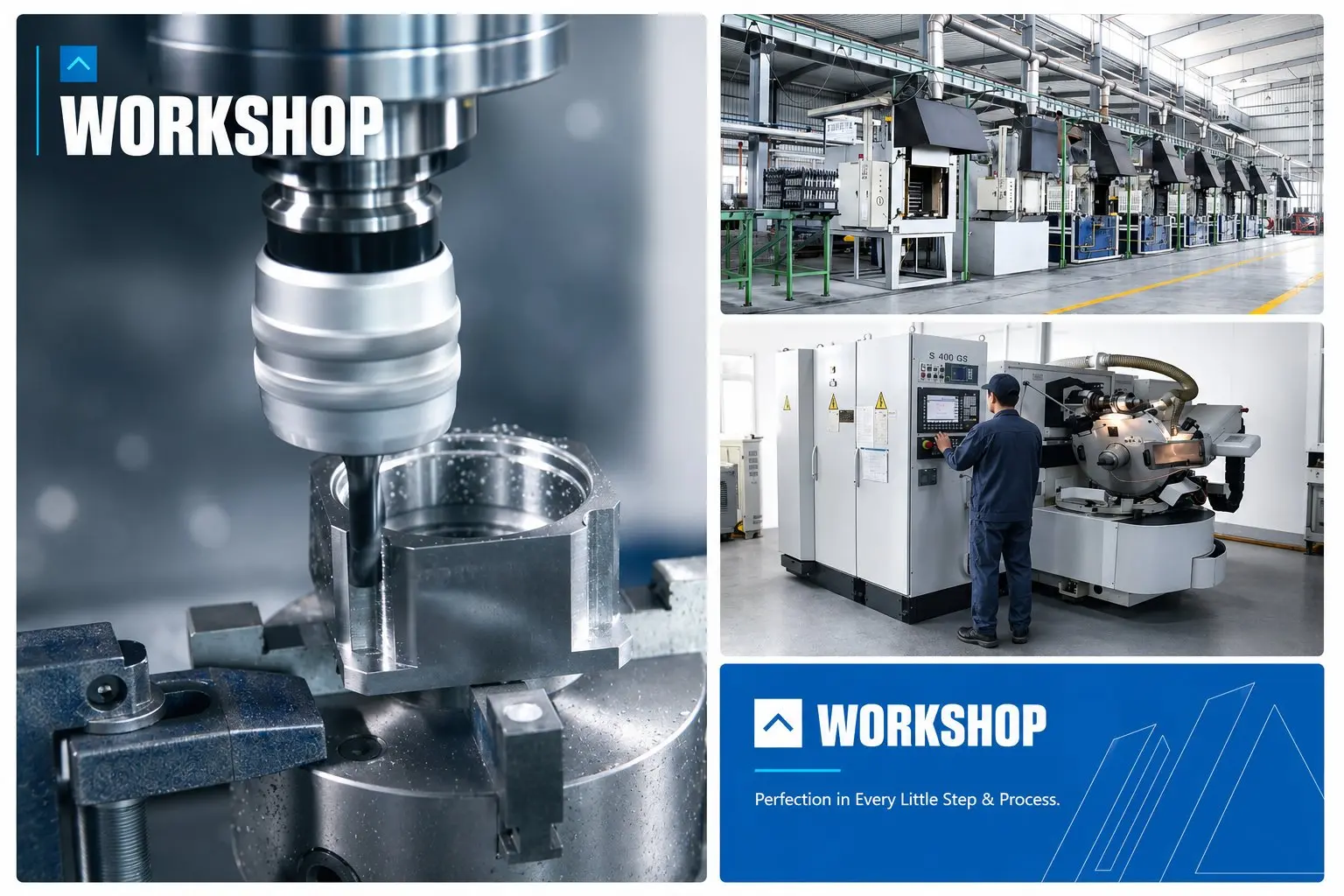
Korea Ever-Power 5-axis CNC gear grinding workshop — DIN Class 5 profile grinding for EP-FAB, EP-FAD, and EP-FADS precision planetary gearboxes

Test centre (individual backlash measurement at 2% rated torque load — every unit) and 5-axis CNC profile-grinding workshop, Korea Ever-Power facility, Ansan-si, Korea.

Achieving and verifying P0 backlash grade requires two manufacturing steps that cannot be substituted: 5-axis CNC profile grinding of the ring gear to DIN Class 5 accuracy, and individual unit backlash measurement under load with the result recorded and stamped on the nameplate.

The profile grinding step: Gear hobbing and shaving produce tooth profiles within DIN Class 6–7 accuracy — adequate for P2 and standard grade, insufficient for P0. The residual tooth form errors from hobbing (profile deviation, pitch variation, helix angle error) produce assembly backlash scatter that exceeds P0 tolerance. 5-axis CNC profile grinding removes these macro-geometry errors, tightening the tooth-to-tooth spacing and profile accuracy to DIN Class 5 — which produces a narrower backlash distribution in the assembled gearbox population. From this tighter distribution, P0-grade units can be reliably selected by measurement.

The individual measurement step: Even from a well-controlled DIN Class 5 production line, the backlash distribution of assembled gearboxes spans a range — some units measure 0.6 arc-min, others 1.2 arc-min, all within the same production batch. Without individual measurement, a unit at 1.2 arc-min ships as P0 even though it is at the boundary. With Korea Ever-Power’s individual measurement, that unit is identified, re-classified as P1, and the customer who specified P0 receives a unit that genuinely measures below 1.0 arc-min. The stamped value — not just the grade code — gives the machine engineer the starting backlash data for servo compensation programming and service-interval wear tracking.

📋
What Korea Ever-Power Provides with Each EP-Series Unit
P0 and P1 grades: Nameplate stamp showing measured backlash value (e.g., 0.78 arc-min), grade code (P0), measurement date, and production lot. Per-unit IP pressure test record available on request. P2 and standard grades: Nameplate grade stamp (e.g., P2). IP test record available on request. All grades: RoHS declaration; material certificates on request; noise measurement reports on request for specific frame sizes and ratios; CE technical file support documentation (MDR, IEC 60601, Machinery Directive) on request. Lead time for documentation package: 3–5 business days from order confirmation.

Related Technical Guides and Application Articles
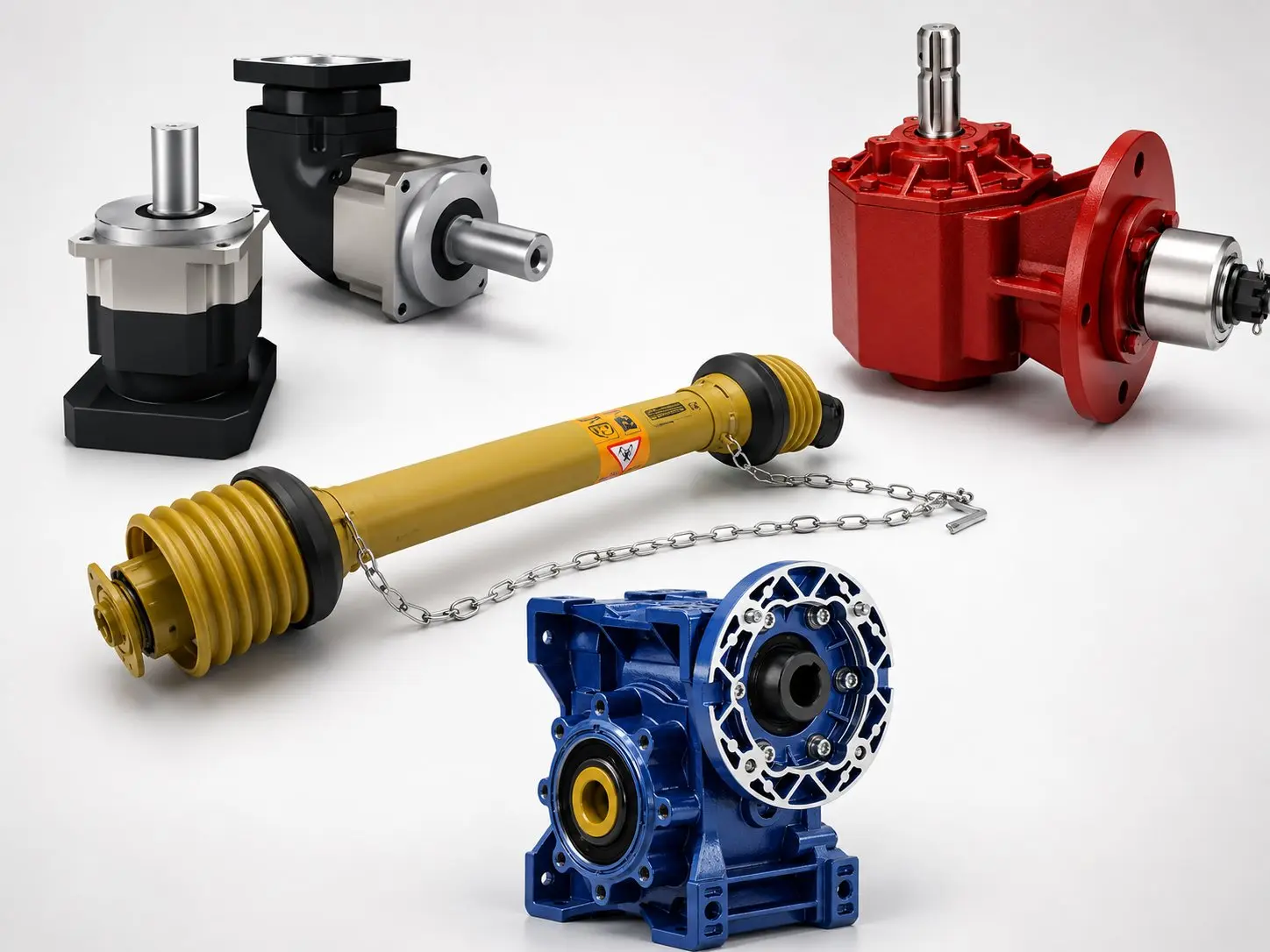
Korea Ever-Power EP series planetary gearbox product range — FAB FAD FADS FAL FALR FPG FPGA all series P0 P1 P2 standard grades

This grade selection guide applies to all EP-series gearboxes. The highest-precision applications — CNC machining centres, surgical robots, semiconductor equipment — use EP-FAB P0 or EP-FADS P0. Standard precision industrial applications use EP-FAD P1 or EP-FAB P1. Economy-tier applications use EP-FPG/FPGA standard grade. All series share the C1–C10 universal motor adapter — one qualification covers every grade and series in the EP range. Browse the complete EP series product catalogue.

For industry-specific application guides showing grade selection in context: CNC machining, industrial robots, semiconductor, AGV, battery/EV manufacturing, packaging, metal fabrication, textile, medical, agriculture, and printing. For related drive components: cvjointdriveshaft.com. For worm reducer comparison: worm-reducers.xyz.

Frequently Asked Questions — Backlash Grade Selection

Is P0 always better than P1, or are there applications where P0 is unnecessary?
P0 is not universally better than P1 — it is more precise, at higher cost, and that precision has value only when the application’s accuracy requirement demands it. For an AGV drive wheel, P0 provides zero benefit over standard grade because the AGV positioning accuracy is determined by its navigation sensors and controller, not by gearbox backlash. For a CNC 5-axis B-axis at 315 mm radius needing ±0.02 mm, P0 is required because even P1 with full servo compensation cannot reliably achieve this accuracy over the press service life. The grade selection calculator in this guide provides the mathematical basis for this decision: calculate the required grade for your specific r and δ, then apply the service-life growth allowance. Any grade that satisfies the calculation is adequate — a higher grade is unnecessary cost.
If I specify P1 now, can I upgrade to P0 later without redesigning the machine?
Yes — within the same series and frame size, upgrading from P1 to P0 is a direct gearbox swap. All mounting dimensions, output shaft geometry, gear ratio, and motor adapter interface (C1–C10) are identical between P0 and P1 within a given series (e.g., EP-FAD P1 → EP-FAD P0). The motor, mounting hardware, coupling, and servo parameters remain unchanged — only the gearbox body is replaced. The servo backlash compensation parameter should be updated to reflect the new unit’s measured backlash value (from the P0 nameplate stamp). This upgrade path is the reason Korea Ever-Power recommends specifying the correct grade from the calculation rather than upgrading “just in case” — but it also means that a P1 pilot machine can be upgraded to P0 on production machines without redesign cost if the field results justify it.
Why does Korea Ever-Power stamp the measured value (e.g., 0.78 arc-min) rather than just the grade code (P0)?
The measured value stamp serves three engineering functions that a grade code alone cannot. First, it enables precise servo backlash compensation: a controller programmed with 0.78 arc-min compensates more accurately than one programmed with “≤1 arc-min” (which could mean anything from 0.3 to 1.0 arc-min). Second, it establishes the baseline for service-interval wear tracking: a machine engineer who measures backlash at a 3-million-impression service interval and finds 1.1 arc-min knows that 0.32 arc-min has been consumed since installation — and can calculate the remaining budget and project the replacement schedule. Third, it provides IEC/MDR/CE documentation traceability: the nameplate value links the gearbox unit to the production test record, which is a required document in medical device and machinery safety technical files. Grade code alone would require the machine engineer to accept the worst-case assumption within the grade range for all three of these functions.
Does DIN Class 5 gear accuracy mean the same thing across different gearbox manufacturers?
DIN 3962 (the applicable standard for cylindrical gear accuracy) defines Class 5 by specific numerical tolerances for profile deviation, pitch variation, helix angle error, and total contact ratio deviation — these are objective, measurable parameters that are the same regardless of manufacturer. A DIN Class 5 gear ground by a Korean manufacturer and a DIN Class 5 gear ground by a German manufacturer will have the same maximum permissible profile deviation (specified in micrometres per module), measured by the same CMM or gear measurement machine against the same standard. What differs between manufacturers is the production process used to achieve DIN Class 5: profile grinding is the standard method. Korea Ever-Power uses 5-axis CNC profile-grinding machines at the Ansan-si facility — the same process class used by European premium gear manufacturers — to achieve DIN Class 5 accuracy on EP-series ring gears and planet gears. The claim of DIN Class 5 should always be accompanied by documentation of the measurement method and the equipment used — Korea Ever-Power can provide gear inspection reports on request.
How do I measure the backlash of an installed gearbox to check wear against the nameplate value?
For an installed gearbox on a servo-driven axis, the most practical field method is the torque-reversal encoder measurement: (1) Command the servo to a reference position and note the encoder count. (2) Apply a torque load of approximately 2% of the gearbox rated output torque in one direction (either mechanically via a known weight at a known radius, or by commanding a torque-limited servo move against a fixed stop). (3) Record the encoder position as Position A. (4) Release and apply the same torque in the opposite direction. (5) Record the encoder position as Position B. (6) The difference (Position A − Position B), converted to arc-minutes at the gearbox output shaft, is the backlash. For axes where this procedure is impractical (continuous rotation drives, belt-axis drives where the belt compliance adds to the measurement), an alternative method is to slowly jog the axis at very low speed through a direction reversal while monitoring position error on the servo oscilloscope — the plateau in position error at the reversal point is the backlash dead zone, readable directly in angular or linear units depending on the servo display. Korea Ever-Power can provide application-specific guidance for backlash measurement on specific EP-series installations — contact [email protected] with your axis type and servo controller model.

Get Grade Recommendation for Your Application
Send your axis radius (r), required accuracy (δ), application type, annual cycle estimate, and servo motor model — Korea Ever-Power will apply the grade selection calculator, recommend the series and grade, confirm the C-adapter code, and advise on service-life considerations within 24 hours.

Request Grade Selection Review →

Editor: Cxm