Planetary Gearbox for CNC Machining Centers — Precision Rotary Tables & High-Speed Servo Drives

≤1 arc-min
P0 Backlash — Every Unit Stamped
10,000 rpm
Max Input Speed (EP-FAD)
30,000 hr
Design Life — S5 Intermittent
IP65
Pressure-Tested — Every Unit
DIN 5
Profile-Ground Gear Accuracy
C1–C10
Universal Motor Adapter Rings

Engineering Context

Why CNC Machining Centers Demand ≤1 Arc-Min Backlash — And What Happens When They Don’t Get It

A CNC 5-axis machining center performing a simultaneous B/C-axis contour at feed rates above 6,000 mm/min generates reversal errors that, in the absence of a P0-grade planetary gearbox, translate directly into surface finish defects. For precision component manufacturers — turbine blades, implant housings, aerospace brackets — this is not a quality issue. It is a reject rate issue.

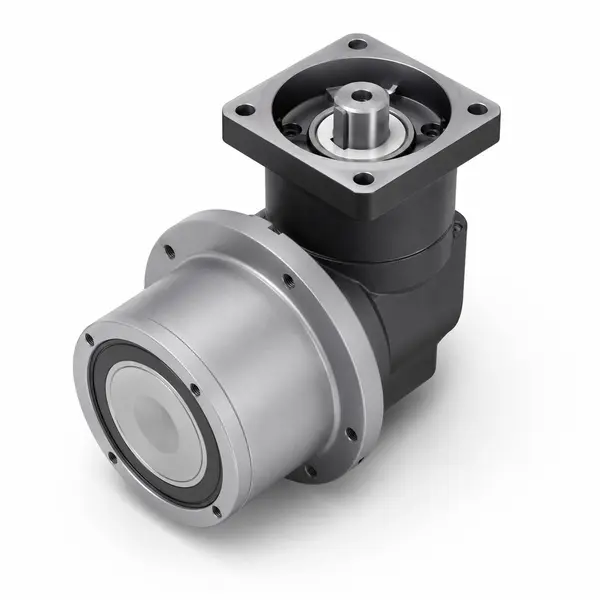
EP-FAB planetary gearbox installed in CNC 5-axis machining center rotary table — B/C-axis precision drive

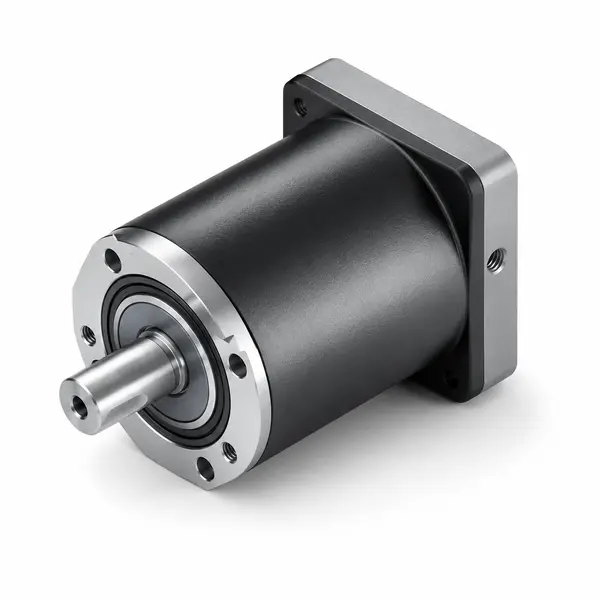
Korea Ever-Power EP-FAB/EP-FAD P0 planetary gearboxes — precision B/C-axis and trunnion drives for 5-axis machining centers

Modern 5-axis machining centers are specified by their rotary table positioning accuracy: typically ±2–5 arc-seconds on the best machines, dependent on the complete drive train from motor to table surface. The servo motor contributes its encoder resolution. The bearing contributes its runout. And the gearbox between them contributes its backlash — a dead zone of angular play that the servo controller must model, compensate for, and continuously re-learn as the gearbox wears and its backlash grows.

The practical consequence of P1 (≤3 arc-min) vs. P0 (≤1 arc-min) gearbox selection on a 630-mm pallet 5-axis machining center is not subtle. At a table radius of 315 mm, 1 arc-min of uncompensated backlash produces 0.0917 mm of positional uncertainty — roughly the difference between an H7 tolerance bore held and not held in production. When a machine builder installs a P1 gearbox on a B/C-axis to save cost, that saving evaporates within one customer acceptance test.

There is also a secondary failure mode that machine builders encounter 12–18 months into production: backlash growth. All planetary gearboxes experience some degree of backlash increase as gear tooth surfaces wear under load. A P1 gearbox starting at 2.8 arc-min may measure 4.5 arc-min after 8,000 hours of 2-shift production — a standard grade gearbox at that point, invisible to the servo controller, producing position errors that cannot be compensated away. A P0 gearbox starting at 0.8 arc-min has a much larger wear budget before it degrades to P1 level, and the individual unit backlash stamping from Korea Ever-Power means the exact starting value is documented for each unit — allowing maintenance teams to track actual backlash growth by measurement rather than estimating from general production statistics.

📐
The Backlash-to-Linear-Error Conversion
At table radius r, positional error from backlash θ (in arc-min) = r × tan(θ/3438). At r = 315 mm and θ = 1 arc-min: error = 315 × tan(0.000291 rad) = 0.0917 mm. At θ = 3 arc-min (P1 grade): error = 0.275 mm — outside H7 tolerance for bore diameters above 18 mm.

Backlash Grade Impact on Table Positioning Accuracy — Practical Comparison

The following comparison shows the achievable table-surface linear positioning accuracy for each backlash grade at a typical 315 mm table radius, with and without servo compensation. This data is based on customer acceptance test results reported across Korean and Japanese CNC machine builder applications.

P0 ≤1 arc-min (EP-FAB/FAD) — With servo compensation
±0.005 mm

P0 ≤1 arc-min (EP-FAB/FAD) — Without compensation
±0.09 mm

P1 ≤3 arc-min — With servo compensation
±0.05 mm

P1 ≤3 arc-min — Without compensation
±0.28 mm

Standard ≤8 arc-min (EP-FPG) — Economy conveyor use only
±0.75 mm

Bars represent relative positional capability (longer = better). Values at r = 315 mm table radius.

Application Scenarios

Six Specific CNC Applications — Which EP-Series for Each Drive Point

Korea Ever-Power EP-series planetary gearboxes are specified across the full range of precision CNC servo drive applications — from the most demanding 5-axis rotary table to high-volume ATC cycle drives and laser cutting gantries. Each drive point has different requirements. The correct series selection prevents over-specification (cost waste) and under-specification (quality failure).

⚙️
5-Axis B/C-Axis Rotary Table

The most demanding CNC planetary gearbox application. B and C-axis simultaneous contouring requires P0 backlash with zero backlash growth over 10,000+ operating hours. JIS Class-1 positioning tolerance — typically ±3 arc-seconds at the table surface — demands that the gearbox contribute ≤1 arc-min of the rotary error budget.

Korea Ever-Power EP-FAB P0 planetary gearbox (square flange, 9 frame sizes 042–220 mm) is the confirmed series. Grade-stamped on every unit, not batch sampled. The universal C1–C10 motor adapter system eliminates custom bracket design for Siemens 1FT6, Yaskawa Sigma-7, and Mitsubishi HG-SR motor families.

EP-FAB P0 / EP-FAD P0
042–220 mm
≤1 arc-min

🔄
Trunnion Drive (A/B-axis Tilt)

Trunnion-type 5-axis machining centers use a tilt axis to position the table at fixed angles — typically 0°, 45°, and 90° — for 5-sided machining. The tilt axis gearbox must hold position under cutting forces without backlash growth, as the axis is not continuously interpolated.

The round-flange bolt-circle interface on EP-FAD P0 planetary gearbox (047–255 mm) simplifies direct mounting to aluminium trunnion frames. 30,000 hr S5 design life is appropriate for the intermittent-duty tilt axis. Special ratios i=16 and i=61 cover non-standard tilt angle requirements.

EP-FAD P0
047–255 mm
30,000 hr

🔧
Automatic Tool Changer (ATC)

The ATC cam drive is a high-cycle application — on a production machining center, tool changes may occur 10,000–30,000 times per day. The gearbox must maintain P1 backlash through this fatigue regime without service interval requirements.

EP-FAB P1 (060–090 mm frame) is the standard selection. The C1–C10 motor adapter system means the servo motor specified for the ATC — often a smaller motor than the axis drives — can be accommodated without a custom adapter plate. NYOGEL 792D lifetime lubrication eliminates maintenance windows that interrupt production.

EP-FAB P1
060–090 mm
10,000+ cycles/day

📦
Pallet Changer Transfer Drive

The pallet changer on a horizontal machining center uses a rotary motion to transfer loaded pallets between the machining zone and the load/unload station. This layout requires a right-angle drive with a timing belt output — a layout that exactly matches EP-FALR.

EP-FALR P1 planetary gearbox (110–190 mm) provides right-angle output with integrated timing belt pulley — the perpendicular motor layout reduces the pallet changer footprint. Ratios to 40:1 cover the low-speed, high-torque pallet transfer requirement.

EP-FALR P1
Right-angle + belt pulley


Laser Cutting Gantry X/Y Axis

CNC laser cutting machines use belt-driven linear gantry axes with acceleration profiles above 2 g. The drive gearbox output shaft carries a timing belt pulley, generating large radial forces — up to 34,200 N on wide AT10 belts. A conventional gearbox + separate pulley hub creates hub-to-shaft eccentricity that causes a periodic position error at the pulley rotation frequency.

EP-FAL P0/P1 with integrated timing belt pulley eliminates this eccentricity entirely. One Korean CNC router OEM documented Y-axis periodic position error reduced from 0.08 mm to 0.015 mm after switching to EP-FAL — moving from grade C to grade A on the customer acceptance test.

EP-FAL P0/P1
F_rad to 34,200 N
Zero hub eccentricity

🪨
Stone / Wood CNC Router (Heavy Gantry)

Stone CNC machining centres and heavy-duty wood routers mount the motor behind the end plate — perpendicular to the direction of belt travel — to maximise working length. This corner-drive layout requires a right-angle gearbox with an integrated belt pulley output: EP-FALR.

EP-FALR P1 (150–280 mm, F_rad to 34,200 N) allows the motor to fold 90° behind the end plate, recovering 180+ mm of working length. IP65 sealing keeps stone slurry and wood dust out of the gear mesh. No external support bearing is required — F_rad capacity is rated at the integrated output bearing.

EP-FALR P1
150–280 mm
+180 mm working length

Technical Data

EP-Series CNC Application Specification — Complete Comparison Table

Use the table below to match your specific CNC drive point to the correct EP-series before requesting datasheets or contacting the engineering team.

Series Output Interface Frame Sizes P0 Backlash Max Torque Max rpm Life (hr) Primary CNC Application
EP-FAB Square flange — Inline 042–220 mm ≤1 arc-min 2,000 Nm 6,000 20,000 B/C-axis rotary table; ATC cam drive
EP-FABR Square flange — 90° R/A 042–220 mm ≤2 arc-min 2,000 Nm 4,000 20,000 Right-angle CNC axis; dial index tables
EP-FAD Round flange — Inline 047–255 mm ≤1 arc-min 2,000 Nm 10,000 30,000 Trunnion tilt axis; high-speed spindle servo
EP-FADS Direct-insert — No adapter plate 047–255 mm ≤1 arc-min 2,000 Nm 10,000 30,000 Fixed-motor axis; minimum axial length
EP-FAL Inline + integrated belt pulley 070–280 mm ≤1 arc-min 2,000 Nm 5,000 30,000* Laser/CNC gantry X/Y belt drive (inline motor)
EP-FALR 90° R/A + integrated belt pulley 070–280 mm ≤2 arc-min 2,000 Nm 4,000 30,000* Corner-drive gantry; stone/wood CNC; plasma cutter
EP-FPG Round housing — Economy 040–160 mm ≤8 arc-min 423 Nm 4,000 20,000* Chip conveyor; workpiece transfer (non-precision)

* FAL/FALR: 30,000 hr S5 intermittent; 15,000 hr S1 continuous. FPG: 20,000 hr S5; 10,000 hr S1.

When specifying against the table above, keep in mind that the design life figures for all premium EP-series (FAB through FALR) assume the rated load torque is calculated correctly — specifically, using mean load torque rather than peak torque. A B/C-axis rotary table that peaks at 180 Nm during aggressive 5-axis contouring but spends 70% of its operating time at 40 Nm mean load will have a service life 3–5× longer than a calculation based on peak torque alone. Korea Ever-Power engineering team can assist with L10h service life calculations for any duty cycle profile — include your motor rated torque, application duty cycle, and required service interval in your enquiry to the engineering team.

DIN Class 5
Gear Accuracy (5-axis CNC profile-ground)
≥97 %
1-Stage Transmission Efficiency
NYOGEL 792D
Lifetime Grease — No Re-Lube Interval
−10°C to +90°C
Operating Temperature Range
C1 –C10
Universal Motor Adapters

Engineering Insight

Inside the EP-FAB / EP-FAD — What Makes a P0-Grade CNC Gearbox Different
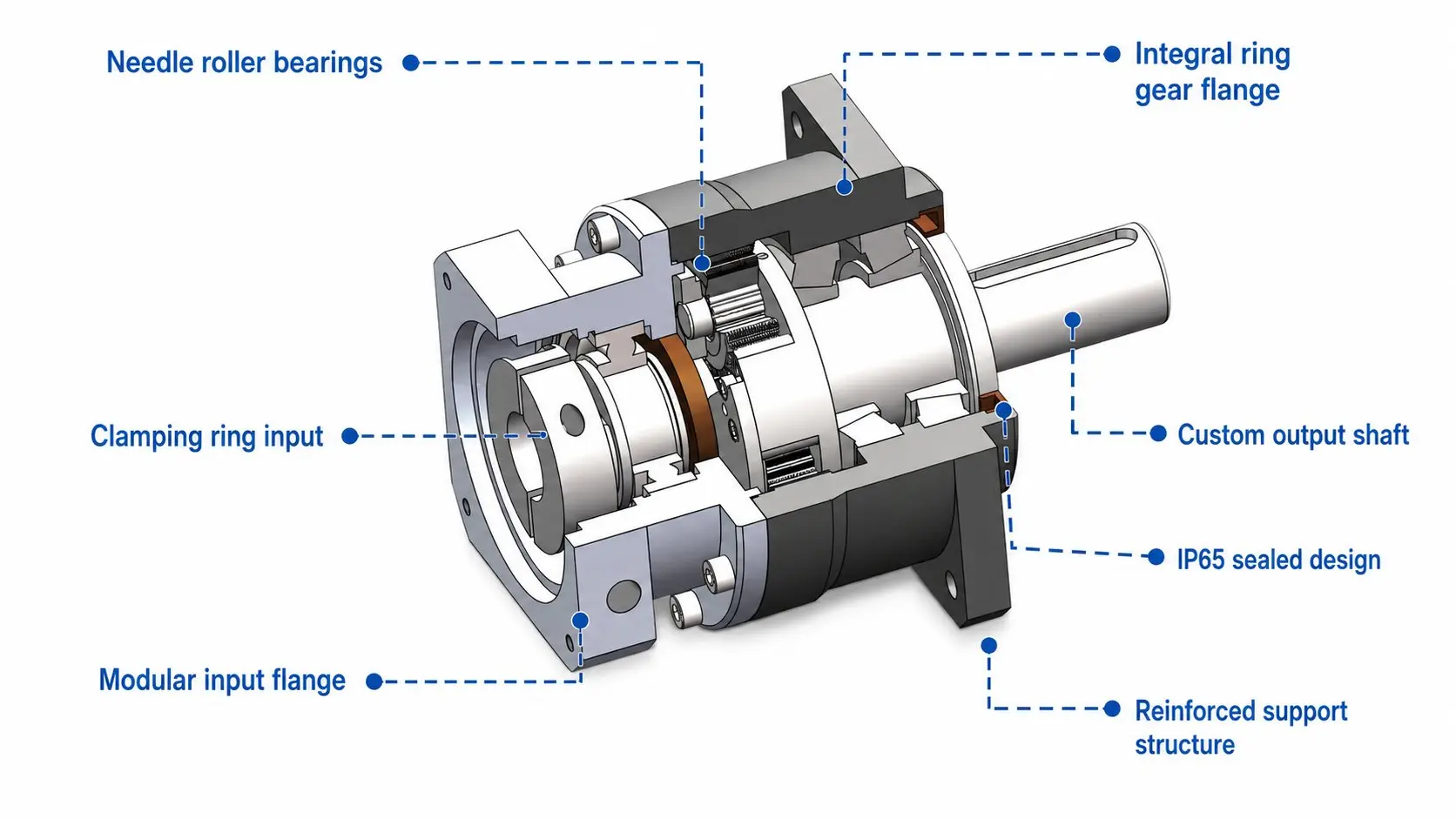
EP-FAB planetary gearbox internal structure — ring gear DIN 5 profile-ground planet gears sun gear output carrier bearing for CNC rotary table

Load Distribution
5-axis
CNC Profile Grinding
CMM
Housing Bore Check

Every unit is assembled from DIN Class 5 profile-ground gears, inspected on a CMM, and tested on a closed-loop servo dynamometer before backlash grade is stamped on the nameplate.

Five Internal Components That Determine CNC Gearbox Performance

Every EP-FAB and EP-FAD unit is built from the same five sub-assembly groups. The difference between a P0 grade and a P1 grade is not in materials — it is in the precision of manufacturing and the individual measurement and verification of each completed unit before shipment.

  1. 01
    Ring Gear (Annulus) — DIN Class 5, 5-axis CNC profile-ground

    Case-hardened alloy steel. Profile-ground to DIN Class 5 accuracy. The ring gear is the fixed outer element; its tooth geometry sets the backlash floor for the completed assembly.

  2. 02
    Planet Gears (3×) — 20CrMnTi helical-cut, case-hardened

    Three helical planet gears distribute the transmitted torque equally, tripling the effective contact area and producing the smooth, low-vibration transmission that CNC servo systems require.

  3. 03
    Sun Gear (Input) — Ground and lapped for precise pitch diameter

    The sun gear drives all three planets simultaneously via the clamp-ring motor adapter. Its pitch diameter, ground and lapped to tolerance, is the primary determinant of the completed assembly’s backlash grade.

  4. 04
    Output Carrier — CMM-inspected housing bore

    Every housing bore is checked on a CMM for alignment and parallelism before assembly — ensuring the carrier runs true and backlash is consistent across the rated load range.

  5. 05
    Output Bearing & IP65 Sealing — Pressure-tested on every unit

    Oversized angular-contact or cross-roller output bearing; IP65 dynamic seals on all interfaces; NYOGEL 792D synthetic grease. Every unit undergoes a 60-second pneumatic pressure decay test before shipping.

Selection Guide

CNC Gearbox Selection Decision Matrix — 5 Questions to the Right Series

This decision matrix covers the five selection dimensions that determine which EP-series is correct for your specific CNC drive point. Work through Q1 to Q5 in sequence — each question narrows the options before the next. For most CNC machining center applications, the decision tree leads to either EP-FAB or EP-FAD at P0 grade for the precision axes, EP-FALR for any gantry corner-drive, and EP-FAB or EP-FAD at P1 grade for the ATC and pallet transfer drives. The EP-FPG/FPGA economy series is appropriate for chip conveyor, coolant pump, and workpiece transport drives within the same machine — all of which can be qualified with the same C1–C10 motor adapter system as the precision axes, eliminating separate procurement workflows.

Selection Question
Your Answer → Series Implication
Recommended

Q1 — Output direction?
Coaxial (motor inline with output) → FAB / FAD / FADS / FAL / FPG  |  90° perpendicular → FABR / FADR / FALR
Inline or R/A

Q2 — Output interface?
Square bolt-pattern flange → FAB/FABR  |  Round bolt-circle flange → FAD/FADR/FADS  |  Timing belt pulley → FAL/FALR  |  Housing mount → FPG/FPGA
Flange / Pulley

Q3 — Backlash grade required?
≤1 arc-min P0 (JIS Cl-1 rotary tables, 5-axis contouring) → FAB / FAD / FADS / FAL  |  ≤2 arc-min (R/A, ATC, pallet transfer) → FABR / FADR / FALR  |  ≤8 arc-min (chip conveyors) → FPG
P0 / P1 / Std

Q4 — Design life requirement?
20,000 hr S1 → FAB / FABR (sufficient for most CNC axes)  |  30,000 hr S5 → FAD / FADR / FADS / FAL / FALR (high-cycle ATC, gantry belt drives)
20K or 30K hr

Q5 — Motor model: fixed or interchangeable?
Motor may change over machine life → FAD series (C1–C10 clamp-ring accommodates future motor changes)  |  Motor fixed AND axial length critical → FADS (direct insert, −22 mm axial vs. FAD+adapter)
FAD or FADS

💡
One Supplier Qualification Covers All 8 Series
The C1–C10 motor adapter ring system is validated once per motor model and applies across all EP-series in the same frame size. A motor adapter validated for EP-FAB090 fits EP-FAD090, EP-FADS090, EP-FAL090, and EP-FALR090 without modification. For CNC machine builders specifying multiple axis types, this eliminates repeated adapter qualification costs — a procurement process that typically takes 2–4 weeks per motor/gearbox combination at European supplier prices.

Manufacturing Quality

Korea Ever-Power Manufacturing — How DIN 5 Accuracy Is Verified in Ansan-si
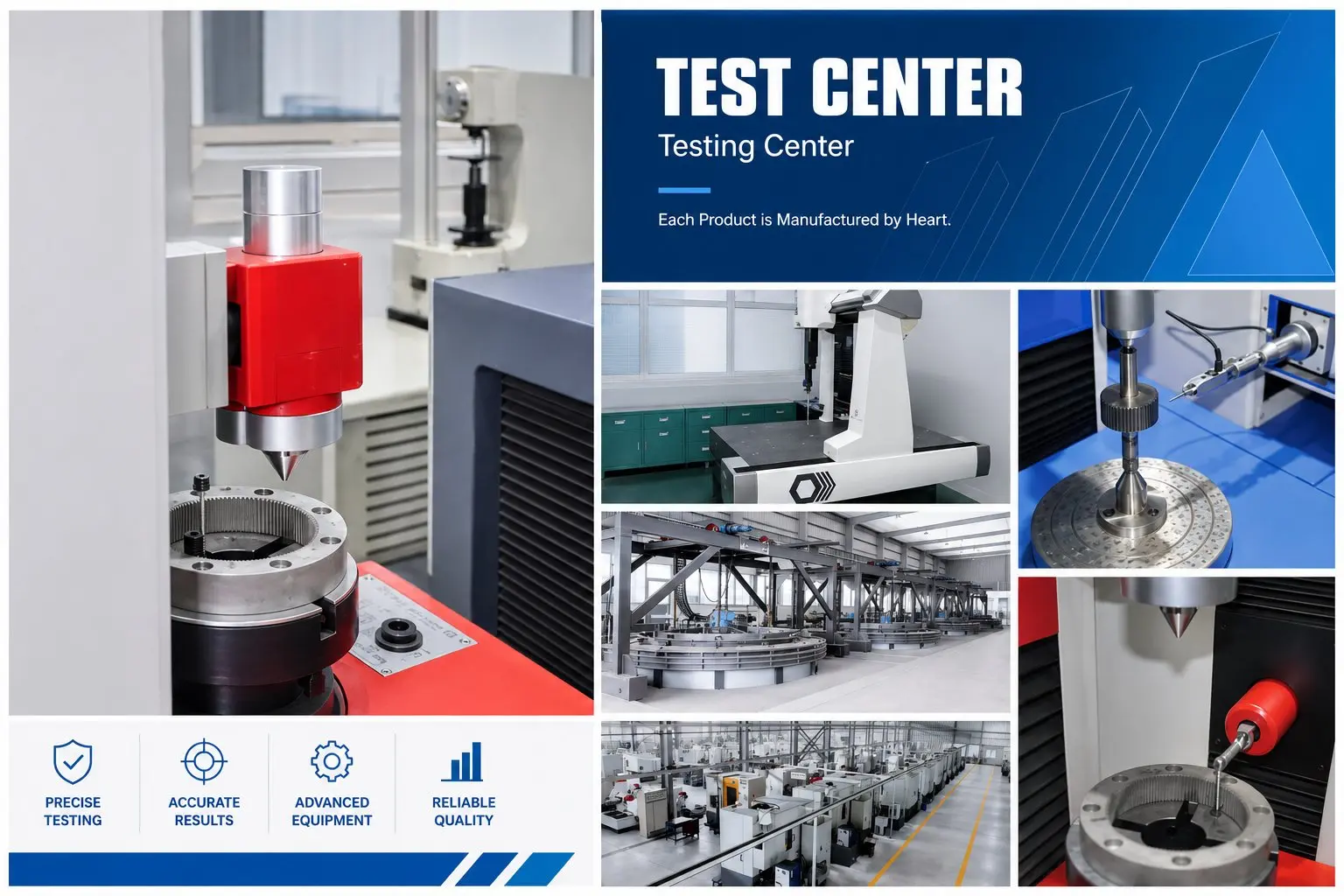
Korea Ever-Power servo gearbox test center — loaded noise testing and individual backlash measurement for CNC planetary gearbox production
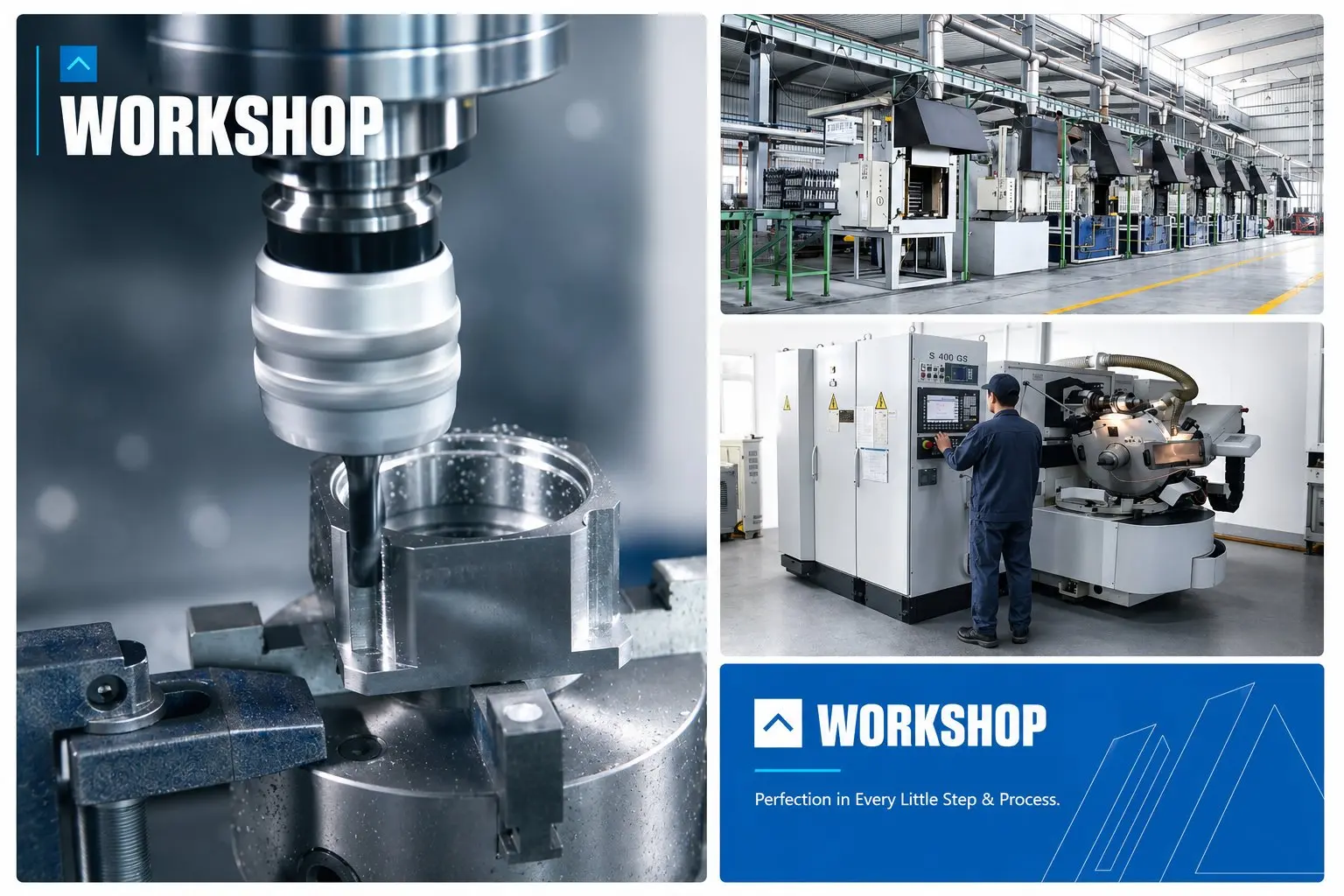
Korea Ever-Power precision manufacturing workshop — 5-axis CNC gear grinding for EP-FAB and EP-FAD planetary gearboxes

Above: test center (backlash measurement + IP65 pressure test) and precision gear-grinding workshop, Ansan-si, Korea.

Every EP-series planetary gearbox is manufactured at Korea Ever-Power’s production facility in Ansan-si, Gyeonggi-do, Korea — equipped with the same 5-axis CNC profile-grinding machines used by German and Japanese gear manufacturers.

The four production stages that distinguish a P0-grade Korea Ever-Power unit from a standard-grade alternative are: (1) 5-axis CNC profile grinding to DIN Class 5; (2) CMM housing bore inspection; (3) individual loaded noise and vibration testing on a closed-loop servo dynamometer; and (4) IP65 pneumatic pressure decay testing at every dynamic seal interface. Stage 4 is routinely skipped by competitors who sample-test only — Korea Ever-Power applies it to every unit.

The practical implication of stage 4 for CNC machining center builders is straightforward: a gearbox with a failed IP65 seal will allow coolant and chip fines to enter the lubrication chamber within 3–6 months of 3-shift operation. NYOGEL 792D synthetic grease is not water-soluble, but sustained coolant ingress dilutes the grease film and promotes corrosive pitting on gear tooth flanks — the initiation point for exponential backlash growth. A gearbox that passes IP65 testing on every unit, not on a sample of one per production batch, eliminates this failure pathway entirely.

The NYOGEL 792D lubrication used in all EP-FAB, EP-FAD, EP-FADS, EP-FAL, and EP-FALR series is rated for the full operating temperature range of −10°C to +90°C. It does not require a relubrication interval within the design life of the gearbox — the sealed, lifetime-filled chamber eliminates the periodic lubrication maintenance task entirely. This is a significant operational advantage for machine builders selling to automotive and aerospace customers whose maintenance programs cannot tolerate unscheduled gearbox service windows.

🔍
Individual Unit Backlash Stamping — Not Batch Sampling
Every EP-FAB/FAD/FADR unit is backlash-measured at 2% rated torque. The measured grade (P0, P1, or P2) is stamped on the nameplate. If a unit measures above P0 threshold during production, it is regraded — it does not ship as P0. This per-unit stamping is the same standard applied by Neugart and Apex Dynamics, at approximately 25–40% lower unit cost depending on series and frame size.

Korea Ever-Power EP-FAB/FAD vs. European Premium — Technical Attribute Comparison

Korea Ever-Power EP-FAB and EP-FAD are manufactured to the same technical specification as the European premium brands they replace. The comparison below is factual and technically verifiable. We do not claim to manufacture identical products; we claim to manufacture to the same governing standards.

Technical Attribute European Premium
(Apex, Neugart)
Korea Ever-Power
EP-FAB / EP-FAD
Korea Ever-Power
EP-FPG (Economy)
Gear accuracy class DIN Class 5 DIN Class 5 (5-axis CNC) DIN Class 6–7
Backlash verification Individual unit stamp Individual unit stamp Batch sample
P0 grade available Yes Yes (stamped per unit) No
Special ratios (i=21/31) Custom order only Standard catalogue No
IP65 testing Sample test Every unit IP64 (sample)
Motor adapter system Brand-specific C1–C10 universal C1–C10 universal
Relative unit price (P1) 100% (benchmark) ~60–75% ~35–50%

Korea Ever-Power does not sell counterfeit products and does not claim to manufacture products identical to named brands. Comparative data is based on publicly available specifications and customer substitution tests.

Customer Feedback

From CNC Machine Builders and End Users — What Changes When You Switch to EP-FAB/FAD

The following three case summaries are drawn from Korea Ever-Power customer applications in CNC machining, laser cutting, and precision milling. All performance data is reported by the customer.

★★★★★

“We replaced an EP-FAB090-P1 on our 5-axis PCB drilling machining center with EP-FAB090-P0 after a 12-month backlash growth issue. The P0 unit has now run 14 months of 3-shift operation with zero measured backlash growth. The motor adapter system saved 3 weeks of custom bracket procurement.”

K
Kim J., Senior Automation Engineer
Precision PCB Manufacturing Equipment OEM — Incheon
★★★★★

“On our CNC router Y-axis, we were getting a 0.08 mm periodic position error with EP-FAB110 plus a separate belt pulley hub. After switching to EP-FAL110, the error dropped to 0.015 mm. That one change moved us from grade C to grade A on our customer’s acceptance test. We’ve now standardised EP-FAL on all new gantry builds.”

H
Han J., Chief Application Engineer
CNC Router and Gantry Machine Manufacturer — Incheon
★★★★★

“We specified EP-FALR190 on a stone CNC machining centre where the motor folds behind the end plate perpendicular to gantry travel. The right-angle layout gave us 185 mm more working length. IP65 has been clean after 18 months — no stone slurry ingress, no seal maintenance required.”

K
Kim B., Machine Design Director
Stone CNC Machining Centre Builder — Gimhae

Complete Product Range

Browse the Full EP-Series — All Eight Planetary Gearbox Lines

Korea Ever-Power manufactures eight planetary gearbox series covering every servo integration scenario in CNC, robotics, semiconductor, packaging, and logistics automation — all from one supplier qualification.
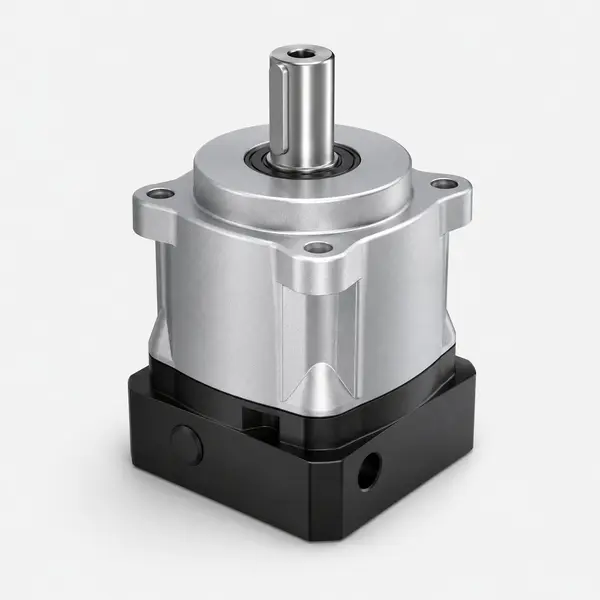
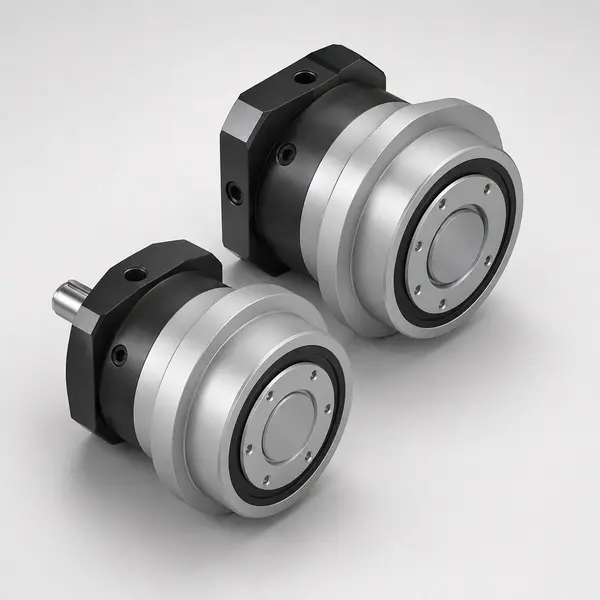
EP-FAB Series High Precision Square-Flange Planetary Gearbox for CNC rotary tables
EP-FAB Series
Square flange · Inline · P0 ≤1 arc-min · 042–220 mm · 2,000 Nm

View Series →

EP-FAD Series High Speed Round-Flange Planetary Gearbox for CNC trunnion and semiconductor
EP-FAD Series
Round flange · P0 · 047–255 mm · 10,000 rpm · 30,000 hr

View Series →

EP-FALR Series Right Angle Belt Pulley Planetary Gearbox for CNC gantry corner drive
EP-FALR Series
90° R/A + belt pulley · 070–280 mm · 180:1 · Stone/wood/laser gantry

View Series →

EP-FPG Economy Series Planetary Gearbox for CNC chip conveyors and AGV drives
EP-FPG / FPGA Series
Economy · Round/square housing · ≥97% eff. · Conveyors / AGV

View Series →

For the complete CNC servo drivetrain, Korea Ever-Power planetary gearboxes can be paired with precision CV joint drive shafts for flexible coupling between gearbox and table, or with worm gear reducers where a lower-cost secondary stage is appropriate for non-precision chip and coolant conveyor drives.

Start Your CNC Gearbox Specification

Get the Right Series, Grade and Frame Size for Your CNC Drive Point

Send our engineers your servo motor model, required torque, reduction ratio, and duty cycle. We respond within 24 business hours with a confirmed series recommendation, P0/P1 grade specification, motor adapter ring selection, and delivery lead time — at no charge and with no obligation to order.

Frequently Asked Questions

Planetary Gearbox for CNC Machining — Engineering FAQ

Technical questions most commonly asked by CNC machine builders and production engineers when specifying planetary gearboxes for rotary table, ATC, gantry, and multi-axis CNC applications.

What backlash grade do I actually need for a 5-axis CNC machining center B/C-axis rotary table?
+

For JIS Class-1 positioning accuracy on a B/C-axis rotary table — the standard required by most 5-axis machining center builders to pass customer acceptance testing — P0 (≤1 arc-min) is mandatory. At a table radius of 300–350 mm, 1 arc-min of backlash translates to approximately 0.087–0.102 mm of linear positioning uncertainty. Most customer acceptance specifications for 5-axis machining centers require ±0.005 mm or better with servo compensation, which is achievable only with a P0-grade gearbox providing the low backlash floor that the servo system can compensate around.

P1 (≤3 arc-min) is acceptable for ATC cam drives and pallet transfer mechanisms where the positioning requirement is less stringent (typically ±0.1 mm or greater). P2 (≤5 arc-min) is suitable for non-precision conveyor and chip-handling drives in the CNC environment.

Can I use EP-FAD instead of EP-FAB on a CNC rotary table, and what is the practical difference?
+

Yes — both EP-FAB and EP-FAD are available in P0 grade and both achieve ≤1 arc-min backlash. The practical difference is the output interface and design life:

EP-FAB: Square bolt-pattern flange output. Standard for machining center rotary table builders using bolt-circle square-flange table interfaces. 20,000 hr design life at S1 continuous duty. 6,000 rpm max input.

EP-FAD: Round bolt-circle flange output. Required for tables with round-flange interface standards (common in Japanese machine designs and trunnion-type tables). 30,000 hr design life. 10,000 rpm max input. Special ratios i=16/21/31/61/91 available in standard production for non-standard reduction requirements.

Why does the EP-FAL integrated belt pulley reduce periodic position error compared to a separate pulley hub assembly?
+

The periodic position error in a conventional gantry drive (gearbox output shaft + separate pulley hub + keyway + set screw) arises from dimensional tolerance stack between the output shaft and the hub bore — typically ±0.005–0.015 mm TIR — and any angular misalignment at the shaft-to-hub interface.

This eccentricity error appears in the gantry axis position feedback at the spatial frequency corresponding to one pulley revolution — hence the characteristic “periodic” nature of the error. At AT10 belt pitch and typical pulley sizes, this frequency falls within the bandwidth of the CNC interpolation algorithm, producing the banding pattern visible in machined surfaces.

In EP-FAL, the timing belt pulley bore IS the gearbox output shaft — there is no shaft-to-hub interface. The pulley teeth are concentric with the output bearing to ±0.003 mm TIR. This is why EP-FAL users report periodic position error reductions of 5–6× compared to the equivalent FAB + separate hub assembly.

How does the C1–C10 universal motor adapter system work, and which servo motor brands are covered?
+

The C1–C10 clamp-ring adapter system consists of a split clamp-ring collar machined to match the specific motor’s shaft diameter, shoulder diameter, and flange bolt pattern on one side, and the EP-series gearbox input bore and flange on the other side.

Covered motor families include: Siemens 1FT6, 1FK7, 1FT7; Yaskawa Sigma-5, Sigma-7, Sigma-X; Mitsubishi HG-SR, HG-KR, HG-RR; Panasonic MHMD, MHME; Bosch Rexroth MSK, MKD; ABB BSM, BSW; and several hundred additional frames from Lenze, Parker, Allen-Bradley, and Kollmorgen families.

Key procurement advantage: once a C-series adapter ring is validated for a given motor model, it fits the same frame size across all EP-series — FAB, FAD, FADS, FAL, FALR, and FPG. A CNC machine builder qualifying one motor model qualifies it for the complete EP-series range simultaneously.

What is the correct EP-series for a CNC gantry laser cutting machine with a corner-drive layout (motor behind the end plate)?
+

For a corner-drive gantry layout — where the servo motor is mounted perpendicular to the direction of belt travel (behind the gantry end plate) — the correct series is EP-FALR. This series provides a 90° right-angle output combined with an integrated timing belt pulley, so the motor can be oriented at 90° to the belt with no separate bevel stage or external pulley hub required.

The practical advantages for a CNC laser cutting machine are:

1. +180 mm working length: the motor folds behind the end plate, recovering the axial space that an inline motor + right-angle attachment would occupy.

2. F_rad up to 34,200 N: no external support bearing or pillow block required for the belt pulley shaft.

3. Ratios to 180:1 in a single unit: covers the full speed reduction requirement without a tandem gearbox stage. EP-FALR is available in frame sizes 070–280 mm; typical gantry laser applications use 110–190 mm frames at P1 grade.

Editor: Cxm