Planetary Gearbox for AGV & Warehouse Automation — Drive Wheel Integration, ≥97% Efficiency & Economy Pricing

≥97%
Efficiency — EP-FPG Series
38%
Motor Current Saving vs. Worm
≤56dB
Noise Level — EP-FPG040
IP64
Standard — IP65 Available
20,000hr
Design Life (S5 Intermittent)
C1–C10
Universal Motor Adapter

Engineering Context

Why AGV & Warehouse Automation Demands a Better Drive Gearbox Than Worm

EP-FPG planetary gearbox installed in AGV drive wheel — round housing press-fit into hub bore for warehouse logistics robot

Korea Ever-Power EP-FPG economy planetary gearbox — round housing press-fits directly into machined AGV wheel hub bore, eliminating adapter bracket and external bearing housing

Modern warehouses operate AGV and AMR fleets at scales that would have been impossible a decade ago: 500 to 2,000 drive units per 100,000 m² distribution centre, running three shifts, seven days a week. At this scale, the choice of drive gearbox is no longer a component-level decision — it is a total-cost-of-ownership calculation. A gearbox that draws 38% more motor current than necessary, runs at 10 dB higher noise than necessary, and requires a mounting adapter bracket that adds two additional failure interfaces is not merely inconvenient — it is a quantifiable drain on operating economics that compounds across every drive point in the fleet.

The root of this problem is the worm gearbox. Worm reducers remain the default choice for AGV drive units in lower-tier automation because they are cheap and familiar. But the physics of worm gearing imposes an efficiency ceiling of approximately 65%, and often lower — the sliding contact between the worm shaft and worm wheel converts a significant fraction of motor torque into heat rather than traction force. In a single AGV drive unit, this efficiency difference is small. In a 240-unit conveyor installation, Korea Ever-Power has documented a 38% reduction in measured motor current per drive point when EP-FPGA economy planetary gearboxes replaced worm reducers — a result that directly translates to reduced battery capacity requirements, longer battery run time between charges, and lower electricity cost at the infrastructure level.

The noise argument compounds the economic one. Worm gearboxes in typical warehouse automation run at 60–70 dB under load. EP-FPG040 has been measured at ≤56 dB at rated load. This difference matters because modern warehouse regulations in Korea and the EU increasingly cap operational noise levels in human-collaborative zones — the same areas where AGVs and AMRs operate alongside workers. A gearbox that allows the noise limit to be met without acoustic enclosures eliminates a class of compliance cost entirely.

The 240-Unit Installation: Documented Efficiency Gain
A Korean logistics integrator replaced worm gearboxes with EP-FPGA economy planetary gearboxes across a 240-unit conveyor installation. Measured result: 38% lower motor current per drive point. Gearbox unit cost saving: 18% vs. EP-FAB baseline. Total installation payback on energy savings: under 14 months at KRW 120/kWh industrial tariff. The round-housing press-fit into the existing hub bores required zero machining changes — only adapter brackets were eliminated.

EP-FPG Planetary vs. Worm Gearbox — Head-to-Head Performance Comparison

The following comparison covers the six performance dimensions that determine AGV drive gearbox total cost of ownership. All data is based on verified specifications (EP-FPG040 datasheet) and the documented 240-unit conveyor installation result for the efficiency figure.

Transmission Efficiency

EP-FPG (Planetary)

≥97%

Worm Gearbox (typical)

≤65%

Operating Noise Level
Lower bar = quieter

EP-FPG040 (measured)

≤56 dB

Worm Gearbox (typical)

60–70 dB

Motor Current Draw
Lower bar = less current (better)

EP-FPG (documented)

Baseline

Worm Gearbox (documented)

+38%

Backlash (Position Accuracy)
Higher bar = tighter (better)

EP-FPG (≤8 arc-min grade)

≤8 arc-min

Worm Gearbox (typical)

10–20 arc-min

Unit Cost (Relative)
Lower bar = cheaper (better)

EP-FPG/FPGA Economy

~48% of FAB

Low-grade Worm (Chinese)

Comparable

Hub Integration (Mounting Parts)
Lower bar = fewer parts (better)

EP-FPG (press-fit housing)

1 part

Worm + adapter bracket

3–4 parts

Efficiency and noise data: EP-FPG040 verified datasheet values. Motor current saving: documented 240-unit Korean logistics installation. Cost data: relative to EP-FAB P1 baseline at equivalent torque class. Worm gearbox data: representative Chinese OEM market specification.

Application Scenarios

Six AGV & Warehouse Drive Applications — Series, Spec, and Why

AGV and warehouse automation spans a wide range of drive architectures — from indoor flat-floor traction wheels and differential steering to AS/RS stacker crane travels and high-speed sortation divert drives. Each application has a distinct torque, speed, mounting geometry, and backlash requirement. The six scenarios below cover the main drive types encountered in Korean and international warehouse automation projects.

01 — Indoor AGV Traction Drive
Flat-floor differential or single-axis drive wheel
EP-FPG
Frame 040–120 mm
≤8 arc-min

The EP-FPG round housing is machined to press-fit directly into the AGV wheel hub bore — eliminating the adapter bracket, separate bearing housing, and two additional assembly torque joints that are standard with worm gear motor packages. Ratio range 10–50:1 covers the full AGV speed range at 3,000–4,000 rpm input.

Key spec: ≥97% efficiency; ≤56 dB noise; CASTROL LMX sealed lifetime grease; 20,000 hr S5 design life. C1–C10 universal motor adapter fits all servo motor brands in a single qualification.

02 — AMR Omnidirectional Drive
Autonomous mobile robot multi-wheel navigation unit
EP-FPG
Frame 040–080 mm
10–30:1 ratio

AMR platforms with 4–6 independently driven wheels require gearboxes that fit within the compact wheel pod envelope. The FPG040 and FPG060 round housings press-fit into 40 mm and 60 mm hub bores, enabling wheel pod designs that are 18–22 mm shorter axially than equivalent worm-motor packages. Low noise is critical in human-collaborative AMR zones.

Key spec: ≤56 dB (FPG040); compact round housing; 4,000 rpm max input; IP64 standard (IP65 option for spray cleaning environments).

03 — Conveyor Indexing Drive
Accumulation zone, pallet roller, flat-belt conveyor
EP-FPGA
Frame 060–120 mm
10–50:1 ratio

The EP-FPGA square-housing variant mounts flat against conveyor frame faces and end plates — zero adapter required, four bolt holes, standard bolt circle. In the documented 240-unit installation, FPGA replaced worm gear motors on all accumulation zone drives: unit cost saving 18% vs. EP-FAB; energy saving 38% per drive point; noise reduced 10–14 dB.

Key spec: Square housing flat-mount; 423 Nm max output torque; IP64 standard; CASTROL LMX lifetime grease; 20,000 hr S5 life at 3,000 rpm input.

04 — Sortation Conveyor Divert Drive
High-volume parcel routing deflector or pop-up wheel
EP-FPG P2
Frame 040–080 mm
10–30:1 ratio

Sortation divert drives cycle at 60–120 operations per minute in high-volume e-commerce fulfilment centres. The key requirement is fatigue life at high cycle count combined with economy pricing at volumes of 500–2,000 units per site. EP-FPG P2 grade (≤5 arc-min) meets the positioning requirement for divert accuracy, and economy pricing enables cost-effective OEM volume sourcing.

Key spec: High-cycle fatigue life; long maintenance interval; C1–C10 motor adapter for multi-supplier motor compatibility; IP64; economy OEM volume pricing available.

05 — AS/RS Stacker Crane Travel
High-rack X/Y travel drive — multi-shift duty
EP-FAD P1
Frame 110–180 mm
30,000 hr life

AS/RS stacker cranes run 3-shift continuous at high duty cycle — the X-axis travel motor drives a rack-and-pinion system through the gearbox, and the Y-axis (lift) similarly. The design life requirement is 30,000 hours (S1 continuous), which EP-FAD meets. Low noise is required for warehouse environments adjacent to picker areas. Ratio 10–40:1 covers the full travel speed range.

Key spec: 30,000 hr S1; ≤3 arc-min P1; round-flange direct mount; 10,000 rpm max input (EP-FAD); NYOGEL 792D lifetime lubrication; IP65.

06 — Shuttle & Dense Storage Drive
Narrow-aisle pallet shuttle — high-density racking
EP-FPG
Frame 060–100 mm
20–50:1 ratio

Pallet shuttle systems operate within narrow aisle rails where axial gearbox length is critical — every millimetre of gearbox overhanging the wheel centreline reduces the usable aisle width or requires wider rail spacing. The FPG round housing presses directly into the wheel bore, keeping the drive assembly compact. Economy pricing enables cost-effective deployment at 100–500 units per warehouse system.

Key spec: Compact round housing; low noise ≤56 dB; economy tier; minimal maintenance interval; IP64 for dusty racking environment; C1–C10 adapter.

Technical Specifications

EP-FPG / EP-FPGA Series Specification for AGV & Logistics Applications

The EP-FPG (round housing) and EP-FPGA (square housing) are economy-tier planetary gearboxes designed for high-volume OEM applications where P0/P1 precision is not required but transmission efficiency, noise, mounting geometry, and maintenance interval are key selection factors. Both share the same gear train, lubrication, and motor adapter system as the precision EP-FAB/FAD series.

Parameter EP-FPG
(Round Housing)
EP-FPGA
(Square Housing)
AGV Application
Relevance
Frame Sizes 040, 060, 080, 100, 120, 160 mm 040, 060, 080, 100, 120, 160 mm FPG040/060 for small AMR wheels (75–120 mm dia); FPG080/100 for standard AGV wheels (150–200 mm dia)
Output Torque (Max) 14–423 Nm (by frame size) 14–423 Nm (by frame size) 200–300 Nm covers most AGV drive wheels up to 500 kg payload per wheel
Backlash Grade ≤8 arc-min (std) / ≤5 arc-min (P2) ≤8 arc-min (std) / ≤5 arc-min (P2) Sufficient for closed-loop position control with servo encoder correction; not required for P0 unless ±0.1° stop accuracy specified
Efficiency ≥97% ≥97% vs. ≤65% worm; enables 38% motor current reduction per drive point
Noise Level ≤56 dB (FPG040) ≤58 dB (FPGA040) Meets EU warehouse noise limit for human-collaborative zones; eliminates need for acoustic enclosures
Max Input Speed 4,000 rpm 4,000 rpm Supports servo motors up to 4,000 rpm; 3,000 rpm typical for AGV traction
Ratio Range i = 3, 4, 5, 7, 10, 14, 20, 25, 30, 35, 40, 50, 70, 100:1 Same as FPG i=10–50:1 covers all AGV/AMR traction and conveyor speed ranges in single-stage configuration
Design Life 20,000 hr (S5 intermittent) 20,000 hr (S5 intermittent) Equivalent to ~10 years at 6 hr/day AGV duty; 20,000 hr S5 = 10,000 hr S1 continuous
IP Rating IP64 standard / IP65 option IP64 standard / IP65 option IP64 sufficient for standard warehouse; IP65 for washdown cleaning environments
Lubrication CASTROL LMX sealed lifetime fill CASTROL LMX sealed lifetime fill Zero relubrication maintenance within design life; no scheduled lube service required
Motor Adapter C1–C10 Universal C1–C10 Universal One adapter qualification fits Siemens, Yaskawa, Mitsubishi, Panasonic, Bosch — all brands across all 8 series
Housing Interface Round — press-fit into hub bore Square — flat bolt-pattern mount FPG round: zero adapter bracket for AGV wheel integration. FPGA square: flat-mount on conveyor frames and end-plates
Operating Temperature 0°C to +90°C (CASTROL LMX) 0°C to +90°C Note: minimum 0°C — for cold storage warehouses (−20°C), specify NYOGEL 792D grade with −10°C lower limit or confirm cold-rated option

FPG040–160
6 Frame Sizes
14–423 Nm
Output Torque Range
≥97%
Efficiency (Helical Planetary)
≤56 dB
Noise (FPG040 Rated Load)
C1–C10
Universal Motor Adapter
IP64 / IP65
Standard / Option

Engineering Insight

Inside the EP-FPG/FPGA — What Separates Economy Planetary from Economy Worm
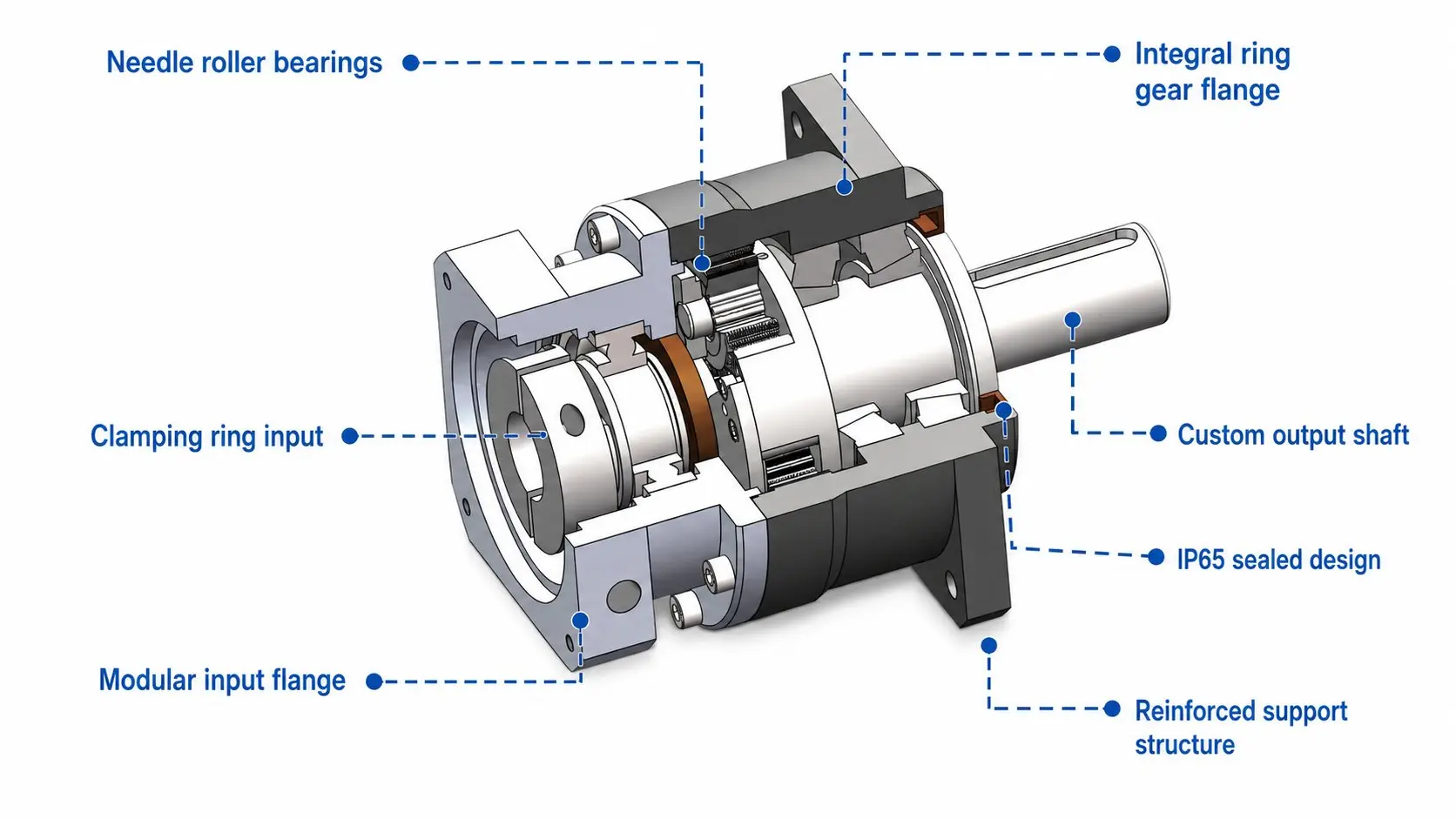
EP-FPG economy planetary gearbox internal structure — helical planet gears CASTROL LMX lubrication round housing for AGV drive wheel

Planet Gear Load Share
≥97%
Helical Efficiency
DIN 6–7
Gear Accuracy Class

The EP-FPG/FPGA gear train uses ground helical planet gears (DIN Class 6–7) — the same helical cutting geometry as the premium FAB/FAD series, at economy-tier pricing. This is the mechanical basis for the efficiency and noise advantage over worm gear reducers.

Four Design Decisions That Make EP-FPG Different from a Worm Reducer

The price of an EP-FPG at economy tier is comparable to a Chinese worm gear motor package. The engineering difference is that the EP-FPG uses helical planetary gearing rather than worm-and-wheel sliding contact. This single design decision produces the efficiency, noise, and backlash advantages documented above — and those advantages accumulate across every drive point in a large fleet deployment.

  1. 01

    Helical Planet Gears (3×) — DIN Class 6–7, Ground

    Three helical planet gears distribute the transmitted torque equally via rolling contact — not sliding contact as in worm gearing. Rolling contact at helical angles produces ≥97% transmission efficiency. The DIN 6–7 ground accuracy keeps noise at ≤56 dB even in the smallest FPG040 frame.

  2. 02

    Round Housing (FPG) — Press-Fit into Wheel Hub Bore

    The FPG housing outer diameter is machined to press-fit directly into a standard wheel hub bore — 40 mm OD for FPG040, 60 mm for FPG060, and so on through FPG160. No adapter bracket, no separate bearing housing, no external bolted interface between gearbox and wheel. This eliminates three parts, three assembly torque points, and three additional wear surfaces from the drive assembly.

  3. 03

    CASTROL LMX Sealed Lifetime Lubrication

    CASTROL LMX synthetic grease is rated for 0°C to +90°C continuous service. The sealed housing means zero relubrication maintenance within the 20,000-hour design life. In a 500-unit AGV fleet, this eliminates a scheduled maintenance task that would otherwise require fleet downtime and technician time on a 6–12-month interval across every gearbox.

  4. 04

    C1–C10 Universal Motor Adapter — One Qualification, All Series

    The C1–C10 clamp-ring motor adapter system is identical across all 8 EP-series — EP-FAB, EP-FAD, EP-FPG, EP-FALR, and the rest. An AGV OEM that qualifies a Yaskawa servo motor with EP-FPGA can use the same adapter with EP-FAD if they later upgrade the precision specification without re-engineering the motor interface. One qualification covers the full product range.

Selection Guide

AGV Gearbox Selection Decision Matrix — 5 Questions to the Right Series

For most AGV and warehouse automation applications, the selection decision is between EP-FPG (round housing), EP-FPGA (square housing), and EP-FAD P1 (for AS/RS precision axes). Work through these five questions in sequence. For fleets above 50 units, volume pricing applies — contact Korea Ever-Power with your BOM for an OEM pricing schedule.

Selection Question
Your Answer → Series Implication
Recommended

Q1 — Backlash requirement?
Closed-loop servo with position correction (≤8 arc-min OK) → FPG/FPGA  |  ±0.1° stop precision (≤5 arc-min) → FPG P2  |  High-precision AS/RS travel (≤3 arc-min) → EP-FAD P1  |  CNC/robot precision not relevant for AGV → eliminate P0
FPG / FAD

Q2 — Housing geometry?
Press-fit into wheel hub bore → EP-FPG (round)  |  Flat-mount on frame face or conveyor end-plate → EP-FPGA (square)  |  Flange-mount (robot or AS/RS crane) → EP-FAD (round bolt-circle)  |  Right-angle layout → EP-FABR
FPG / FPGA

Q3 — Output torque range?
Up to 423 Nm → FPG/FPGA (sufficient for AGV wheels up to ~500 kg payload per wheel)  |  Above 423 Nm → step up to EP-FAB P1 (2,000 Nm max) for heavy conveyor or high-payload AGV
FPG → FAB

Q4 — Environment?
Standard indoor warehouse → FPG/FPGA IP64 standard  |  Daily washdown or outdoor yard → specify IP65 option  |  Cold storage below 0°C → confirm cold-rated NYOGEL or specify EP-FAD (NYOGEL 792D rated to −10°C)  |  Food-grade cleanroom → EP-FAD P1 with NYOGEL 792D
IP64 / IP65

Q5 — Volume / pricing tier?
Prototype / small batch (1–10 units) → standard pricing, FPG040–160 from stock  |  OEM project (50+ units) → request volume pricing schedule with BOM  |  Large fleet (200+ units) → contact [email protected] with motor model + wheel bore diameter for OEM pricing and C-adapter specification
OEM Pricing

Manufacturing Quality

Korea Ever-Power Production — Why Economy Tier Still Means Every-Unit Testing
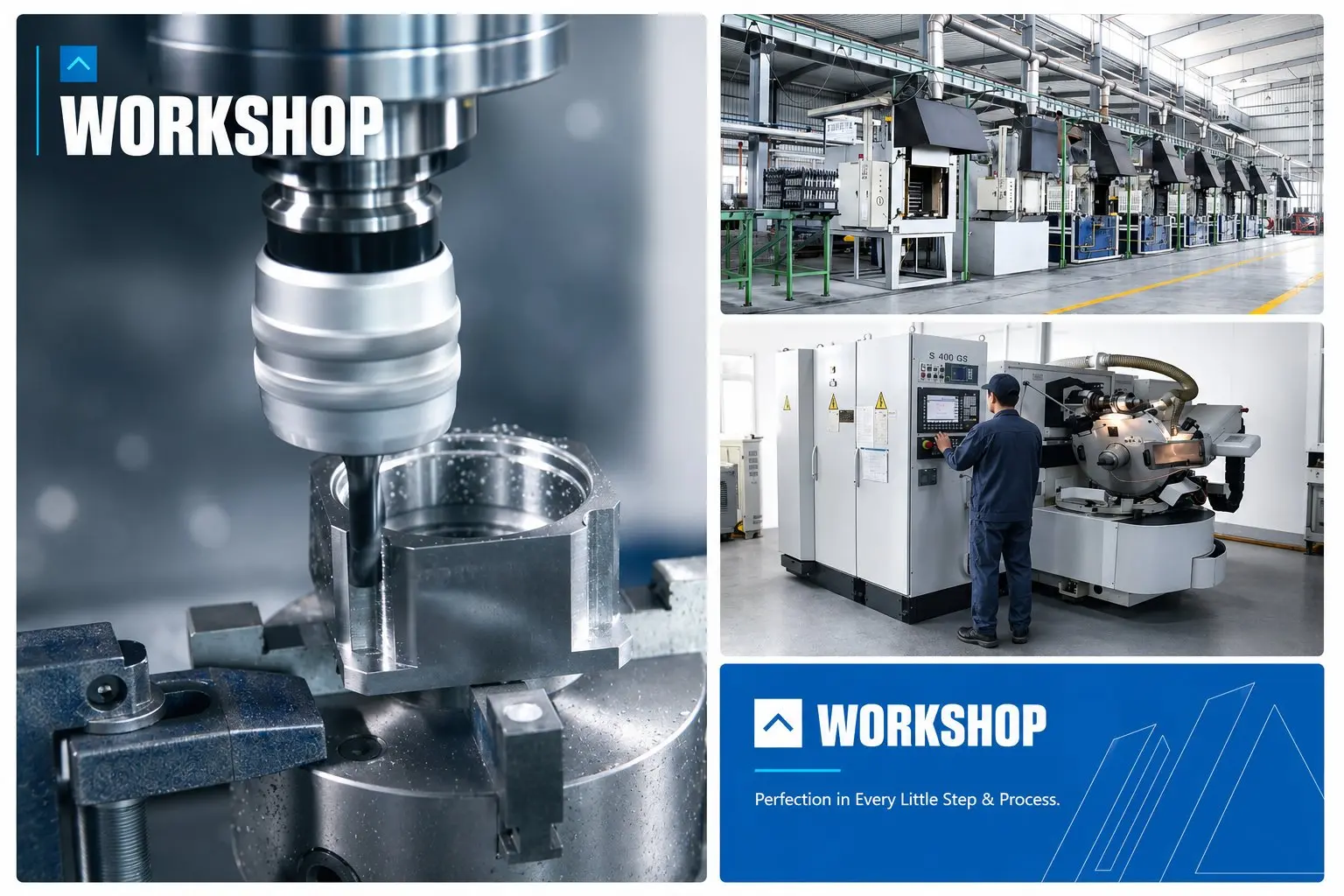
Korea Ever-Power precision manufacturing workshop — gear grinding and assembly for EP-FPG economy planetary gearbox series
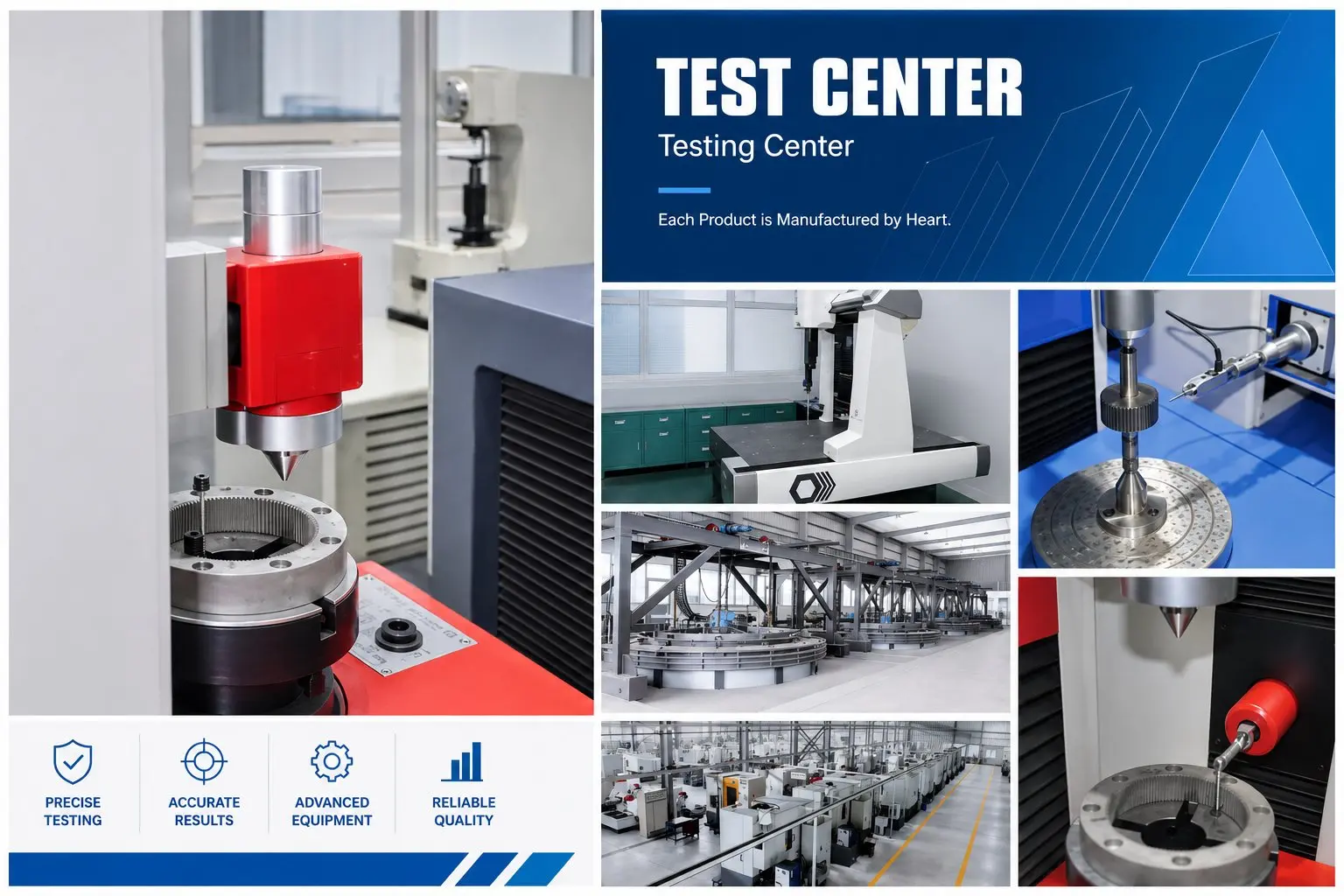
Korea Ever-Power test center — backlash measurement and IP seal pressure testing for EP-FPG economy planetary gearbox production

Above: gear manufacturing workshop and test centre at Korea Ever-Power facility, Ansan-si, Gyeonggi-do. Both the precision EP-FAB/FAD and economy EP-FPG/FPGA lines are produced and tested on the same floor.

The distinction between economy tier and precision tier at Korea Ever-Power is in gear accuracy class and backlash grade — not in manufacturing process discipline. The EP-FPG/FPGA series is produced on the same gear-grinding machines, in the same facility in Ansan-si, Gyeonggi-do, Korea, that produces the premium EP-FAB/FAD series. The same CMM inspection, the same IP seal pressure testing, and the same test-center noise and vibration measurement apply to every unit.

For AGV and warehouse automation OEMs, this matters in two concrete ways. First, IP64 on every unit (not a batch sample) means that a leaked gearbox in a warehouse floor environment — where motor current monitoring and temperature telemetry typically flag failure well after actual ingress has begun — is not a production process variability event. Every unit was pressure-tested before shipment. Second, the backlash grade is measured and documented on each unit’s test record, making traceability available for any warranty or commissioning audit.

Chinese worm gear motors that compete on price in this segment typically do not perform individual unit IP testing — they batch-sample. They do not document individual backlash measurements — they specify a nominal grade with no per-unit data. For an AGV fleet deployed across multiple warehouse sites, and returned to service after any repair, the absence of per-unit documentation creates a class of maintenance complexity that Korea Ever-Power’s production standard eliminates at the point of manufacture.

🔧
Economy Tier ≠ Sample Testing — Every EP-FPG Unit Is IP-Tested
Korea Ever-Power applies IP64 pneumatic pressure decay testing to every EP-FPG/FPGA unit before shipment. This is the same test applied to the premium EP-FAB/FAD series (which is tested to IP65). The FPG economy tier trades gear accuracy class (DIN 6–7 vs. DIN 5) and backlash grade (≤8 arc-min vs. ≤1 arc-min) — not production discipline. An AGV integrator specifying FPG on a 200-unit project receives 200 individually pressure-tested units, not a consignment batch-sampled from a statistical population.

EP-FPG/FPGA vs. Chinese Worm Gearbox — Technical Attribute Comparison

The following comparison is factual and based on verified specifications. It is intended to help AGV and warehouse OEM engineers communicate the total-cost-of-ownership case for planetary over worm to procurement teams working from a unit-price-only evaluation.

Attribute Chinese Worm Gearbox
(OEM Market Typical)
Korea Ever-Power
EP-FPG / EP-FPGA
Fleet Impact
(200-unit scale)
Transmission type Worm-and-wheel (sliding contact) Helical planetary (rolling contact) Rolling contact = ≥97% eff.; sliding contact = ≤65% eff.
Efficiency ≤65% ≥97% 38% motor current saving per drive × 200 units = significant operating cost reduction
Noise 60–70 dB ≤56 dB (FPG040) 10–14 dB quieter; meets EU warehouse noise limit without acoustic enclosures
Backlash 10–20 arc-min (batch) ≤8 arc-min (per unit) Tighter backlash reduces servo correction demand; per-unit measurement enables warranty traceability
IP testing Batch sample (typical) ✓ Every unit tested Eliminates IP-failure variability across fleet; supports tier-1 supplier audit requirements
Hub integration Requires adapter bracket Press-fit into hub bore (FPG) Eliminates adapter bracket: 3 fewer parts, 2 fewer assembly torque checks per drive unit
Motor adapter system Motor-specific only C1–C10 universal (all series) Single motor qualification covers FPG through FAB; no re-tooling if series upgraded later
Relative unit price ~90–100% of FPG Comparable at volume At comparable unit price, the FPG provides 32% more efficiency, 10–14 dB less noise, and individual IP testing

Korea Ever-Power does not manufacture worm gearboxes and does not claim to manufacture products identical to named brands. Comparative data is based on publicly available specifications and documented customer installation results.

Customer Feedback

What AGV and Logistics Automation Engineers Say

★★★★★

“We replaced worm gear drives on 240 conveyor zones with EP-FPGA. The measured motor current dropped by 38% at each drive point — that translated directly to smaller inverter sizing on the project. The round-housing press-fit eliminated the adapter bracket entirely: faster assembly, fewer parts in BOM, and no torque-check maintenance on the bracket bolts. We also saw the noise floor drop by 12 dB across the conveyor area.”

KL
Kim J., Lead Engineer
Logistics Systems Integrator — Incheon, Korea

★★★★★

“Our AMR fleet deploys EP-FPG060 in the drive wheel pod. The compact round housing press-fits into our 60 mm hub bore — the wheel pod axial length is 18 mm shorter than our previous design with a worm motor package. That extra 18 mm matters for our narrow-aisle navigation margins. At ≤56 dB noise we meet the EU human-collaborative zone regulation without any additional acoustic treatment.”

PW
Park W., AMR Platform Designer
Mobile Robotics OEM — Suwon, Korea

★★★★★

“For our AS/RS stacker crane X/Y travel, we use EP-FAD P1 — the 30,000-hour S1 design life was the deciding factor. At 3-shift continuous operation the crane runs ~6,500 hours per year. EP-FAD P1 gives a projected 4.6-year interval to first service inspection, which aligns with our planned maintenance calendar. The C1–C10 motor adapter made Yaskawa qualification straightforward with the same tooling we already use on our packaging line FAB series.”

CJ
Choi J., Mechanical Systems Lead
AS/RS Crane Manufacturer — Changwon, Korea

Related Products & Upgrade Path

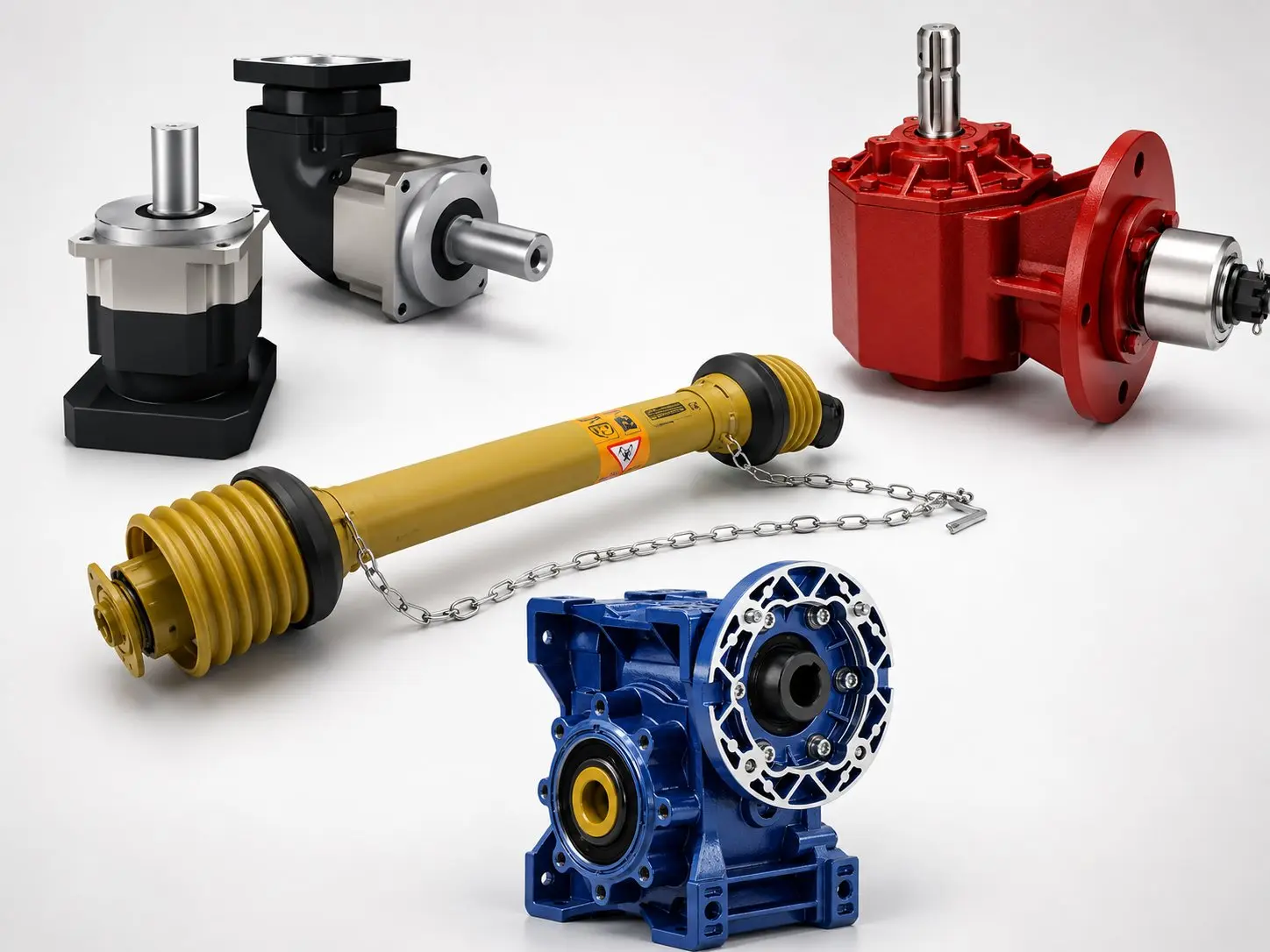
Korea Ever-Power EP series planetary gearbox product range — FPG economy through FAB FAD precision series

Most AGV and warehouse automation projects begin with EP-FPG/FPGA economy series for the main drive wheel and conveyor axes. As requirements evolve — for example, when adding high-precision pick-and-place arms to an AGV, or upgrading to a higher-specification AS/RS crane — the same C1–C10 motor adapter qualification covers the upgrade path to EP-FAD P1 or EP-FAB P0 without any motor interface re-engineering.

For conveyor systems with right-angle motor layouts, the EP-FABR series provides up to 200:1 in a single unit with a square-flange 90° output. For robot-arm options on mobile platforms, see the full EP series product range. External reference: for CV joint and driveshaft components in heavy AGV applications, see cvjointdriveshaft.com.

Frequently Asked Questions — AGV Drive Gearbox Selection

Why is a planetary gearbox more efficient than a worm gearbox for AGV drive wheels?
Worm gearboxes transmit torque via sliding contact between the worm shaft and worm wheel — a type of contact that generates significant heat and has an inherent efficiency ceiling around 65% at best (and often lower depending on lead angle and lubrication condition). Planetary gearboxes transmit torque via rolling contact between helical planet gears and the ring gear — a contact geometry that generates far less heat and achieves ≥97% transmission efficiency. In a single drive unit the difference translates to 38% less motor current for the same output torque. In a fleet of 200 AGV drive units, this difference determines whether you can reduce battery capacity, motor sizing, or both — all of which affect the total system cost beyond the gearbox unit price.
What does “round housing press-fit into wheel hub bore” mean in practice?
The EP-FPG housing outer diameter is machined to an exact fit tolerance — for example, FPG060 has a 60 mm OD machined to an h6 tolerance, which press-fits into a hub bore machined to H7. No separate adapter bracket, no additional bearing housing, and no through-bolts between the gearbox flange and the wheel structure. The gearbox body is the wheel hub bearing surface. This eliminates between two and four parts from the wheel drive assembly (bracket, bracket bolts, separate bearing housing, housing-to-bracket fasteners), reduces assembly time, eliminates two scheduled torque-check maintenance intervals for the bracket fasteners, and reduces the axial envelope of the drive pod by 15–22 mm depending on the previous design. The output shaft engages the wheel bore directly via a keyway or spline.
Is the EP-FPG suitable for cold storage warehouse environments (−20°C)?
Standard EP-FPG/FPGA units use CASTROL LMX grease, rated for a minimum operating temperature of 0°C. For cold storage applications at −10°C to −30°C, Korea Ever-Power recommends specifying the EP-FAD P1 series with NYOGEL 792D lubrication, which is rated to −10°C. For deep-freeze environments below −10°C, contact [email protected] for a cold-rated grease specification — the sealed housing and DIN 6–7 gear accuracy remain unchanged, only the lubricant grade is substituted. Do not operate a standard CASTROL LMX-filled unit below 0°C without confirming the low-temperature viscosity specification with the application engineering team.
How does the C1–C10 motor adapter work across different servo motor brands?
The C1–C10 designation refers to ten standard motor pilot diameter and bolt-circle combinations that cover the vast majority of servo motors from Siemens, Yaskawa, Mitsubishi, Panasonic, ABB, Bosch Rexroth, and other major brands. Each adapter ring is a precision-machined aluminium clamp-ring that fits the motor front flange and pilots the motor shaft into the gearbox input coupling without play. Because the C1–C10 ring geometry is identical across all eight EP-series (FAB, FABR, FAD, FADR, FADS, FAL, FALR, FPG/FPGA), an AGV OEM that qualifies a motor-to-gearbox interface for EP-FPGA can use the same adapter and the same qualification documentation if they later specify EP-FAD or EP-FAB on the same project — with no re-machining or re-qualification required.
What is the minimum order quantity for OEM volume pricing on EP-FPG?
There is no minimum order quantity for standard catalogue stock items (FPG040 through FPG160, all standard ratios in P2/standard backlash grade). Volume pricing schedules are available from 50 units upward per frame size per order, with additional breaks at 100, 250, and 500 units. For OEM project pricing on large fleet deployments (200+ units per installation), contact [email protected] with: (1) frame size and ratio required, (2) motor model and C-adapter specification, (3) annual volume estimate, and (4) delivery schedule. Korea Ever-Power maintains FPG040–120 standard ratio units in stock for 5–10 day delivery on orders up to 50 units.

Specify EP-FPG/FPGA for Your AGV or Warehouse Project
Send your wheel hub diameter, payload per wheel, and motor model — Korea Ever-Power will confirm the frame size, ratio, and C-adapter specification within 24 hours. OEM volume pricing available from 50 units.

Request AGV Gearbox Specification →

Editor: Cxm