Planetary Gearbox for Metal Fabrication — Laser Cutting Gantry Drives, Press Brakes & High-Speed Servo Feeders

34.2 kN
Max Belt Radial Force — EP-FAL
0.015 mm
Periodic Error — FAL Integrated Pulley
+180 mm
Working Length Gain — EP-FALR
180:1
Single Unit — EP-FALR
IP65
Every Unit — Coolant & Waterjet
C1–C10
Universal Motor Adapter

Engineering Context

Why Gantry Drive Precision Determines Cut Quality — And Where the Error Budget Goes

EP-FAL integrated belt-pulley planetary gearbox on laser cutting machine gantry X-axis — AT10 belt drive high-speed profiling

Korea Ever-Power EP-FAL integrated belt-pulley planetary gearbox on laser cutting gantry X/Y axis. Periodic position error reduced from 0.08 mm to ≤0.015 mm vs. separate hub arrangement — documented in Korean machine builder acceptance tests.

A fiber laser cutting machine is sold by its cutting quality — specifically by its ability to hold tight kerf width and straight edge quality at maximum traverse speed. Both depend on the servo axis positional accuracy at the cutting head. The servo controller, the motor encoder, and the gearbox each contribute to the total axis error budget. Of these three, the gearbox contribution is the only one that contains a systematic periodic component — an error that repeats at belt rotation frequency and cannot be fully compensated by PID tuning because it has a fixed waveform the controller treats as a disturbance rather than a reference.

This periodic error has a specific mechanical origin: the eccentricity between the belt pulley bore and the gearbox output shaft in a conventional separate-hub arrangement. When the hub is keyed or clamped onto the output shaft, the manufacturing tolerance between the two mating surfaces introduces a concentricity error — typically 0.05–0.12 mm total indicator runout. Every time the pulley completes one revolution, this eccentricity produces a position deviation of the same amplitude at the cutting head. In a laser cutting machine running at 60 m/min traverse speed with a 100 mm diameter belt pulley, the pulley rotates at approximately 190 rpm — producing a periodic disturbance at 3.2 Hz that the servo controller sees as a continuous sinusoidal position error on every cutting pass.

Korea Ever-Power EP-FAL resolves this at the mechanical design level: the timing belt pulley is machined integral to the gearbox output shaft — not a separate hub — so there is no hub-to-shaft interface and no eccentricity. The only remaining periodic error contribution from the gearbox is the gear mesh frequency component, which is approximately 5× smaller in amplitude and at a frequency too high for the laser head to follow. Documented result in a Korean CNC router OEM: Y-axis periodic position error reduced from 0.08 mm to ≤0.015 mm after switching from EP-FAB plus a separate pulley hub to EP-FAL. The machine changed from Grade C to Grade A on the customer acceptance test without changing servo parameters.

📐
FAL vs FALR: The Layout Decision That Determines Which Series
EP-FAL is the inline series — motor axis parallel to the gantry belt axis, gearbox between motor and pulley in line. EP-FALR is the right-angle series — motor perpendicular to the belt axis, mounted behind or beside the gantry end plate, adding 180 mm to usable working length. The choice between FAL and FALR is a machine layout decision, not a performance decision. When the motor can be positioned inline at the end of the axis, FAL is simpler and gives P0 backlash. When the motor must be hidden behind the end plate to maximise cutting table length or to avoid motor protrusion beyond the machine frame, FALR is the correct choice — it delivers the same integrated-pulley eccentricity elimination with a 90° motor layout.

Gantry Axis Error Budget — Laser Cutting Machine Y-Axis at 60 m/min

The following error budget quantifies each contribution to Y-axis positional error at the cutting head for a typical 3-kW fiber laser cutting machine with a 1,500 mm wide cutting table, AT10 belt, 100 mm pitch-diameter pulley, and 60 m/min maximum traverse speed. Two configurations are compared: conventional gearbox + separate pulley hub, and EP-FAL with integrated pulley. Values are peak-to-peak amplitudes at the cutting head position.

Error Source Physical Origin Conventional
Gearbox + Hub
EP-FAL
Integrated Pulley
Reducible by
Servo Tuning?
Notes
Motor encoder resolution Encoder quantisation at output (after gearbox ratio) ±0.003 mm ±0.003 mm N/A — fixed At i=10, 17-bit encoder; negligible vs. other sources
Gearbox backlash Dead zone at direction reversal (gear mesh clearance) ±0.015–0.045 mm (P0–P1) ±0.003–0.015 mm (P0) Partially — servo compensation at reversal FAL P0 ≤1 arc-min at 100mm pulley radius = ≤0.029 mm; partial servo compensation reduces to ±0.015 mm effective
Hub-to-shaft eccentricity
(separate hub only)
Hub bore/shaft OD tolerance; keyway angular offset ±0.025–0.060 mm 0 mm — eliminated No — periodic, fixed frequency Dominant error source in conventional designs. Appears as sinusoidal band pattern in cut edge. Cannot be compensated — servo sees it as a disturbance input
Belt elongation (pre-tension) AT10 belt compliance under dynamic load ±0.010 mm ±0.010 mm Partially — feed-forward Governed by belt pre-tension and gantry mass; same for both configurations at equal pulley diameter
Gear mesh frequency vibration Helical planet mesh harmonics transmitted to belt ±0.005 mm ±0.005 mm No — above servo BW Frequency too high (typically 200–800 Hz) for cutting head to follow; manifests as surface roughness below measurement threshold
Linear guide straightness Rail manufacturing tolerance and mounting error ±0.010–0.020 mm ±0.010–0.020 mm No — geometric Fixed by machine assembly; equal for both; typically compensated by controller geometric error mapping
RSS Total (all sources) Root-sum-square of independent contributions ~±0.075 mm ~±0.022 mm Eliminating hub eccentricity reduces total axis error by ~70%. Difference between Grade C and Grade A on standard machine acceptance tests

Error budget based on typical 3 kW fiber laser cutting machine parameters: 1,500 mm table width, AT10 belt, 100 mm pulley diameter, 60 m/min traverse speed, i=10:1 ratio. Individual values are representative engineering estimates; actual values depend on machine-specific tuning and assembly quality. RSS = √(e₁² + e₂² + … + eₙ²).

Application Scenarios

Six Metal Fabrication Applications — Series, Layout Rationale, and Critical Specifications

Metal fabrication spans cutting, forming, and feeding — each with distinct motion requirements. The six scenarios below cover the drive types engineers encounter most frequently across laser cutting, plasma, press brake, punch press, tube bending, and roll forming. For each, the series selection is driven by a specific engineering constraint, not general preference.

01 — Fiber Laser Cutting Gantry X/Y (Inline Motor)
Motor parallel to belt axis — standard table layout
EP-FAL P0/P1
Frame 110–190 mm
0.015 mm periodic error

The standard fiber laser cutting machine has the X-axis servo motor mounted inline at the end of the gantry beam, driving the Y-axis belt through the gearbox. EP-FAL P0 is the correct series for this layout: the integrated timing belt pulley eliminates the hub-to-shaft eccentricity that is the dominant periodic error source in conventional designs. The P0 backlash grade (≤1 arc-min) further reduces the direction-reversal error at the cornering points of the cut profile — the locations where kerf width deviation is most visible in thin stainless steel and aluminium.

Key spec: Integrated pulley eliminates hub eccentricity; F_rad 34,200 N (AT10 belt); P0 ≤1 arc-min; 5–20:1; 5,000 rpm input; IP65 coolant mist; 30,000 hr S5 life. Documented: 0.08 mm → ≤0.015 mm periodic error reduction.

02 — Laser / Plasma Gantry Corner Drive (R/A Motor)
Motor perpendicular to belt axis — behind end plate
EP-FALR P1
Frame 110–280 mm
+180 mm working length

When the machine designer needs to maximise cutting table working length within a fixed machine footprint, the inline motor layout of EP-FAL is not viable — the motor protruding beyond the end plate consumes the working area. EP-FALR solves this by positioning the motor perpendicular to the gantry beam, hidden behind the end plate. This recovers approximately 180 mm of usable cutting width, which at standard sheet sizes (1,500 × 3,000 mm) makes the difference between a full sheet fitting or requiring trimming before loading. The integrated belt pulley output of FALR provides the same eccentricity elimination as FAL.

Key spec: Right-angle motor layout; +180 mm working length; integrated belt pulley; 5–50:1 single unit; 4,000 rpm input; IP65; F_rad 34,200 N (FALR150/190); 30,000 hr S5 life.

03 — Plasma / Flame Cutter Heavy Gantry
Wide-format heavy-duty profiling — structural steel
EP-FALR P1
Frame 150–280 mm
Wide AT10 belt

Plasma and flame cutting gantries are larger and heavier than laser systems — gantry masses of 300–800 kg produce belt tension forces at maximum acceleration that exceed the radial load capacity of standard planetary gearbox output bearings. EP-FALR150/280 is rated for maximum radial force of 34,200 N at the standard belt overhang distance, which covers all practical wide-format AT10 belt configurations without an external support bearing or idler pulley. The right-angle motor layout is mandatory on most plasma gantry designs because the torch height control unit occupies the space at the gantry end.

Key spec: F_rad 34,200 N — no external support bearing; frame 150–280 mm for heavy gantry; 5–20:1; 3,000 rpm input; IP65 for plasma slag and fume environment; NYOGEL 792D heat-stable to +90°C.

04 — Press Brake Back-Gauge Axis
Sheet metal back-stop positioning — high cycle count
EP-FAB P1
Frame 090–110 mm
±0.1 mm gauge

Press brake back-gauge axes perform 3,000–10,000 positioning cycles per shift — rapid approach at full speed, precise stop at gauge position, hold during bend, retract. The positioning accuracy requirement is ±0.1 mm at the back-gauge finger, which at a typical back-gauge leadscrew pitch and lever ratio corresponds to ≤3 arc-min gearbox backlash (P1 grade). The IP65 requirement comes from metalworking lubricant mist in bending operations on coated and oiled sheet stock — lubricant that reaches an inadequately sealed gearbox through a batch-sample-quality seal eventually contaminates the grease chamber and accelerates backlash growth.

Key spec: ≤3 arc-min P1; 10–40:1; 4,000 rpm; IP65 every unit; 20,000 hr S5 life for 3-shift high-cycle duty; individual backlash stamp for press brake CE documentation.

05 — Punch Press Servo Strip Feeder
Sheet metal strip feed — progressive die stamping
EP-FAD P1
Frame 060–090 mm
10,000 rpm input

Servo strip feeders on progressive die punch presses cycle at the press stroke rate — typically 60–180 strokes per minute — with the feeder advancing the strip by precisely the die pitch on each stroke. The critical specification is feeder accuracy: ±0.05 mm pitch error at the die produces cumulative progressive die misregistration that scraps the punched part. EP-FAD P1 at ≤3 arc-min backlash provides the pitch accuracy required. The 10,000 rpm max input speed accommodates the high-speed motor requirements of feeders on fast stamping presses running at 150–180 strokes per minute.

Key spec: 10,000 rpm max input (EP-FAD unique advantage); ≤3 arc-min P1; 5–16:1; round-flange compact mount on feeder housing; 30,000 hr life; IP65 for metalworking lubricant.

06 — Tube Bending Head & Roll Forming Drive
Bending head rotation + section rolling drives
EP-FAB P1 / EP-FPG
Frame 090–160 mm
High torque

Tube bending machines require high torque on the bending head rotation axis — bending forces for 50–100 mm diameter tube require up to 1,500 Nm output torque at low speed. EP-FAB P1 at frame 110–142 mm covers this range with ≤3 arc-min backlash for precise bend angle control and IP65 for the metalworking coolant environment. Roll forming section drives — continuous rolling of sheet metal into profile sections — are lower-precision (±8 arc-min acceptable for closed-loop tension control) and high-volume OEM: EP-FPG/FPGA economy tier at 35–50% lower cost than EP-FAB, with the same C1–C10 motor adapter system for procurement simplicity.

Tube bender: EP-FAB P1; 110–142 mm; ≤3 arc-min; 10–50:1; 1,500 Nm; IP65. Roll former: EP-FPG/FPGA; 090–160 mm; ≤8 arc-min; economy tier; same C-adapter as bender.

Technical Specifications

EP-Series Metal Fabrication Specification — Complete Drive Point Reference

The table below provides the full specification for each metal fabrication drive type. The FAL vs. FALR distinction is layout-driven: both deliver the same integrated-pulley eccentricity elimination; the selection depends solely on whether the motor can be mounted inline or must be perpendicular to the belt axis.

Machine / Drive Point Series Frame
(mm)
Backlash Ratio Max
rpm
IP Life
(hr)
Layout / Key Reason
Laser cutting X/Y (inline) EP-FAL P0 110–190 ≤1 arc-min 5–20:1 5,000 IP65 30,000* Motor inline; integrated pulley; 0.08→0.015 mm periodic error; no external support bearing
Laser cutting (corner/R/A motor) EP-FALR P1 110–190 ≤2 arc-min 5–50:1 4,000 IP65 30,000* Motor ⊥ belt; +180 mm working length; integrated pulley; same eccentricity elimination as FAL
Plasma / flame cutter gantry EP-FALR P1 150–280 ≤2 arc-min 5–20:1 3,000 IP65 30,000* Heavy gantry; F_rad 34,200 N; wide AT10; no external support bearing; torch-side motor space
Waterjet cutter XY gantry EP-FAL P1 090–150 ≤3 arc-min 5–20:1 5,000 IP65 30,000* IP65 for waterjet spray; belt pulley integration; inline motor typical on waterjet layout
Press brake back-gauge EP-FAB P1 090–110 ≤3 arc-min 10–40:1 4,000 IP65 20,000 ±0.1 mm gauge accuracy; high cycle; IP65 lubricant mist; square flange; grade-stamped
Punch press servo feeder EP-FAD P1 060–090 ≤3 arc-min 5–16:1 10,000 IP65 30,000 10,000 rpm input for high-speed press; round-flange compact; ±0.05 mm pitch accuracy
Tube bending head rotation EP-FAB P1 110–142 ≤3 arc-min 10–50:1 4,000 IP65 20,000 High torque bending; IP65 coolant; square flange; up to 1,500 Nm at FAB142
Roll forming section drive EP-FPG/FPGA 090–160 ≤8 arc-min 10–50:1 3,000 IP64 20,000* Economy; reliable torque density; long service; same C1–C10 adapter as FAB on same machine

★ FAL/FALR: 30,000 hr S5 intermittent (15,000 hr S1 continuous); FPG: 20,000 hr S5 (10,000 hr S1). FAD/FAB values are S1 continuous. C1–C10 motor adapter applies to all series.

0.015 mm
FAL Periodic Error
34.2 kN
Belt Radial Force
+180 mm
FALR Working Length
10,000 rpm
FAD — Punch Feeder
IP65
Every Unit Tested
C1–C10
One BOM Qualification

Engineering Insight

Inside EP-FAL and EP-FALR — The Four Components That Define Gantry Drive Performance
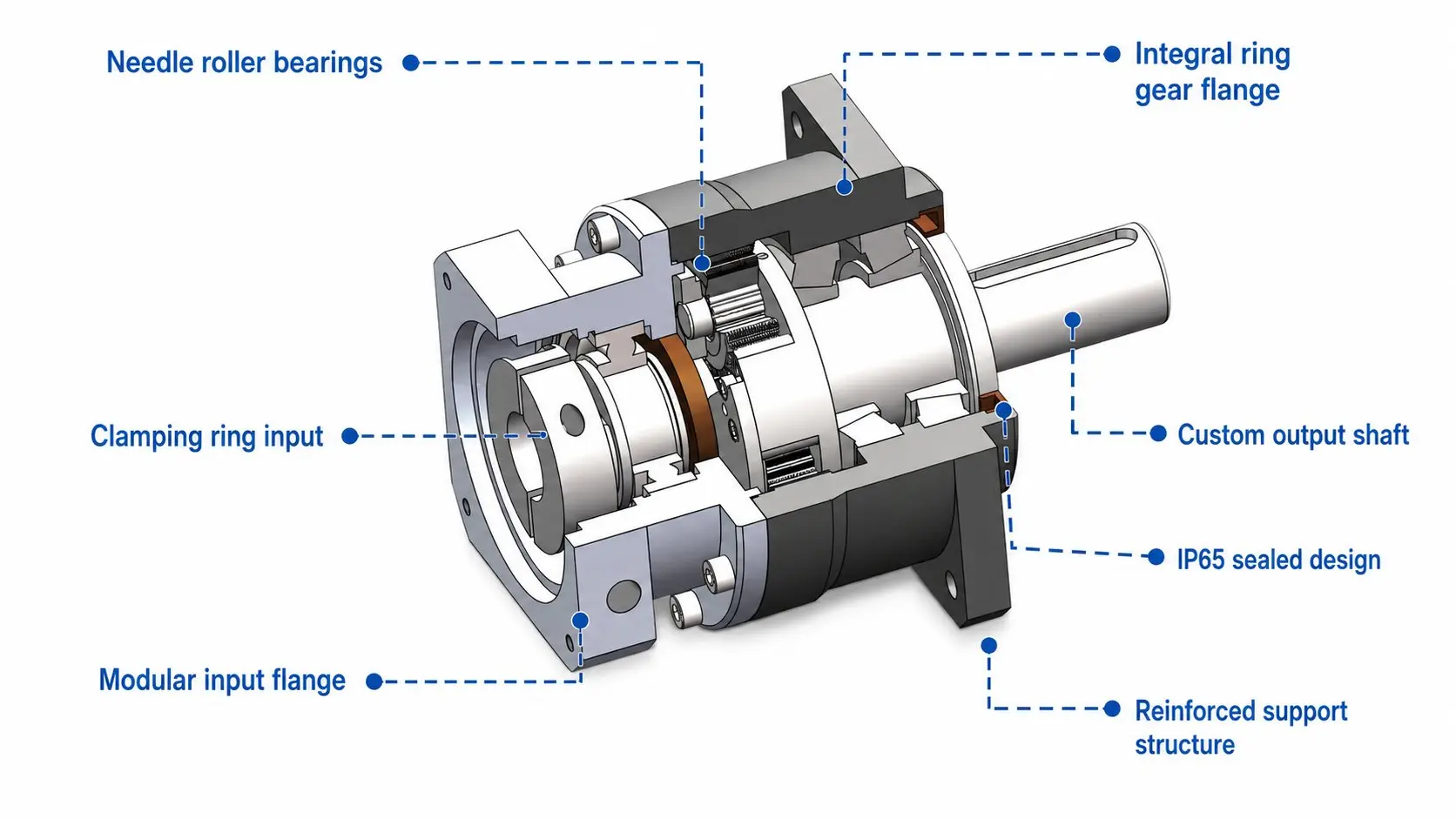
EP-FAL planetary gearbox internal structure — helical planet gears integrated timing belt pulley oversized output bearing for laser cutting gantry drive

0.015
mm Periodic Error
34kN
F_rad Rating
P0
≤1 arc-min

EP-FAL/FALR: the integrated timing belt pulley, oversized output bearing, DIN Class 5 helical gears, and NYOGEL 792D sealed lubrication are combined in a single unit that replaces four separate components in a conventional gantry drive assembly.

Four Design Elements That Set EP-FAL Apart from a Standard Gearbox Plus Pulley Hub

Machine builders who have used conventional gearbox-plus-hub setups on laser and plasma gantry axes typically encounter three recurring problems: periodic band patterns in cut quality, unexpected bearing failures on the gearbox output shaft, and IP seal failures from coolant or plasma fume ingress. All three have the same root cause — the conventional arrangement was not designed for the combined demands of integrated belt drive, radial load, and industrial contamination. EP-FAL addresses all three at the component design level.

  1. 01
    Integrated Timing Belt Pulley — Eliminates the Dominant Error Source

    The pulley groove is machined directly on the output shaft forging — sharing the same centreline as the gear output axis with zero additional tolerance. This eliminates hub-to-shaft eccentricity, which the gantry error budget analysis above identifies as the largest and most problematic error source: 0.025–0.060 mm peak-to-peak, periodic, not reducible by servo tuning. Once this source is eliminated, the remaining error budget is dominated by belt compliance and guide straightness — both of which are manageable by machine assembly quality and servo feed-forward.

  2. 02
    Oversized Output Bearing — Rated for Full Belt Tension Load

    A standard planetary gearbox output bearing is designed for torque transmission with minimal overhung radial load. AT10 belt drives at maximum gantry acceleration generate radial forces of 5,000–20,000 N depending on gantry mass and speed — forces that produce significant shaft bending at the output bearing if not designed for. EP-FAL specifies an oversized output bearing as part of the standard design, rated for F_rad up to 34,200 N at the standard overhang distance. This eliminates the need for an external idler bearing or support block that would otherwise be required to protect the gearbox output shaft.

  3. 03
    DIN Class 5 Helical Gears — P0 Backlash from the Gear Train

    EP-FAL P0 uses the same DIN Class 5 profile-ground helical planet gears as the premium EP-FAB and EP-FAD precision series — not a lower-accuracy gear set to compensate for cost. The ≤1 arc-min P0 backlash grade is measured and stamped on every unit at 2% rated torque. In a gantry axis with a 100 mm pitch-diameter pulley, 1 arc-min of backlash at direction reversal translates to 0.029 mm of positional uncertainty — partially compensable by servo backlash compensation to approximately ±0.015 mm effective. Combined with zero hub eccentricity, the total gearbox contribution to gantry error is reduced to ±0.015–0.018 mm.

  4. 04
    IP65 Sealed Housing — Every Unit Pressure-Tested for Laser/Plasma Environment

    Laser cutting machines generate metalworking assist-gas residue and cutting fume particles that settle on machine components including the gantry gearbox. Plasma and flame cutters are worse: plasma slag spatter reaches the gantry axis regularly. IP65 protection on every unit — not a batch-sample standard — prevents these contaminants from entering the gear chamber and starting the progressive backlash growth that batch-sample-tested seals allow when they fail on the production units that were not individually tested.

The practical result is that EP-FAL/FALR replaces a four-component sub-assembly (gearbox + pulley hub + external support bearing + hub clamp hardware) with a single sealed unit. Machine assembly time is reduced, the BOM is simplified, and the dominant periodic error source is eliminated by design rather than managed by servo tuning.

Selection Guide

Metal Fabrication Gearbox Selection Matrix — 5 Questions to the Right Series

The key distinction in metal fabrication is between gantry belt drives (FAL/FALR) and direct-coupled drives (FAB/FAD for precision; FPG/FPGA for economy). Within gantry belt drives, FAL vs. FALR is a layout decision — the engineering performance is equivalent. Work through Q1 to Q5 in sequence for each drive point on the machine.

Selection Question
Your Answer → Series Implication
Recommended
Q1 — Drive type?
AT belt gantry drive → FAL (inline) or FALR (right-angle)  |  Direct-shaft / flange coupling → FAB / FAD / FPG based on precision  |  Belt drive with motor behind end plate (corner layout) → FALR specifically
FAL/FALR vs FAB/FAD
Q2 — Motor layout?
For belt drives only: Motor inline with belt axis (motor protrudes at table end) → EP-FAL  |  Motor must hide behind end plate (maximum working length, or torch/head space occupied at end) → EP-FALR (+180 mm working length, motor ⊥ belt). Both deliver same integrated-pulley eccentricity elimination.
FAL or FALR
Q3 — Cut quality grade?
Grade A / tight kerf tolerance (thin stainless, aluminium, precision parts) → FAL P0 (≤1 arc-min)  |  Grade B / standard structural cutting (plasma, heavy sheet) → FAL P1 or FALR P1 (≤2–3 arc-min)  |  Economy profile cutting (flame/plasma, structural steel) → FALR P1 large frame sufficient
P0 / P1
Q4 — Gantry mass / belt force?
Light gantry (<100 kg, AT5 or narrow AT10) → FAL/FALR110 sufficient  |  Standard gantry (100–300 kg, AT10) → FAL/FALR110–150  |  Heavy gantry (300–800 kg plasma/stone, wide AT10) → FALR150/190/280; F_rad check required. Calculation: F_rad = (gantry mass × max accel) + 2 × belt pre-tension
Frame by F_rad
Q5 — Other axes on same machine?
Press brake: FAB P1 back-gauge + economy FPG for other axes → C1–C10 one qualification  |  Punch press feeder: FAD P1 for high-speed feeder, FAB P1 for die clamping  |  Tube bender: FAB P1 bending head + FPG for section feed  |  All configurations use same C-adapter type for a given motor model
C1–C10

Manufacturing Quality

Korea Ever-Power Manufacturing — How P0 Accuracy Is Produced and Verified at Ansan-si

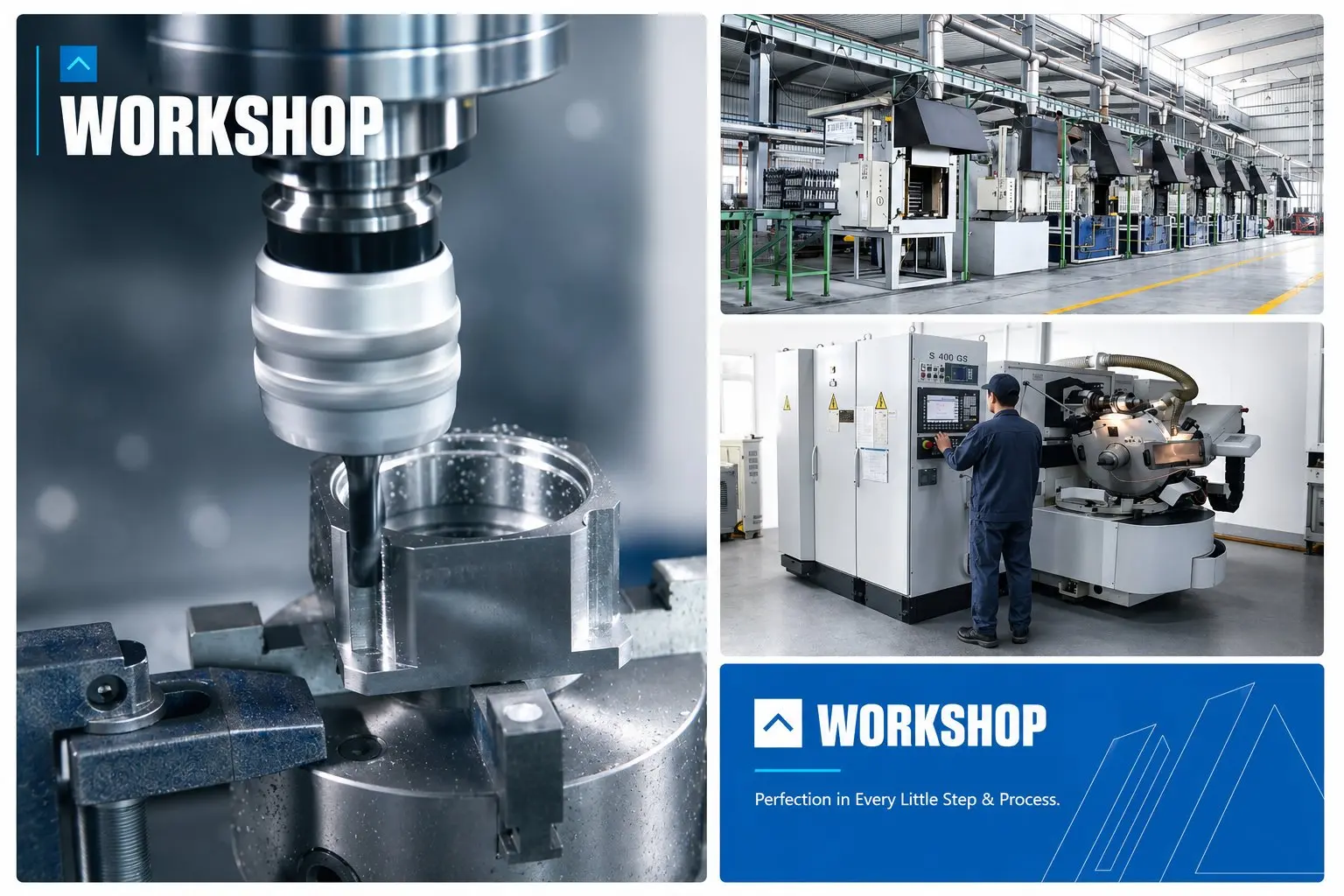
Korea Ever-Power test center — individual backlash measurement and IP65 pressure testing for EP-FAL and EP-FALR laser cutting gantry gearboxes
Korea Ever-Power 5-axis CNC gear grinding workshop — DIN Class 5 profile grinding for EP-FAL and EP-FALR planetary gearboxes

Test centre (backlash measurement and IP65 pressure decay, every unit) and 5-axis CNC gear-grinding workshop at Korea Ever-Power, Ansan-si, Korea.

The ≤1 arc-min P0 backlash grade in EP-FAL depends on two manufacturing steps that cannot be separated: 5-axis CNC profile grinding of the ring gear to DIN Class 5 accuracy, and individual unit backlash measurement under 2% rated torque load with the measured grade stamped on the nameplate before shipment.

The profile grinding step is not optional for DIN Class 5 — gear hobbing and shaving alone cannot achieve the tooth-to-tooth spacing tolerance that defines Class 5 accuracy. Korea Ever-Power operates 5-axis CNC profile-grinding machines at the Ansan-si facility — the same equipment type used by German and Japanese gear manufacturers for premium-grade planetary gearboxes. This is not a claim of identical manufacturing lineage; it is a statement of process: DIN Class 5 accuracy requires a grinding process, and that process is present in the production facility.

The individual backlash measurement step distinguishes Korea Ever-Power from suppliers who claim P0 grade without per-unit measurement. In a production batch of 50 EP-FAL units, statistical process control on a well-managed gear grinding line may produce 95% of units within P0 threshold. The remaining 5% — 2–3 units per batch — are P1 grade. Without individual measurement, those units ship with a P0 label and fail the customer’s machine acceptance test. With Korea Ever-Power’s per-unit test, those units are identified at the factory and either regraded (shipped as P1, labelled P1) or reprocessed. The customer receives a unit whose measured grade matches its nameplate grade — on every unit, without exception.

🔬
Three Production Tests on Every EP-FAL / EP-FALR Unit
(1) Backlash measurement at 2% T_rated: Measured grade P0/P1/P2 stamped on nameplate. Units measuring above P0 threshold are re-classified — they do not ship as P0. (2) IP65 pneumatic pressure decay test: 60-second test on all dynamic seals; any unit showing decay above threshold is rejected. (3) Noise and vibration check on closed-loop servo dynamometer: Units above the noise floor threshold for their frame size and ratio are flagged for root-cause analysis before shipment. All three tests apply to every unit, from a single-unit prototype order to a 500-unit production run.

EP-FAL / EP-FALR vs. European Premium — Metal Fabrication Comparison

Attribute European Premium Korea Ever-Power
EP-FAL / EP-FALR
Buyer Implication
Integrated belt pulley Some models (premium) Standard item — FAL/FALR FAL/FALR is the standard product — no premium for integrated pulley configuration
Gear accuracy DIN Class 5 DIN Class 5 (5-axis CNC) Same governing gear accuracy standard; same grinding process class
Per-unit backlash stamp Yes Yes — every unit Same traceability standard; supports machine builder CE/acceptance documentation
IP65 per-unit test Sample test Every unit Plasma and metalworking environments make IP seal failures costly; per-unit testing eliminates field failure risk
F_rad rating Documented (varies) Up to 34,200 N Covers heavy plasma gantry without external support bearing
C1–C10 universal adapter Brand-specific All 8 series One motor qualification covers FAL gantry + FAB back-gauge + FPG section drive on same machine BOM
Unit price (P1) 100% benchmark ~60–75% 25–40% cost saving at same DIN Class 5 / P0 technical specification

Comparative data based on publicly available specifications and customer substitution test results from Korean laser cutting machine OEMs. Korea Ever-Power does not sell counterfeit products.

Customer Feedback

What Metal Fabrication Machine Builders Say About EP-FAL and EP-FALR

★★★★★

“Our 3 kW fiber laser had a periodic band pattern in stainless steel cuts that we could reproduce consistently but couldn’t tune out. Measured the Y-axis position signal on the oscilloscope — clean 3.2 Hz sinusoid at 0.08 mm amplitude, locked to belt rotation frequency. Swapped the gearbox-plus-hub for EP-FAL. The sinusoid disappeared. Error dropped below 0.02 mm and was no longer periodic — just broadband noise. Machine went from Grade C to Grade A on the standard acceptance test. We’ve specced EP-FAL on every laser machine we’ve built since.”

JC
Jung C., Chief Engineer
Fiber Laser Cutting Machine Manufacturer — Incheon, Korea
★★★★★

“We build a 4 × 8 m plasma gantry for structural steel cutting. Motor space at the X-axis end is occupied by the height control unit — there’s no room for an inline motor protruding beyond the frame. EP-FALR solved it completely: motor mounts at 90° behind the end plate, the gantry working length increased by 180 mm, and the integrated pulley output eliminated the eccentricity problem we’d had with the previous separate-hub design. The FALR280 handles our 500 kg gantry AT10 belt without any external support bearing — that alone saved us a significant amount of machining on the gantry beam end block.”

BH
Baek H., Lead Mechanical Designer
Heavy Plasma Cutting Machine Builder — Changwon, Korea
★★★★★

“Our press brake uses EP-FAB P1 for the back-gauge X axis and Z-axis (upper beam positioning). The per-unit backlash stamp was the deciding factor for the P0/P1 choice — our CE technical file required documented gearbox backlash for each machine serial number, and Korea Ever-Power’s nameplate stamp gave us exactly that without any additional test or certificate request. C1–C10 adapter on our Panasonic motors worked first time. We also use EP-FPG on the back-gauge Y-axis (lateral position) where ±0.5 mm is acceptable — same adapter, significant cost saving on a lower-precision axis.”

KS
Kim S., Automation Systems Engineer
CNC Press Brake Manufacturer — Daegu, Korea

Related EP-Series — Complete Metal Fabrication Line Coverage
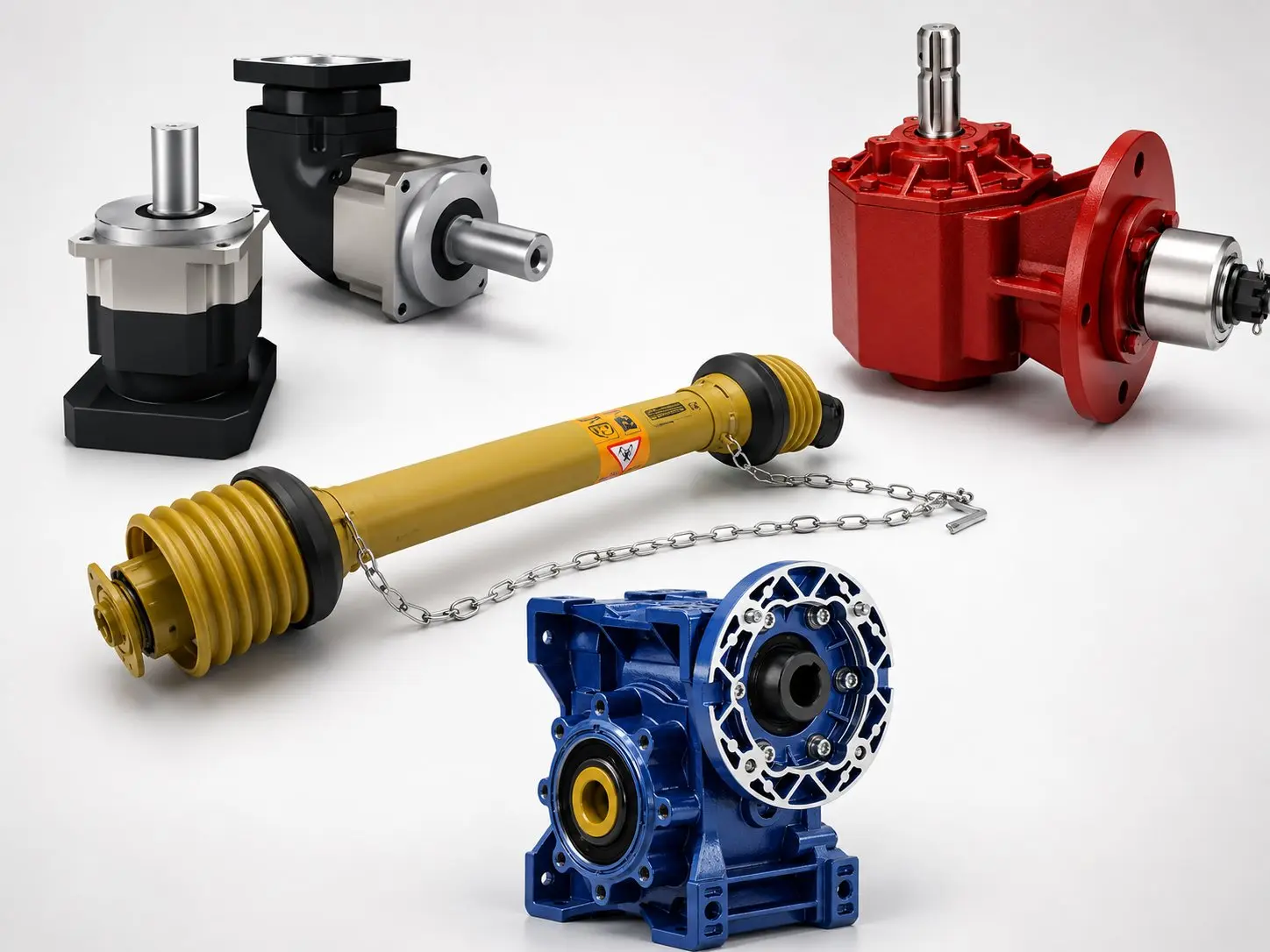
Korea Ever-Power EP series planetary gearbox range — FAL FALR FAB FAD FPG for metal fabrication laser cutting plasma press brake

The core metal fabrication series are EP-FAL (inline gantry belt drive, P0 available) and EP-FALR (right-angle corner drive, up to 180:1). For direct-coupled precision axes: EP-FAB P1 (press brake back-gauge, tube bending head) and EP-FAD P1 (punch press servo feeder at 10,000 rpm). For economy roll forming and secondary drives: EP-FPG/FPGA.

Browse the full EP series range, or explore related drive components at cvjointdriveshaft.com and worm reducer alternatives at worm-reducers.xyz.

Frequently Asked Questions — Metal Fabrication Gearbox Selection

What is the hub eccentricity problem in gantry belt drives, and how does EP-FAL solve it?
In a conventional gantry drive, the timing belt pulley is a separate component that mounts onto the gearbox output shaft via a keyway, clamp hub, or shrink disc. The manufacturing tolerance between the hub bore and shaft OD (typically h6/H7) produces a concentricity error of 0.03–0.05 mm. The keyway adds a further angular offset. The combined hub-to-shaft TIR is typically 0.05–0.12 mm. Every revolution of the pulley, this eccentricity causes the belt to advance or retard by this amount, producing a sinusoidal position error at the cutting head at belt rotation frequency. At 60 m/min traverse speed with a 100 mm diameter pulley, the pulley rotates at 190 rpm — the error appears as a 3.2 Hz sinusoidal disturbance that the servo controller sees as an external input, not as backlash, and cannot compensate. In EP-FAL, the pulley groove is machined directly on the output shaft forging — there is no hub-shaft interface, and therefore no hub eccentricity. The only eccentricity that remains is the bearing radial clearance and gear concentricity, which are an order of magnitude smaller and not periodic in the same way.
When should I use EP-FAL vs. EP-FALR on a laser or plasma cutting machine?
The choice between FAL and FALR is entirely a machine layout decision — the engineering performance of the integrated belt pulley is identical in both. Use EP-FAL when the servo motor can be mounted inline at the end of the gantry axis — motor shaft parallel to the belt, protruding beyond the gantry end plate. This is the simpler arrangement and allows P0 backlash grade. Use EP-FALR when the motor must be hidden behind or beside the gantry end plate — for example, when the end plate space is occupied by a torch height controller (plasma), a Z-axis drive motor (CNC router), or when maximising the usable cutting table length within a fixed machine footprint. EP-FALR recovers approximately 180 mm of table length (the motor body length that would otherwise protrude) and accommodates single-unit ratios up to 180:1, which on long-stroke gantry applications with large pulley diameters provides useful slow-travel speed for setup moves. Both FAL and FALR have the same F_rad rating at equivalent frame sizes.
How do I calculate the required gantry gearbox frame size from my machine parameters?
The frame size selection for a gantry belt drive requires two parallel checks: output torque and radial force. Output torque: T_out = (gantry mass × max acceleration × pulley radius) / transmission efficiency. For a 150 kg laser gantry at 20 m/s² maximum acceleration with a 50 mm pulley radius: T_out = (150 × 20 × 0.05) / 0.97 = 155 Nm — which falls in the EP-FAL110 range (maximum output torque 180 Nm). Radial force: F_rad = (gantry mass × max acceleration) + (2 × belt pre-tension force). For the same gantry at 20 m/s² with 400 N pre-tension per strand: F_rad = (150 × 20) + (2 × 400) = 3,800 N — well within the EP-FAL110 rated F_rad. For heavy plasma gantries (300–800 kg, higher pre-tension), the F_rad calculation typically determines the frame size rather than torque. Korea Ever-Power provides a gantry application engineering review for projects with non-standard parameters — send gantry mass, maximum acceleration, belt type, and pulley diameter to [email protected].
Does EP-FAD P1 really support 10,000 rpm input for punch press feeders?
Yes — 10,000 rpm is the rated maximum continuous input speed for all EP-FAD and EP-FADR series units (all frame sizes, all standard ratios in the catalogue). This is one of the key technical differentiators of the EP-FAD round-flange series: the EP-FAB square-flange series is rated to 6,000 rpm maximum input, while EP-FAD reaches 10,000 rpm. The higher speed rating is achieved through the round-flange architecture, which allows a shorter axial input shaft length and reduced input shaft deflection at speed, combined with the same NYOGEL 792D synthetic grease that is rated for the thermal load at 10,000 rpm input. For punch press servo feeders running at 150–180 strokes per minute with a high-speed motor, this makes EP-FAD the correct series choice — EP-FAB would require a motor with a lower nominal speed to stay within the 6,000 rpm limit, which often requires a larger motor frame to achieve the same power.
What documentation does Korea Ever-Power provide for CE machine declaration on laser cutting machines?
Korea Ever-Power can provide the following documentation for CE technical file purposes: per-unit backlash test certificate (measured grade at 2% rated torque, date, serial number, production lot reference); per-unit IP65 pressure test record (pass/fail, test pressure, test duration, serial number); material certificates for ring gear, planet gear, and housing alloy lots (available on request per production batch); RoHS compliance declaration for EP-FAL, EP-FALR, EP-FAB, and EP-FAD series; and product conformity declaration for IP65 rating in accordance with IEC 60529. For CE declarations requiring gearbox noise data: noise measurement reports are available for standard frame sizes and ratios from the servo dynamometer test records. Lead time for documentation package: 3–5 business days from order confirmation. Contact [email protected] specifying the machine series number and required document types.

Specify EP-FAL, EP-FALR, or EP-FAB for Your Metal Fabrication Machine
Send your gantry mass, belt type, maximum acceleration, and motor model — Korea Ever-Power will provide frame size selection, F_rad verification, and C-adapter specification within 24 hours. Laser / plasma / press brake / waterjet covered.

Request Metal Fabrication Gearbox Specification →

Editor: Cxm