Planetary Gearbox for Logistics and E-commerce Automation — Cycle Count, Shock Loading, and Sortation Drive Selection Guide

100M+
Cycles/Year — Sorter Drives
24/7
Continuous Operation
3× Peak
Shock Torque — Jam Events
IP65
Washdown + Dust Protection
EP-FAD
Primary Series — All Sorter Types

Application Guide

Why Logistics Automation Has Different Gearbox Requirements Than Any Other Industry — Cycle Count Is the Specification That Changes Everything
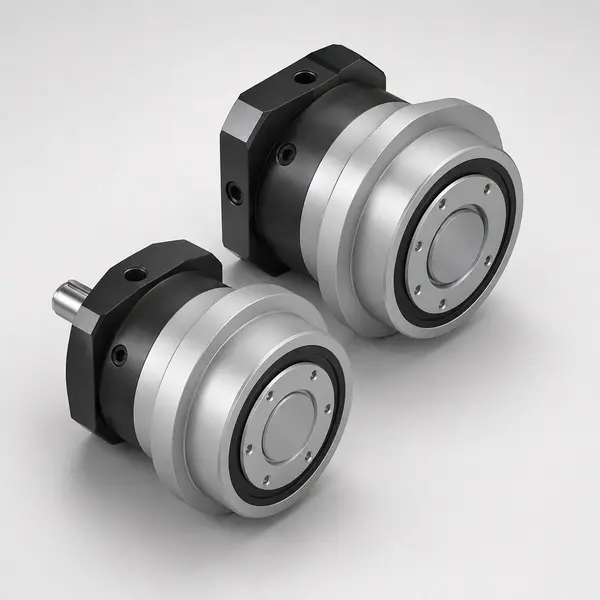
EP-FAD series planetary gearbox for logistics automation — cross-belt sorter drives, AMR wheel drives, conveyor junction actuators, tilt-tray sortation systems in e-commerce fulfillment centres

EP-FAD series in logistics automation context: high-speed sortation, goods-to-person AMR drives, and conveyor switch actuators. The sealed NYOGEL 792D lubricant and IP65 rating make EP-FAD suitable for the dusty, humid warehouse environments of modern e-commerce fulfillment centres operating 24 hours per day, 350 days per year.

Logistics automation — the mechanical infrastructure that moves parcels, cartons, and goods through e-commerce fulfillment centres, postal sorting facilities, and distribution warehouses — is the fastest-growing sector for precision drive components globally. The explosive growth of e-commerce since 2020 has accelerated the deployment of cross-belt sorters, goods-to-person AMR fleets, tilt-tray systems, and automated storage and retrieval cranes at a rate that the industry’s drive component suppliers are still adapting to. The gearbox requirements of this sector are distinctive: not because the loads are extreme (most sortation drives are moderate-torque, moderate-speed applications), but because the cycle counts are extraordinary.

A cross-belt sorter operating at 70 belt actuations per minute, 20 hours per day, 350 days per year accumulates 29.4 million actuations annually — and a major fulfillment centre requires hundreds or thousands of these sorter units operating simultaneously. The gearbox in each sorter belt drive must complete this cycle count without maintenance over a 5–10 year service interval, because maintenance access in a running sortation system is severely limited and planned shutdowns are scheduled only for system-wide maintenance windows. This places demands on gearbox durability that are measured in hundreds of millions of cycles — a metric that virtually never appears in industrial gearbox specifications designed for robot arms, machine tools, or packaging machines.

The critical insight for logistics gearbox selection is that bearing L10 fatigue life — the dominant specification parameter for all other applications covered in this guide series — is almost never the life-limiting mechanism in logistics sortation drives. This distinguishes logistics automation from every other industry application covered in Korea Ever-Power’s guide series: medical robot joints are L10-governed at 30,000-hour targets; CNC rotary tables are compliance-stiffness-governed; SCARA robot J1/J2 are backlash-grade-governed. Logistics sortation drives are cycle-count-governed at cycle counts so high they require a different evaluation methodology entirely.

This article is also distinct from Korea Ever-Power’s existing AGV and Intralogistics guide, which focuses on autonomous guided vehicles — pallet-moving robots operating at low speed with high torque under S5 duty. Logistics sortation systems share the same facility but have completely different drive requirements: cross-belt sorter belt drives complete 70+ start-stop cycles per minute (versus 1–3 cycles per minute for an AGV picking a pallet); the torque level is low (10–25% of rated, versus 60–80% rated for a loaded pallet AGV); and the consequence of a failure is a section of the sortation system shutting down (high operational cost) rather than one AGV being out of service (low operational cost). These differences mean the gearbox specification methodology for logistics sortation is not a scaled version of the AGV specification — it is a fundamentally different engineering analysis starting from cycle count rather than torque-dominated L10 life.

The L10 calculation, applied to a cross-belt sorter drive at 20% of rated torque in S5 duty, typically yields a calculated bearing life of millions of calendar hours — completely irrelevant at a 10-year service target. What matters instead is gear tooth surface fatigue (from cumulative Hertzian contact cycling), seal durability under the dusty warehouse environment, and shock load resistance during jam and overload events. This article provides the framework for evaluating all three.

🔄
The Logistics Gearbox Specification Reversal
In most industrial applications, the engineer starts with the torque and speed requirements and derives the gearbox frame size and grade. In logistics sortation, the engineer should start with the annual cycle count and derive whether the gear tooth surface durability is adequate for the specified service interval — then confirm that torque and speed are within rating. This reversal is not arbitrary: at the low operating torques of most sortation drives (typically 10–30% of rated), the L10 bearing life is so large that it is irrelevant, and the gear tooth durability at the cumulative Hertzian contact cycle count is the real engineering question. Korea Ever-Power EP-FAD and EP-FPG series, with DIN Class 5 or Class 6–7 profile-ground gears respectively, are designed for the gear tooth durability required by logistics applications — but selecting the correct series depends on the cycle count profile, not just the rated torque.

Annual Cycle Count Projection Table — Eight Logistics Applications, Five-Year Endurance Target

The table below calculates the five-year cumulative cycle count for eight representative logistics automation applications, based on typical operating parameters for each system type. The colour coding indicates whether the cycle count requires a cycle-count-specific specification review (green = standard EP series adequate, amber = verify gear tooth durability with Korea Ever-Power, red = high-endurance specification required). Use this table to identify which applications in your system require cycle-count analysis beyond standard torque/speed selection.

Application Cycles
/min
Hours
/day
Days
/year
Annual
cycles (M)
5-year
total (M)
Status EP recommendation
Cross-belt sorter
Belt start/stop per carrier
70 20 350 29.4 M 147 M VERIFY EP-FAD P2, frame 047–060, DIN Cl.5 gears. Confirm gear tooth endurance at 147M cycles with Korea Ever-Power for 5-yr target. Shock protection for jam events.
Tilt-tray sorter
Tray tip + return per tray
75 20 350 31.5 M 157.5 M VERIFY EP-FAD P2 compact (047mm). Asymmetric cycle: fast powered tilt, gravity return. On-time fraction ~40%. Gear tooth fatigue at 157M cycles is the limiting question.
Sliding shoe sorter
Shoe push per divert event
120 20 350 50.4 M 252 M VERIFY EP-FADS P2 (compact linear actuator format). Very short stroke; low torque. 252M cycles in 5 years — highest cycle count in this table. Gear tooth durability confirmation critical.
Conveyor junction
Divert actuations per merge point
45 20 350 18.9 M 94.5 M CHECK EP-FAD P2 or EP-FPG Std. Belt tension adds radial load; confirm bearing load at combined torque + belt tension. Standard DIN Cl.6–7 typically adequate at 94M 5-yr cycles at low torque.
Goods-to-person AMR
Drive wheel revolutions continuous
Continuous
S1 ~ 60% on
20 350 Bearing
life calc
L10 → yrs L10 EP-FAD P1 (drive wheel) + EP-FAD P0 (lift screw). AMR uses L10 bearing life calc — continuous rotation, moderate torque. 30,000hr at 20% rated torque → multi-decade life. L10 not a concern; battery/motor maintenance limits AMR life.
Spiral / vertical conveyor
Continuous elevation drive
Continuous
S1 100%
20 350 S1 load L10 → 7 yr L10 EP-FAD P1 (medium frame). S1 continuous → L10 is the spec. 7-year L10 at rated torque requires 090–110mm frame. Temperature rise in enclosed spiral housing: check housing temp budget.
Robotic piece-picking arm
6-axis or SCARA picks
6–10
picks/min
20 350 2.5–4.2 M 12.6–21 M OK EP-FAD P0/P1 (SCARA or 6-axis spec, per robot guides). Low cycle count vs sorter; L10 bearing life is comfortable. Accuracy (P0/P1) driven by pick placement spec and item variety.
ASRS storage crane
Storage/retrieval cycles
2–3
cycles/min
20 350 0.84–1.26 M 4.2–6.3 M TORQUE EP-FAB P1 large frame (torque-driven, not cycle-count). High torque + 20–30yr design life target. Cycle count low — conventional L10 calc. Oil bath lubrication for this duty class.

Status key:
VERIFYGear tooth endurance confirmation required for 5-yr target — contact Korea Ever-Power with cycle count
CHECKStandard series likely adequate — verify combined torque + radial load
L10Bearing life is the design criterion, not cycle count — use standard L10 calculation
TORQUETorque capacity is the dominant specification — cycle count not a concern

Cycle count parameters are representative for major e-commerce fulfillment centre operations. Actual values vary with system throughput, parcel mix, and operational schedule. Contact Korea Ever-Power with your specific cycle rate and service interval target for a gear tooth endurance confirmation specific to your application.

Failure Mode Analysis

The Jam Event — Why Parcel Overload and Conveyor Jams Are the Primary Cause of Gearbox Failure in Logistics
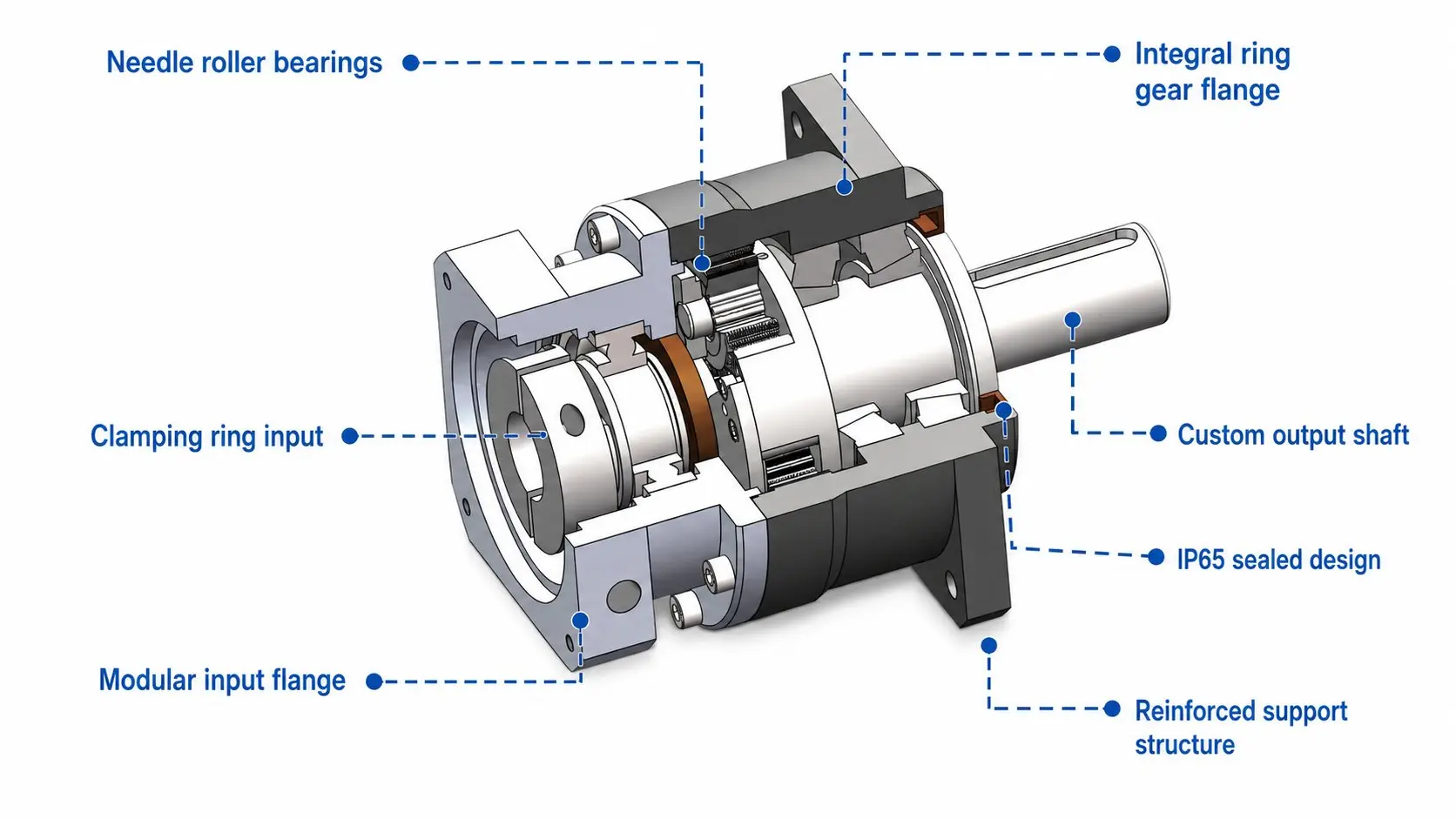
EP-FAD planetary gearbox cross-section — three planets distribute shock load evenly during jam events in logistics sortation applications, preventing catastrophic tooth failure

Peak Torque Margins
EP-FAD rated torque
100%
Typical jam torque
150–200%
EP-FAD peak tolerance
200–300%
Catastrophic jam torque
>300%
The design goal: keep even worst-case jam events below EP-FAD peak torque limit. Achieve this via mechanical slip clutch or motor current limiting at 2× rated, leaving margin to the 2–3× peak limit.

Why Jams Are More Damaging Than Normal Overloads

A sortation system jam occurs when a parcel becomes wedged in the conveyor mechanism — between a sorter belt and a fixed guard, between two convergent conveyor belts, or at a sharp-radius corner where an oversize item contacts the frame. In this condition, the conveyor belt drive continues to attempt to move the jammed parcel, and the motor torque rises to stall torque (typically 3–4× rated motor torque) within fractions of a second. The drive train — including the planetary gearbox — sees this stall torque as an instantaneous shock load far above the normal operating torque.

The physics of planetary gearbox failure under shock loading differs from gradual bearing fatigue in a critical way: fatigue damage accumulates slowly and predictably over millions of cycles, while shock tooth failure occurs at a single event if the instantaneous contact stress on the tooth flank exceeds the material’s yield strength at the contact point. This threshold-crossing failure mode is why shock loads in logistics gearboxes require specific attention beyond the cycle count analysis: a gearbox that is perfectly specified for cycle count and rated torque can still fail catastrophically in a single severe jam event if the jam torque exceeds the gear tooth bending strength.

Korea Ever-Power EP-FAD series specifies a peak torque rating of 2–3× rated continuous torque (the specific factor depends on frame size and ratio — see the product datasheet). This peak torque rating defines the maximum instantaneous torque the gearbox can withstand without immediate gear tooth failure. Designing the sortation system so that the maximum possible jam torque does not exceed the gearbox peak rating requires either: (a) a mechanical slip clutch in the drive train that slips at a torque below the gearbox peak rating, or (b) motor current limiting configured in the servo drive to prevent the motor from reaching stall torque, or (c) a frame size large enough that even the worst-case jam torque is below the peak rating of the selected gearbox.

Option (b) — motor current limiting via the servo drive — is the most common solution in modern sortation systems because it adds no mechanical components and can be configured precisely. Most servo drives used in sortation systems allow the operator to set a current limit that corresponds to a specific torque multiple of rated torque. Setting this limit at 1.5–2.0× rated torque for the sorter belt drive ensures that even at motor stall, the torque seen by the gearbox is at most 2× rated — well within EP-FAD’s 2–3× peak tolerance. The current limit also protects the motor from stall overheating, making it a dual-function protective measure.

The gear tooth failure mechanism under shock loading differs from Hertzian surface fatigue in an important way: it is a single-cycle fracture event rather than a progressive fatigue process. Hertzian surface fatigue accumulates through repeated cycles of contact stress below the material yield strength — the surface gradually develops micropits that coalesce into a spalled area over millions of cycles. Shock tooth fracture occurs when a single instantaneous contact stress exceeds the tooth’s bending fatigue limit at the tooth root — producing a crack that propagates through the tooth cross-section in one or a few cycles. The bending fatigue limit for DIN Class 5 gear steel in EP-FAD is significantly higher than the Hertzian contact endurance limit, which is why EP-FAD can tolerate 2–3× rated torque instantaneously even though its cycle-count endurance at continuous rated torque is a more conservative calculation. The safety margin between the peak torque rating (2–3× rated) and the tooth bending fracture load (typically 5–6× rated for quality gear steel) provides a comfortable safety factor that covers most logistics jam events, provided the motor current limit is set correctly.

The frequency of jam events also matters for long-term gear integrity. A sorter that experiences an average of one jam per day accumulates 1,825 jam events over five years. If each jam reaches 1.5× rated torque for 0.1 seconds, the cumulative tooth bending fatigue contribution from jams is in addition to the Hertzian surface fatigue from normal cycling. For most well-maintained sortation systems with effective current limiting, jam events are infrequent and brief, and their contribution to cumulative tooth fatigue is small relative to the normal operating cycle count. For high-jam-frequency environments (poorly maintained induction conveyor with frequent misfeeds, or a merge point with aggressive throughput targets), the jam event frequency should be estimated and included in the endurance calculation discussion with Korea Ever-Power. An environment with more than 5 jam events per day per drive may benefit from specifying a one-frame-size-larger EP-FAD to increase the peak torque margin and reduce the percentage of rated torque reached during each jam.

The Three-Planet Load Sharing Advantage in Shock Events
When a shock load reaches the EP-FAD planetary gearbox, the torque is distributed simultaneously across three planet gears engaging the ring gear and sun gear. Each planet carries one-third of the total torque simultaneously. This three-way load sharing means the contact stress on any individual tooth is one-third of what it would be on a single-reduction spur gear of equivalent size. At 200% rated torque during a jam event, each planet sees 67% of the stress that a spur gear of the same size would see — which is why planetary gearboxes tolerate higher peak-to-rated torque ratios than equivalent spur gear reductions. This is the mechanical reason EP-FAD’s 2–3× rated peak torque is achievable and why it is the correct choice for logistics applications where jam events produce brief high-torque transients.

System Architectures

Five E-commerce Fulfillment System Architectures — Gearbox Configuration for Each

The five system architectures below represent the primary configurations found in modern e-commerce fulfillment centres. A typical Amazon-scale fulfillment centre of 200,000 square metres may have 10,000–30,000 individual gearbox-motor units across all these systems — more drive components than a large automotive body shop. The scale creates unique procurement and maintenance requirements: standardisation on a small number of gearbox types reduces spare parts inventory, simplifies technician training, and allows bulk procurement pricing. Korea Ever-Power’s C1–C10 universal motor adapter system is particularly valuable in this context: an operator who standardises on EP-FAD P1/P2 for the majority of sortation and transport drives, and EP-FAB P1 for ASRS crane drives, can manage the entire facility’s gearbox inventory with two series and a single motor adapter code — compared to four or five incompatible product lines from multiple suppliers.

The five architectures below reflect the real-world complexity of modern fulfillment centres, where each system type has a different gearbox lifecycle, maintenance schedule, and failure mode profile. Understanding these differences allows the system designer to make specification decisions that balance capital cost (unit gearbox price × quantity) against operational cost (maintenance frequency, spare parts inventory, downtime risk) over the 10–20 year facility lifetime.

Each architecture has a characteristic gearbox demand pattern — the combination of cycle count, torque profile, shock exposure, and environmental conditions that determines the correct EP-series selection. The architectures are not mutually exclusive: a full fulfillment centre typically combines all five, and the same EP-series often appears in multiple architectures at different specification points.

01 — Cross-Belt Sortation System

High Cycle

Cross-belt sorters transport parcels on individual carrier units, each carrying a small transverse belt that activates to divert the parcel at the correct destination chute. Each carrier belt is driven by a separate compact gearbox-motor unit. The carrier circulates continuously on an oval loop; the belt activates 0–70 times per minute depending on sortation density. Cycle count is the dominant specification — 29M+ actuations per year per carrier. The gearbox must be very compact to fit within the carrier housing, must survive 150M+ 5-year cycles, and must operate maintenance-free because carrier unit replacement is the only field service option.

Specification: EP-FAD P2, frame 042–047mm, i=10–16, IP65. Confirm gear tooth endurance at rated 5-year cycle count with Korea Ever-Power. Motor current limit at 2× rated for jam protection. Sealed NYOGEL 792D — zero maintenance lubricant. Replace carrier unit at 5-year maintenance window rather than servicing individual gearboxes in situ.

02 — Goods-to-Person AMR Fleet

L10 Life

Goods-to-person AMR fleets transport pod shelving units to stationary pick stations, reducing picker walking distance by 60–80%. Each AMR carries a shelf pod weighing up to 500kg and travels 2–8 km per hour. The drive system comprises two or four drive wheels with individual gearbox-motor units, plus a lift mechanism that raises and lowers the pod as the AMR approaches the pick station. Unlike sortation drives, AMR wheel drives are continuous rotation (L10 bearing life governs) rather than start-stop (cycle count governs). The lift mechanism is a short-stroke linear actuator — high cycle count at low torque, similar to a sortation drive. Battery management determines operational pattern — AMRs typically charge during off-peak hours, reducing continuous duty to 16–18 hours per day at moderate speed.

Specification: Drive wheels: EP-FAD P1 060–090mm, i=20–50, IP65. Lift screw: EP-FADS P0 047mm, i=5–10. Floor shock from surface irregularities: confirm peak torque margin at 2× rated for wheel drive. Battery life (3–5yr replacement) typically shorter than gearbox life — gearbox survives battery replacement cycle.

03 — Automated Storage & Retrieval (ASRS)

Torque + Life

Automated storage cranes retrieve and deposit unit loads (pallets, bins, trays) in high-bay racking systems. ASRS cranes travel horizontally (X-axis), vertically (Y-axis), and extend a telescopic fork (Z-axis) to deposit or retrieve loads. X and Y drives handle the crane’s dead weight plus the full load weight — these are the highest-torque drives in the fulfillment centre, and the only application in logistics where the ASRS crane drives are sized primarily by torque rather than cycle count. ASRS crane design life targets are typically 20–30 years, making L10 bearing life calculation relevant — though at the slow speeds and moderate cycle rates of crane operation (1–3 storage/retrieval cycles per minute), calculated L10 life typically exceeds the design target comfortably. The practical concern is heavy peak torque during emergency stops with full load, and long-term lubricant condition in the enclosed crane drive housing.

Specification: EP-FAB P1 or EP-FABR, 110–220mm frame depending on crane class. Oil bath lubrication for 20-year sealed maintenance. Peak torque at emergency stop: confirm ≤ 2× rated with servo deceleration ramp. EP-FAB preferred for higher torsional stiffness under heavy load acceleration inertia.

04 — AI-Guided Piece-Picking Robot

Accuracy

AI-guided piece-picking robots use computer vision and machine learning to identify, grasp, and transfer individual items from source totes to destination totes or conveyor feeds. The robot arm — typically a 6-axis collaborative design or a SCARA — must reliably grasp items of varied size, weight, and surface texture, and place them accurately in a destination tote without damaging fragile items. The gearbox specification is accuracy-driven (P0 for ±2–5mm placement accuracy) rather than cycle-count-driven (the relatively low pick rate of 6–10 picks per minute means the 5-year cycle count is only 12–21 million — well within standard EP-FAD durability). The environmental specification for warehouse pick robots is standard IP65 for dust and incidental liquid exposure.

Specification: 6-axis: EP-FAD P0/P1 per Industrial Robotics guide. SCARA-type: EP-FAD P0 (J1/J2) + EP-FADS P0 (J3/J4) per SCARA guide. P0 for ±2mm placement; P1 acceptable for ±5mm. IP65. Cycle count not a concern at pick rates of 6–10/min.

05 — Parcel Induction and Conveyor Merge

Shock + Cycle

Parcel induction systems feed individual parcels onto the main sortation loop at controlled spacing and speed. Merge points consolidate parcels from multiple incoming conveyors onto a single outbound belt. Both involve frequent start-stop conveyor drives, direction changes, and the risk of parcel jams at merge points where multiple parcels compete for position. The combination of moderate cycle count (18–45 actuations per minute at merge switches) and elevated shock exposure (parcel collisions and merge jams at 2–3× rated torque) makes induction and merge drives the most demanding shock environment in the fulfillment centre. Standard belt drives at merge points operate at moderate constant speed but are exposed to brief shock loads when parcels impact each other or the belt edge at merge.

Specification: EP-FAD P2 060–090mm for merge switches. Motor current limit at 2× rated essential for jam protection. Cycle count check: 18–45/min × 20hr × 350 = 7.6–18.9M/yr → 5yr 38–94M — CHECK range. IP65. Shock margin confirmed by 3× rated peak torque specification.

Selection Summary

Logistics Gearbox Selection in Four Steps — From Cycle Count to Confirmed Series

The following four-step process consolidates the cycle count table, shock load analysis, and series selection into a single workflow for logistics system design engineers. Complete all four steps for every drive in the system — the same EP series may satisfy different steps as the limiting constraint for different drives.

Four-Step Logistics Gearbox Selection
1.
Calculate annual and 5-year cycle count
Annual cycles = cycles_per_min × 60 × operational_hours_per_day × operational_days_per_year. Five-year target = annual × 5. Compare to cycle count table above to determine if gear tooth endurance confirmation is required (VERIFY) or standard series is adequate (CHECK/OK/L10).
2.
Identify the maximum jam/shock torque
Determine the worst-case torque during a jam or overload event. Check whether the motor stall torque (3–4× rated motor torque) could reach the drive train. Confirm that the gearbox peak torque rating (2–3× rated continuous) exceeds the maximum jam torque, or specify a mechanical clutch or servo current limit at 1.5–2× rated to prevent gearbox from seeing full stall torque.
3.
Select frame size from rated torque × 1.5 safety factor
Calculate rated output torque for the drive, then select the EP frame size that has a rated continuous torque of at least 1.5× the required output torque. The 1.5× factor provides a safety margin for load variations and allows the gearbox to operate below 67% of rated torque — increasing L10 bearing life by approximately (1.5)³ = 3.4× vs rated and providing additional shock headroom. For logistics drives with high cycle counts, this torque de-rating is beneficial for gear tooth durability as well as bearing life. The relationship between operating torque and gear tooth contact stress follows the same power-law relationship as bearing L10 life: halving the applied torque reduces gear tooth contact stress by a factor of 2, which at the same cycles-to-failure correlation extends the gear tooth endurance at the same cycle count by approximately 8× (same cubic relationship). Operating at 67% of rated torque (the result of 1.5× frame de-rating) reduces gear tooth contact stress to 67% of the rated-torque level, extending tooth endurance by approximately (100/67)³ = 3.3× relative to the rated-torque calculation. This de-rating margin is particularly valuable for the VERIFY applications in the cycle count table (cross-belt, tilt-tray, sliding shoe), where the five-year cycle count is in a range that benefits from reduced operating stress to achieve comfortable endurance margins. When Korea Ever-Power performs the gear tooth endurance calculation for a specific application, the operating torque as a percentage of rated is the most important input — a sortation drive operating at 15% of rated torque has 15–20× better gear endurance at the same cycle count versus the same drive at 30% of rated torque, which can be the difference between a VERIFY application and an adequate standard-series solution.
4.
Confirm backlash grade and environmental specification
Most logistics drives use P2 or standard grade — positioning accuracy is rarely a requirement for sortation, conveyor, and transport drives. P0 or P1 is required only for robotic arms that place items with ±2–5mm accuracy. Environmental: IP65 standard for warehouse dust and incidental liquid; IP69K if pressure washdown is part of the cleaning protocol. For food-adjacent logistics zones (cold storage, food distribution), apply the hygienic zone guide criteria from the Food & Beverage article.

Related EP-Series and Technical Guides
Frequently Asked Questions — Logistics Gearbox Selection

Why is a 30,000-hour L10 rating meaningless for cross-belt sorter drives?
The 30,000-hour L10 rating is the predicted bearing fatigue life at rated output torque, at rated speed, under continuous S1 duty. A cross-belt sorter belt drive operates at approximately 20% of rated torque (light belt load at high speed), in S5 intermittent duty with 10–15% on-time per cycle. Applying the L10 formula: at 20% rated torque, bearing life = 30,000 × (100/20)³ = 30,000 × 125 = 3,750,000 hours. In calendar time at 15% on-time: 3,750,000 / 0.15 = 25,000,000 hours. At 20 hours per day: 25,000,000 / 20 = 1,250,000 days = 3,425 years. This number is physically meaningless — the gearbox will be decommissioned long before any bearing fatigue occurs. The relevant question for cross-belt sorter drives is not bearing fatigue but gear tooth surface fatigue from cumulative Hertzian contact stress cycles. At 147 million cycles in 5 years (from the table above), the question is whether the DIN Class 5 gear tooth contact stress produces fatigue below the tooth surface endurance limit over that cycle count. Korea Ever-Power can confirm this calculation for the specific frame size, ratio, and operating torque level.
Should logistics drives use economy EP-FPG or precision EP-FAD?
The choice between EP-FAD and EP-FPG for logistics drives depends primarily on the cycle count. EP-FPG uses DIN Class 6–7 profile-ground gears (versus Class 5 in EP-FAD). At low cycle counts (below approximately 20 million total cycles), both classes provide adequate tooth surface durability because the Hertzian contact cycles are well below the material’s endurance limit. At higher cycle counts (above 50 million total cycles in 5 years), the Class 5 gears in EP-FAD provide a more conservative tooth contact stress margin because their better tooth form accuracy reduces peak contact stress per cycle. For cross-belt sorters and sliding shoe sorters (VERIFY in the table), EP-FAD is the correct specification to provide adequate cycle-count margin. For conveyor junction switches and merge points at lower cycle rates (CHECK range), EP-FPG may be adequate — confirm with Korea Ever-Power for your specific cycle count. For robotic arms in the logistics environment, accuracy (P0/P1 grade) is the differentiator and EP-FAD is correct regardless of cycle count.
How should the gearbox be specified for a sortation system that will be expanded in phase 2?
For phase 2 expansion planning, the most important logistics gearbox specification decision is the motor adapter code. Korea Ever-Power’s C1–C10 universal motor adapter system means that if phase 1 and phase 2 will use the same motor model, a single C-code adapter qualification covers both phases — even if the gearbox frame size changes between phases. When the motor is confirmed (typically before gearbox selection in logistics system design), document the C-code for that motor from the C1–C10 adapter guide, and specify that code for all current and planned future gearboxes across all EP series. This eliminates the risk of motor qualification rework when expanding the system from EP-FAD to EP-FAB for the ASRS crane drives, for example. For logistics systems that will use multiple gearbox series (EP-FAD for sortation, EP-FAB for ASRS, EP-FADS for AMR lifts), the C-code universality across all eight EP series is the procurement advantage that simplifies BOM management and spare parts stocking.
What causes premature gearbox failure in logistics systems in practice?
Field data from logistics system maintenance teams identifies three leading causes of gearbox failure that are distinct from the bearing fatigue or gear tooth fatigue mechanisms addressed in this article. The most common is mechanical contamination ingress: dust, cardboard particles, and debris from parcel surfaces accumulate on gearbox housing exterior surfaces and are forced into shaft seal interfaces during high-pressure cleaning events. IP65-rated gearboxes that have not been upgraded to IP69K fail their shaft seal under high-pressure cleaning, allowing contamination into the lubricant. The second cause is motor misalignment at installation — when the motor shaft is not coaxial with the gearbox input bore, the C-code adapter forces the shaft into a slightly bent configuration that creates a rotating bending stress on the input shaft bearing. Over millions of cycles, this additional bearing stress shortens life significantly below the L10 prediction. The third cause is incorrect current limit settings on servo drives — drives set to allow motor stall current (3–4× rated torque) during jam events damage the gearbox tooth faces in a single event. All three causes are preventable: specify IP69K for washdown zones, verify motor alignment to ≤0.05mm concentricity at installation, and set servo current limit at 2× rated maximum. Korea Ever-Power includes motor alignment specifications in the installation guide provided with each gearbox.
Is the EP-FAD suitable for cold storage (-20°C to -10°C) logistics environments?
Yes — EP-FAD with NYOGEL 792D standard fill is rated to −40°C operating temperature. NYOGEL 792D is a PAO (polyalphaolefin) base grease that maintains adequate viscosity and lubricating film at −40°C, providing gear and bearing protection during cold-start in frozen storage environments. The critical consideration for cold storage logistics is cold-start torque: at −20°C, the grease viscosity is higher than at operating temperature, and the first few revolutions after a cold start require slightly higher motor torque to overcome grease stiction in the bearing and gear mesh. This transient torque increase is typically 20–40% above steady-state, and the motor current limit should be set above this transient to avoid false jam detection during cold-start cycles. Korea Ever-Power recommends a cold-start current limit of 1.7–2.0× rated (rather than the 1.5× recommended for ambient temperature operation) for cold storage logistics drives to accommodate the cold-start viscosity transient without triggering current limit protection. After approximately 30 seconds of operation, the grease warms to operating temperature and the torque requirement normalises.

Confirm Gear Tooth Endurance for Your Sortation Cycle Count
Send your cycle rate, operational hours, service interval target, operating torque as a percentage of rated, and application type — Korea Ever-Power will calculate the cumulative gear tooth fatigue cycle count, confirm whether standard EP-FAD provides adequate endurance for your 5–10 year target, and recommend the correct frame size and series. Response within one business day.

Confirm Cycle Count Endurance →

Editor: Cxm