Engineering Fundamentals
What 20,000 hr and 30,000 hr Mean — Duty Cycle, Rated Torque, and Why the Asterisk Matters
EP-Series Service Life Reference — All Series, Both Duty Classes, What Limits Life
The following table provides the complete service life reference for every EP-series, showing the design life at both duty classes (S1 and S5), the primary life-limiting mechanism for each series, and the condition under which the stated life applies. Use this table to identify the correct life figure for your specific application duty profile before selecting a series or frame size.
| Series | S1 Continuous (100% on-time) |
S5 Intermittent (cycle with rest) |
Rated torque basis |
Primary life-limiting mechanism | Quoted life applies at | Typical applications |
|---|---|---|---|---|---|---|
| EP-FAD EP-FADR EP-FADS |
30,000 hr | >30,000 hr (calc. higher) |
100% rated output torque |
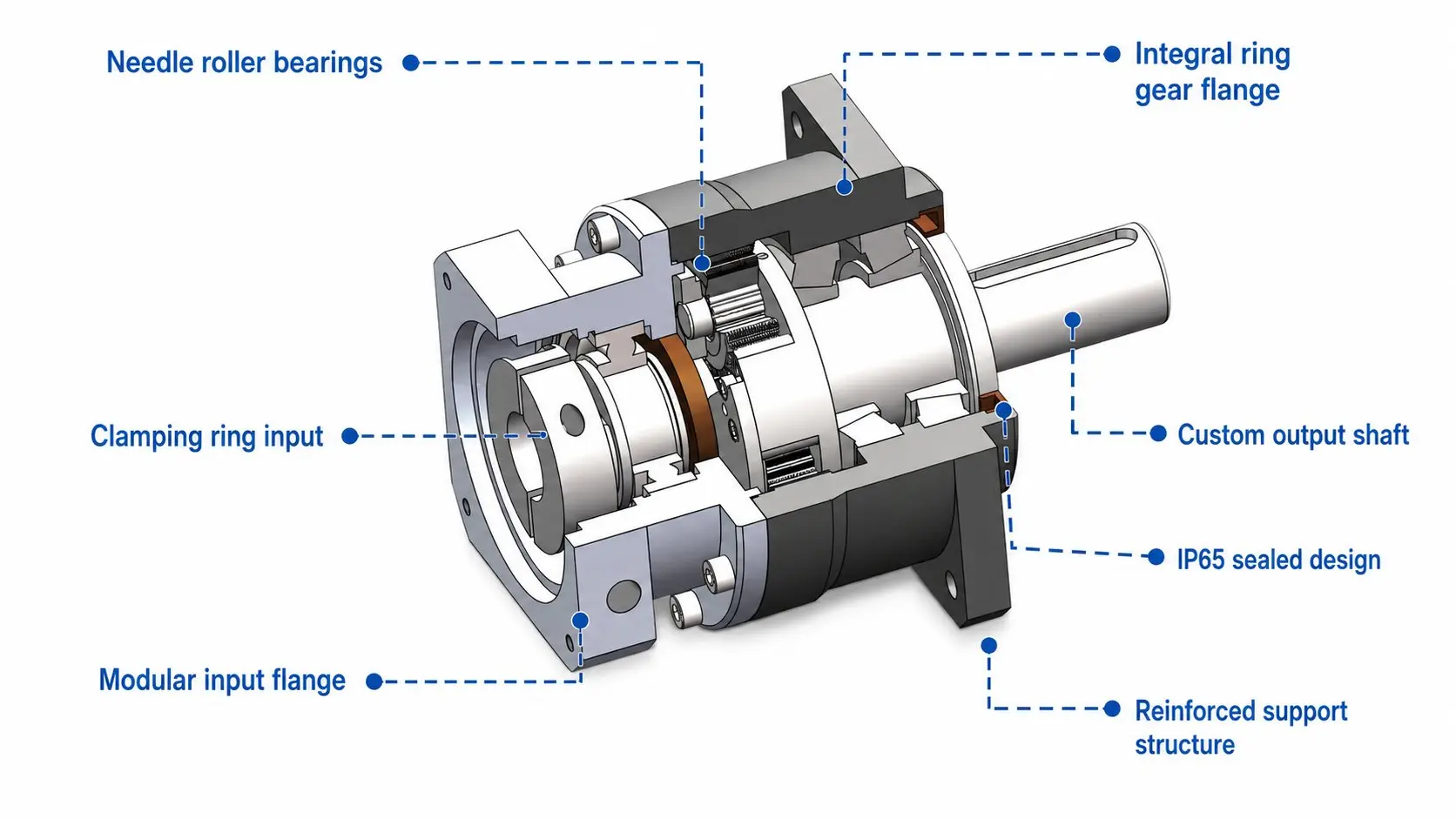
Output bearing L10 fatigue at rated radial + axial load. Gear train life exceeds bearing life — bearing is the first failure mode. | Rated torque, rated input speed (up to 10,000 rpm), ambient ≤40°C, NYOGEL 792D sealed | Robot joints, CNC axes, semiconductor handlers, medical gantries |
| EP-FAB EP-FABR |
20,000 hr | >20,000 hr (calc. higher) |
100% rated output torque |
Output bearing L10 fatigue — square flange design has higher output shaft cantilever load capacity but rated at 20,000 hr due to higher moment loading at the output flange. | Rated torque, rated input speed (up to 6,000 rpm), ambient ≤40°C, NYOGEL 792D sealed | CNC rotary tables, high-torque robot base joints, press cylinder drives |
| EP-FAL EP-FALR |
~15,000 hr
(at full belt tension S1)
|
30,000 hr* (S5 — rated life) |
100% rated output torque + full belt load |
Input bearing L10 — belt tension creates constant radial load at pulley end. Under S5 duty, fatigue cycles accumulate at ~half the S1 rate → L10 doubles. At S1 continuous full belt tension, input bearing is life-limiting at ~15,000 hr. | ★ S5 intermittent duty. Carriage drives, FFS jaw drives, and wide-format axes are inherently S5. Contact Korea Ever-Power for S1 belt-tension life calculation. | FFS jaw drives, carriage belt axes, wide-format inkjet |
| EP-FPG EP-FPGA |
<20,000 hr
(S1 continuous)
|
20,000 hr (S5 — rated life) |
100% rated output torque |
Output bearing L10 fatigue (economy series — DIN Class 6–7 gears produce slightly higher gear mesh load on bearings than DIN Class 5; rated at S5 duty typical for economy applications). | S5 intermittent duty (AGV drive, seeder metering, barn automation). At S1 continuous, bearing life is lower — contact Korea Ever-Power for S1 calculation. | AGV traction, seeder drives, barn automation |
★ FAL/FALR 30,000 hr* is the L10 life at rated output torque, rated speed, and S5 intermittent duty with rest periods sufficient to reduce the input bearing cumulative fatigue cycles to the equivalent of S1 at ~50% duty. The exact S5 duty class (on-time percentage, cycle period) that achieves 30,000 hr depends on the belt tension magnitude — contact Korea Ever-Power with belt tension and cycle profile for a specific life calculation.
IEC 60034-1 Duty Cycles
S1 vs S5 — What Each Duty Class Means and Which One Your Application Uses
Life Calculation Method
The L10 Bearing Life Calculation — How EP-Series Life Figures Are Derived
This worked example shows the general procedure. Korea Ever-Power’s application engineering team performs this calculation as part of the gearbox selection review for any application where service life is a specification requirement — send your typical operating torque (not just rated), typical speed, and duty cycle to [email protected] for a confirmed life calculation.
Life Management
What Shortens Gearbox Life — and the Five Conditions That Extend It Beyond Rating

Related EP-Series and Technical Guides
How to Plan a Maintenance Interval Based on Life Calculation
The L10 life figure is a starting point, not a maintenance interval prescription. The standard practice for precision gearbox maintenance planning in servo automation is to set the planned replacement or inspection interval at a fraction of the calculated L10 — typically 50–70% of L10 in demanding applications (press cylinder drives, continuous-duty printing press drives) and 70–80% in lighter-duty applications (robot joints at typical operating torque). The fraction reflects the engineer’s risk tolerance for unplanned downtime: a gearbox replaced at 50% of its L10 has a very high probability of still being serviceable at replacement time; a gearbox replaced at 90% of L10 has a 10% probability of having already experienced a fatigue event.
For Korea Ever-Power EP-FAD P0 and P1 units, the maintenance planning can be made more precise by using the backlash growth tracking protocol described in the Grade Selection and Printing Press application guides. Rather than replacing the gearbox at a fixed calendar interval, the maintenance team measures backlash at each service interval (annually, or at every N million cycles) and compares it to the nameplate starting value. When the measured backlash has grown to 75–80% of the maximum permissible value for the application’s register tolerance, a replacement is planned for the next scheduled maintenance window. This condition-based approach is more accurate than a fixed-interval approach because it accounts for the actual operating conditions the specific unit has experienced — including periods of higher or lower than typical torque, temperature excursions, and any shock load events — rather than assuming a theoretical average.
For economy series EP-FPG/FPGA units without a per-unit backlash stamp, the maintenance protocol relies on calendar hours and the rated life figure, with periodic visual inspection for bearing noise (a rumbling or grinding sound at normal operating speed indicates that bearing fatigue has begun producing surface damage visible as vibration). Korea Ever-Power recommends recording the operating hours of FPG/FPGA units and planning inspection at 15,000 hr (75% of 20,000 hr S5 rated life). At 18,000 hr, replacement should be planned regardless of condition unless a bearing noise and vibration check confirms acceptable operation. This conservative approach is appropriate for the economy series, where the absence of a per-unit backlash stamp means condition monitoring is less precise than for precision series units.
Frequently Asked Questions — EP-Series Service Life
Editor: Cxm