Technology Comparison
Two Fundamentally Different Approaches to Precision Gear Reduction — And Why One Dominates 90% of Applications
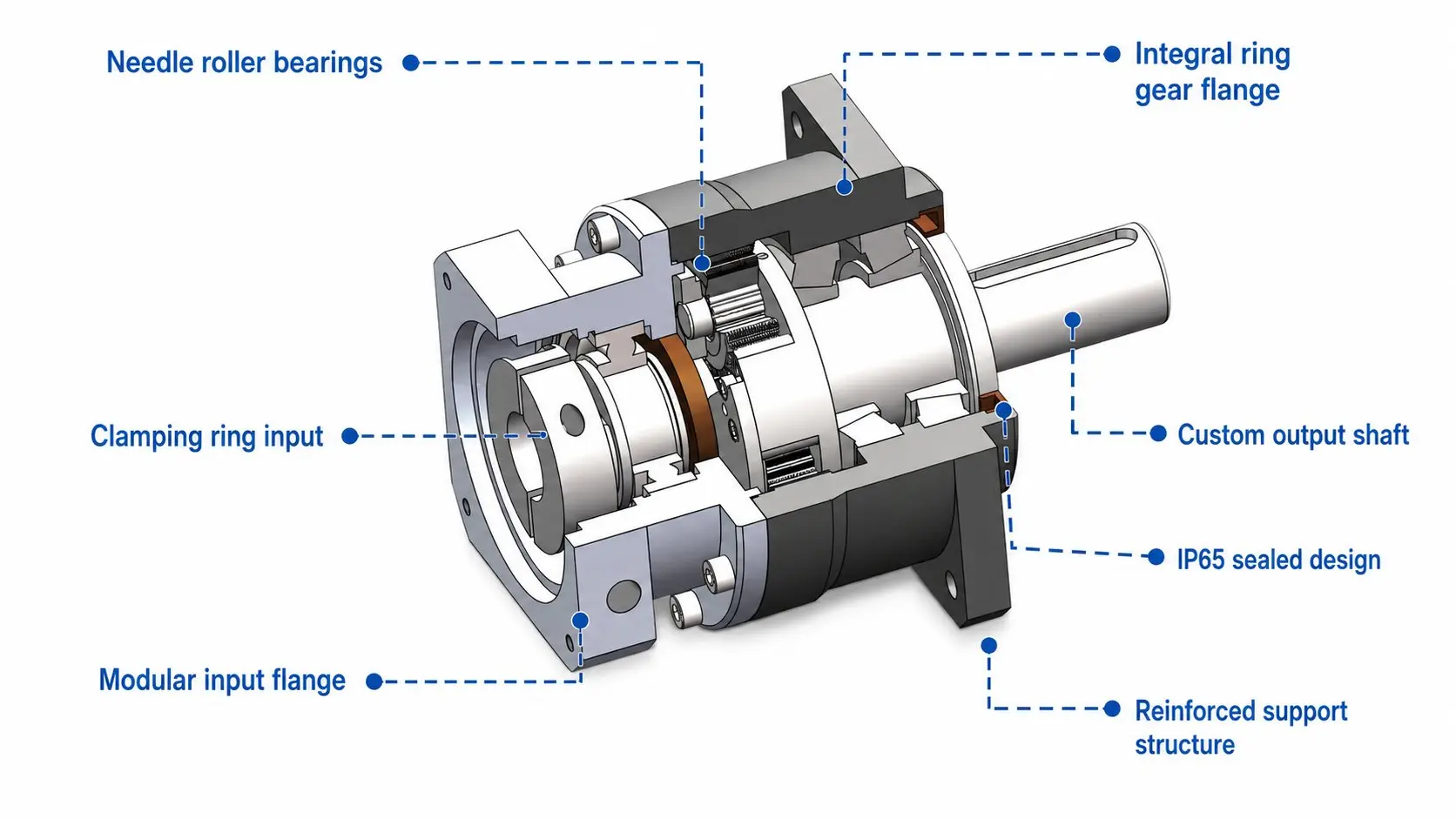
10-Parameter Technology Selection Matrix — Planetary P0 vs Harmonic Drive
The following matrix compares three configurations across ten engineering parameters that precision servo engineers typically specify. Each cell shows the specific value or characteristic, with the column header colour indicating the relative advantage: navy for planetary advantage, amber for harmonic drive advantage, grey for parity. Read each row independently — the correct technology choice emerges from which parameters are decision-critical for your specific application.
| Parameter | EP-FAD P0 Planetary, precision grade |
Harmonic Drive Standard series |
HD Ultra-Precision Premium / superprecision |
Selection notes |
|---|---|---|---|---|
| Backlash (arc-min) |
≤1 arc-min
(0.78 typical, measured+stamped)
|
≤1 arc-min
(similar to P0; some models ±0.5)
|
<0.1 arc-min
(near-zero; true zero with preload)
|
P0 planetary ≈ HD standard. HD Ultra wins if <0.1 arc-min is required without servo compensation. |
| Service life (design life) |
30,000 hr
(L10 bearing fatigue, S1 rated)
|
5,000–15,000 hr
(flexspline fatigue — consumable)
|
5,000–10,000 hr
(thinner flexspline = shorter life)
|
Planetary wins decisively. Flexspline fatigue is 2–6× shorter than planetary bearing life. HD flexspline replacement is a scheduled maintenance cost. |
| Efficiency (at rated torque) |
97–99%
(DIN Class 5 rolling contact)
|
75–85%
(flexspline deformation energy loss)
|
70–80%
(higher preload = more loss)
|
Planetary wins significantly. At 100W motor power, planetary wastes 1–3W; HD wastes 15–30W. Motor sizing, battery life (mobile robots), and thermal management all affected. |
| Shock load tolerance |
High
(3 planets share load; DIN Cl.5 steel; peak 2–3× rated)
|
Low
(flexspline thin wall fatigue; peak 2–4× rated but cumulative)
|
Very low
(thinner flexspline = faster fatigue under shock)
|
Planetary wins decisively. Agricultural equipment, construction robots, any application with mechanical shock: harmonic drive flexspline fatigue failure is a known failure mode. Planetary standard choice. |
| Operating temperature |
−40°C to +125°C
(NYOGEL 792D; sealed lifetime)
|
0°C to +70°C
(standard grease; flexspline steel below 0°C)
|
0°C to +60°C
(tighter tolerance on flexspline)
|
Planetary wins for cold and high-temp. HD flexspline steel becomes brittle below 0°C; NYOGEL-sealed planetary operates to −40°C. Cold-climate robotics, outdoor equipment: planetary. |
| Axial length (disc-form HD) |
Standard gearbox length
(50–120mm depending on frame/ratio)
|
20–40mm disc
(cup-form available; flat disc form very short)
|
15–30mm disc
(ultra-flat — thinnest available)
|
HD wins for ultra-flat requirements. Surgical robot final wrist joint, thin collaborative robot link: disc-form HD is significantly shorter. Note: EP-FADS saves 22mm vs FAD, narrowing (but not closing) the gap. |
| Back-driveability (output→input) |
Medium — can back-drive
(helical gears; back-drive efficiency ~60–80%)
|
Low — difficult to back-drive
(high friction in flex engagement)
|
Very low
(preloaded flexspline increases friction)
|
Depends on application: collaborative robots that must be back-driveable for safe human interaction → planetary advantage. Gravity-holding applications → HD low back-drive can be useful (reduces servo braking power). |
| Efficiency at low speed / low load |
95–98%
(consistent across load range)
|
50–70%
(flexspline deformation loss is load-independent)
|
40–65%
(preload adds constant losses)
|
Planetary advantage increases at partial load. HD flexspline deformation losses are nearly constant (not proportional to torque), so at light loads HD efficiency drops significantly. Battery-powered mobile robots: planetary preferred. |
| Ratio range (single stage) |
5:1 to 100:1
(standard; special: up to 91:1)
|
50:1 to 160:1
(below 50:1 impractical; most common 80:1–160:1)
|
50:1 to 160:1
(same range)
|
Planetary covers low and medium ratios (5:1–50:1) that HD cannot. For high ratios (80:1–160:1), both work. HD is impractical below 50:1 due to geometry. Planetary covers the entire practical range. |
| Unit price (relative) |
100%
(EP-FAD P0 — benchmark)
|
150–250%
(plus flexspline replacement cost at life limit)
|
250–400%
(superprecision grade premium + replacement)
|
Planetary wins significantly. Also: planetary has no scheduled consumable (flexspline). Total cost of ownership gap is wider than unit price comparison shows. |
Specifications shown are representative typical values for comparison purposes. Actual values depend on specific model, frame size, and ratio within each technology. Verify from manufacturer datasheets for your specific application. Harmonic drive life figures are for standard operating conditions at rated load — life varies significantly with duty cycle and torque level.
Engineering Fundamentals
The Flexspline Fatigue Mechanism — Why Harmonic Drives Wear Out 2–6× Faster Than Planetary
The efficiency penalty has a second-order effect on flexspline life that compounds the first-order fatigue argument. A harmonic drive operating at 80% efficiency generates heat within the gear mesh. This heat raises the internal temperature of the gear assembly, which affects the flexspline steel’s fatigue properties: as temperature increases above the steel’s design temperature, the endurance limit decreases, and the fatigue life at a given stress level shortens. In a thermally constrained robot joint where the housing temperature is already elevated by motor losses, the additional 15–20W of flexspline deformation heat pushes the joint temperature higher, further accelerating flexspline fatigue. This thermal-fatigue coupling is one reason why harmonic drive manufacturers specify operating temperature ranges that are tighter than equivalent planetary gearboxes, and why flexspline life in hot environments can be significantly shorter than the rated figure.
The torsional compliance of the flexspline — which contributes to the high torsional stiffness characteristic of harmonic drives — also plays a role in the shock tolerance comparison. The flexspline acts as a torsional spring between the wave generator input and the circular spline output. Under normal operating loads, this spring effect is absorbed by the flexspline material’s elastic range and does not cause immediate damage. Under shock loads — abrupt stops, collisions, or dropped payloads — the spring absorbs energy and deflects beyond the normal operating range, into the plastic deformation zone of the flexspline steel. Each shock event that causes even minor plastic deformation in the flexspline wall accumulates fatigue damage faster than continuous cyclic loading at the rated stress level. This is why harmonic drives are specifically not recommended for applications where shock loads are part of the duty cycle — agricultural equipment, construction robots, human-collaborative robots that may contact obstacles. In contrast, a planetary gearbox under equivalent shock loading distributes the impact across three planets and the ring gear simultaneously, with each contact zone operating well within the elastic range of the DIN Class 5 alloy steel, producing no fatigue damage accumulation from the shock event itself.
Honest Comparison
When Harmonic Drive Is Genuinely the Better Choice — Four Application Scenarios
Selection Framework
The Five-Question Selection Framework — Planetary P0 or Harmonic Drive for Each Joint
Apply these five questions sequentially to each joint. The framework produces the correct technology choice for the overwhelming majority of precision servo applications. For cases where the answers are genuinely ambiguous, a commissioning prototype with both technologies provides the empirical data to resolve the selection.
Worked Selection Example: 6-Axis Collaborative Robot Arm
| Joint | Q1: Backlash | Q2: Axial | Q4: Duty/Shock | Selected | Series |
|---|---|---|---|---|---|
| J1 Base rotation | P1 adequate at large radius | Large housing, no constraint | High duty; occasional shock | Planetary | EP-FAB P1 (high torque) |
| J2 Shoulder | P0 with comp adequate | Link housing, ample space | S5 duty; moderate shock | Planetary | EP-FAD P0 |
| J3 Elbow | P0 adequate | Compact link, check FADS | S5 duty; low shock | Planetary | EP-FADS P0 (compact) |
| J4 Wrist pitch | P0 with comp adequate | Tight wrist — check FADS vs HD | S5 duty; cobotic safety | Planetary | EP-FADS P0 if fits; HD if not |
| J5 Wrist yaw | P0 with comp adequate | Very tight — HD disc likely needed | S5 duty; light shock | HD | HD disc-form (axial constraint) |
| J6 Tool rotation | P0 with comp adequate for collab | Ultra-tight — HD disc only | S5 duty; tool change shock | HD | HD disc-form (axial + ratio) |
This worked example shows a realistic 6-axis collaborative robot where J1–J4 use planetary gearboxes and J5–J6 use harmonic drives — a mixed architecture that optimises cost, life, and efficiency for each joint’s specific constraints. The assumption that “a collaborative robot uses harmonic drives everywhere” leads to unnecessary cost and maintenance burden at J1–J3 where the axial and backlash constraints that justify HD do not apply.
Frequently Asked Questions — Planetary vs Harmonic Drive
Editor: Cxm