EP-FADS Series Adapting-Flange High-Speed Planetary Gearbox | Direct Motor Mount
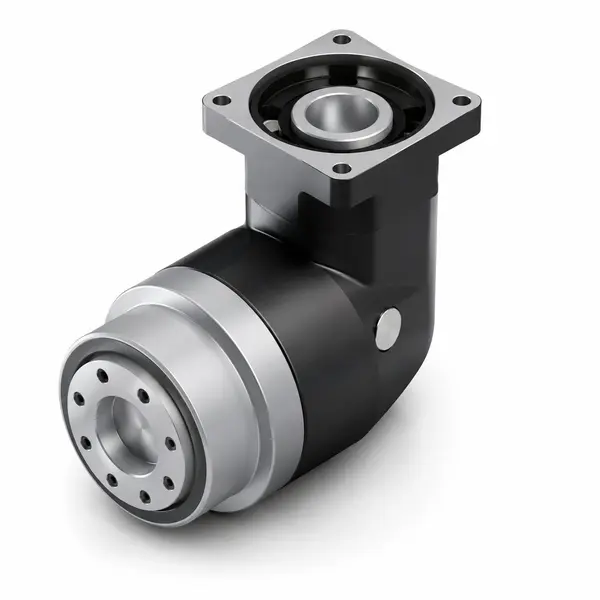
DIRECT SHAFT INSERT
ROUND OUTPUT FLANGE
EP-FADS Series — Adapting-Flange High-Speed Planetary Gearbox
Motor shaft inserts directly into the gearbox input bore — no adapter plate, no clamp ring, minimum axial length. Round output flange, 10,000 rpm, 30,000 hr design life.
Up to 2,000 Nm
i = 4 – 91
30,000 hr Life
IP65
The Adapting-Flange Difference — Why No Adapter Plate?
EP-FAD / EP-FADR — Clamp-Ring Adapter
Motor shaft is clamped via a separate adapter plate and clamp ring. Universal — fits any servo motor flange. Adds 15–30 mm to the axial stack length.
EP-FADS — Adapting Flange (Direct Insert)
Motor shaft inserts directly into a precision-bored input flange machined to the motor's exact shaft diameter. No separate adapter plate. Shortest possible axial dimension.
The EP-FADS uses the same proven high-speed planetary gearset as the EP-FAD — DIN 5 profile-ground helical gears, 30,000-hour bearing life, NYOGEL 792D lifetime lubrication, IP65 sealing, and a circular round output flange. The single change is at the input: instead of a clamp-ring adapter plate, the gearbox input housing is machined with a precision-bored adapting flange that receives the motor shaft directly.
This direct-insert design eliminates the adapter plate thickness (typically 15–30 mm), stiffens the input shaft support, and removes a bolted joint from the torque path. The trade-off is that the input bore is sized for a specific motor shaft diameter — so the motor model is effectively committed at the time of order.
- ◈Shortest axial length in the EP-FAD family — up to 30 mm shorter than EP-FAD with adapter
- ◈Eliminates the adapter plate bolted joint — one fewer potential misalignment source
- ◈Stiffer input shaft support — higher permissible input-side axial and radial force
- ◈Same round output flange, 30,000 hr life, and 10,000 rpm capability as EP-FAD
- ◈Special ratios i=16, 21, 31, 61, 91 available in selected frame sizes
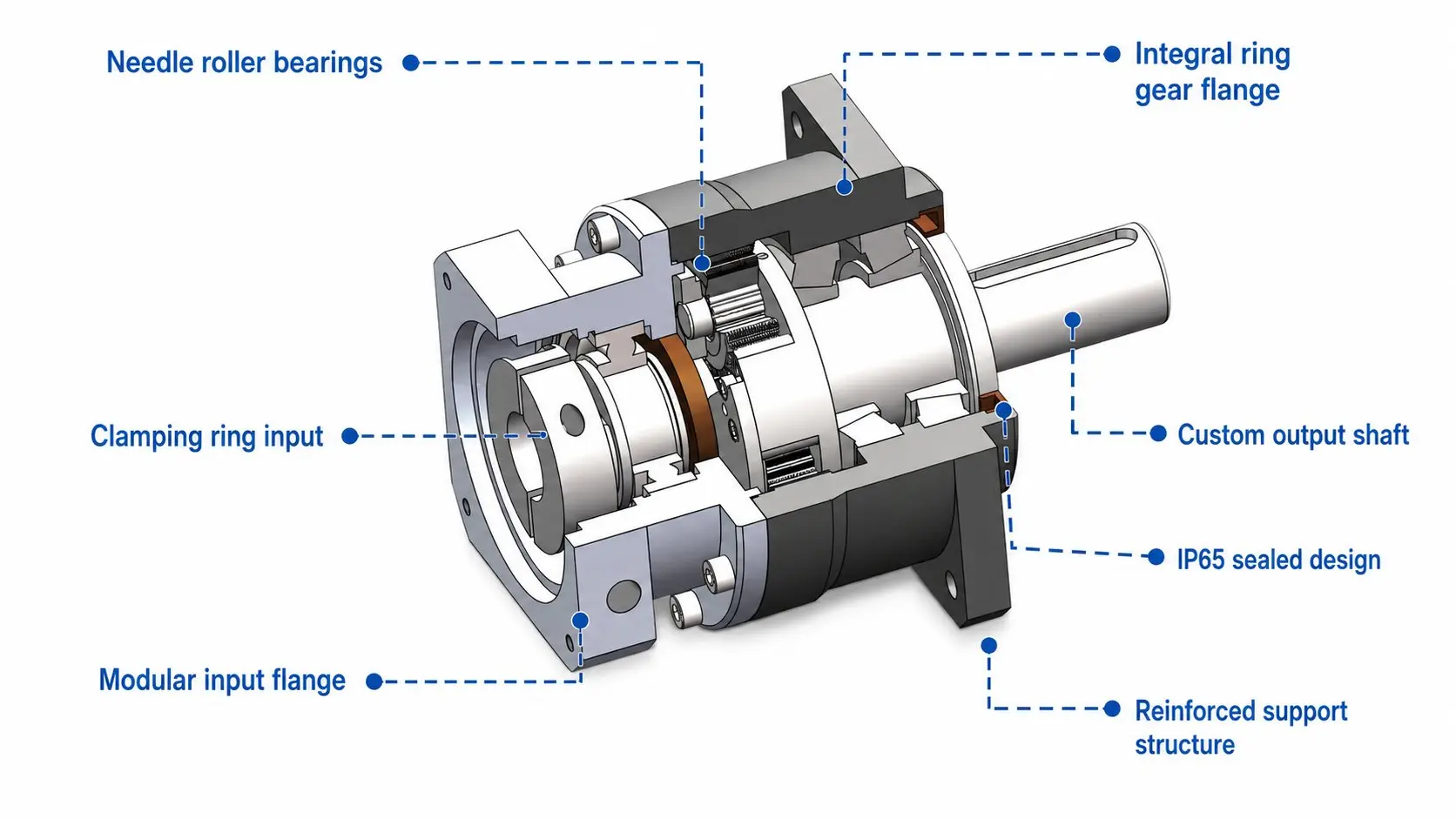
EP-FADS: direct-insert adapting flange input, round output flange
Frame Size Range — EP-FADS047 to EP-FADS255
EP-FADS Series Technical Specifications
| Parameter | EP-FADS047 | EP-FADS064 | EP-FADS090 | EP-FADS110 | EP-FADS140 | EP-FADS200 | EP-FADS255 |
|---|---|---|---|---|---|---|---|
| Rated Output Torque T₂ₙ (Nm) — 1-stage (i=4–10) | |||||||
| i=4 | 19 | 48 | 130 | 270 | 560 | 1,100 | 1,700 |
| i=5 | 22 | 60 | 160 | 330 | 650 | 1,200 | 2,000 |
| i=7 | 19 | 50 | 140 | 300 | 550 | 1,100 | 1,800 |
| i=10 | 14 | 40 | 100 | 230 | 450 | 900 | 1,500 |
| Rated Output Torque T₂ₙ (Nm) — 2-stage + special ratios (i=16–91) | |||||||
| i=16 / 21 | 19 | 48 / 60 | 130 / 160 | 270 / 330 | 560 / 650 | 1,100 / 1,200 | 1,700 / 2,000 |
| i=31 / 61 | 19 | 50 | 140 | 300 | 550 | 1,100 | 1,800 |
| i=91 | 14 | 40 | 100 | 230 | 450 | 900 | 1,500 |
| Performance Parameters | |||||||
| Max Output Torque T₂ₘₐₓ | 3× rated torque (all sizes) | ||||||
| Rated Input Speed nᵢₙ (rpm) | 5,000 | 4,000 | 4,000 | 3,000 | 3,000 | ||
| Max Input Speed nᵢₙₘₐₓ (rpm) | 10,000 | 8,000 | 7,500 | 4,500 | 4,500 / 3,800 | ||
| Backlash P0 — Ultra-Precision (arc-min) | — (N/A, 1-stage) | ≤1 (1-stage) / ≤3 (2-stage) | |||||
| Backlash P1 — Precision (arc-min) | ≤3 (1-stage) / ≤5 (2-stage) | ||||||
| Backlash P2 — Standard (arc-min) | ≤5 (1-stage) / ≤7 (2-stage) | ||||||
| Torsional Rigidity (Nm/arc-min) | 3 | 7 | 14 | 25 | 50 | 145 | 225 |
| Max Bending Moment Mₘₐₓ (Nm) | 42.5 | 125 | 235 | 430 | 1,300 | 3,064 | 5,900 |
| Permissible Output Axial Force F_ax_out (N) — 1-stage | 580 | 1,000 | 1,100 | 980 | 2,700 | 4,700 | 8,000 |
| Permissible Output Axial Force F_ax_out (N) — 2-stage | 580 | 580 | 1,000 | 1,100 | 980 | 2,700 | 4,700 |
| Permissible Input Axial Force F_ax_in (N) — 1-stage | 165 | 395 | 1,300 | 1,525 | 2,800 | 4,500 | 12,500 |
| Permissible Input Axial Force F_ax_in (N) — 2-stage | 165 | 395 | 395 | 1,300 | 1,525 | 2,800 | 4,500 |
| Service Life (hr) | ≥30,000 | ||||||
| Efficiency η — 1-stage / 2-stage | ≥97% / ≥94% | ||||||
| Weight — 1-stage (kg) | 0.8 | 1.4 | 3.4 | 6.7 | 13.5 | 35.0 | 63.8 |
| Weight — 2-stage (kg) | 1.1 | 1.6 | 4.0 | 7.3 | 16.6 | 36.4 | 74.7 |
| Operating Temperature | -10°C to +90°C | ||||||
| Lubricant | NYOGEL 792D (synthetic, lifetime) | ||||||
| Protection Class | IP65 | ||||||
| Mounting Direction | Any direction | ||||||
| Noise (nᵢₙ=3,000 rpm, dB) | ≤56 | ≤58 | ≤60 | ≤63 | ≤65 | ≤67 | ≤70 |
Note: P0 grade (≤1 arc-min, 1-stage) not available for EP-FADS047 and EP-FADS064 — minimum P0 starts at EP-FADS090. Max input speed varies by frame; EP-FADS255 is limited to 3,800 rpm max. * Continuous-duty life assumes mean load at 50% of rated torque.
Engineering Features
Direct-Insert Adapting Flange
Motor shaft inserts directly into a precision-bored input flange — no clamp ring, no adapter plate. Eliminates one bolted joint from the torque path and reduces axial stack length by up to 30 mm.
Round Output Flange
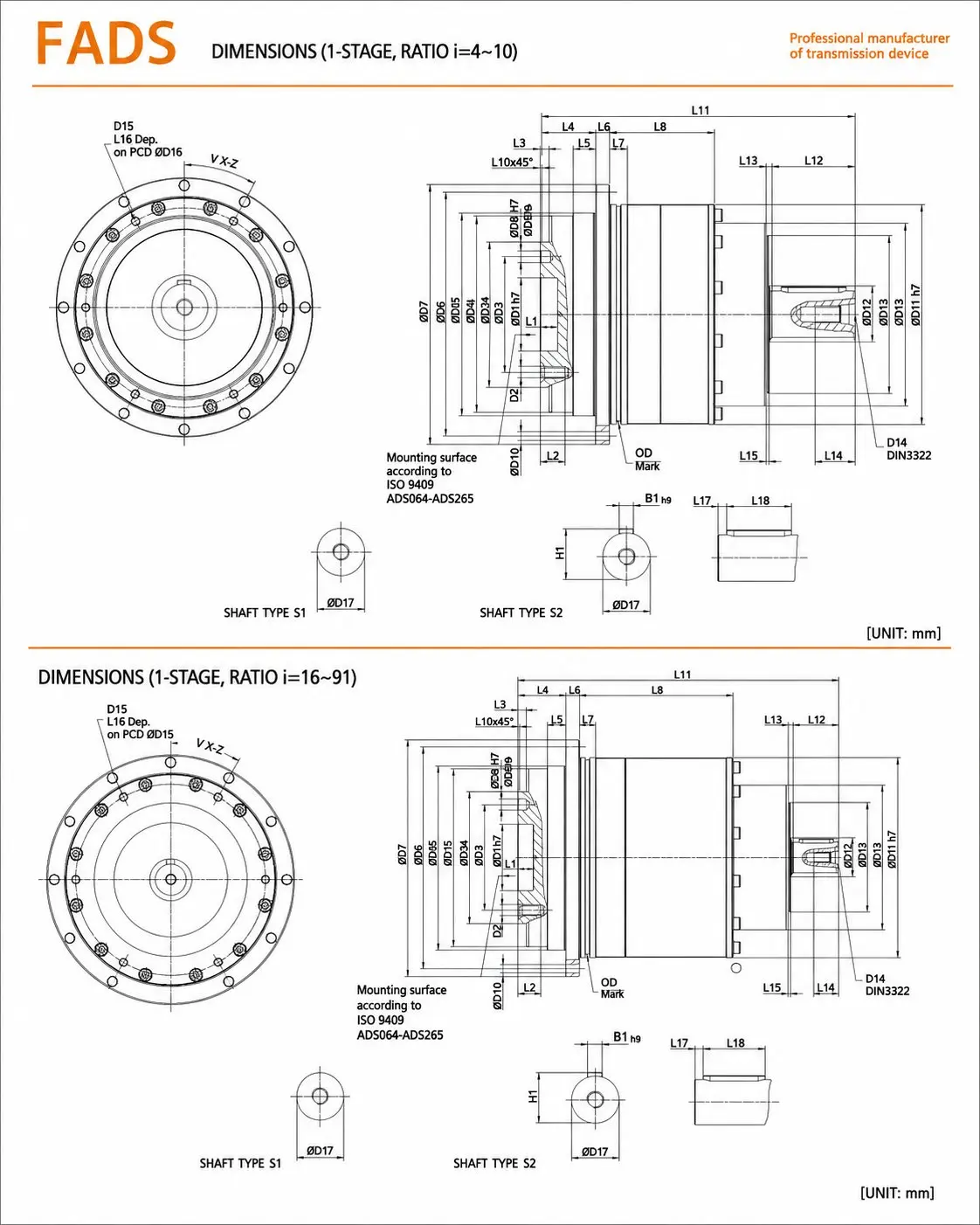
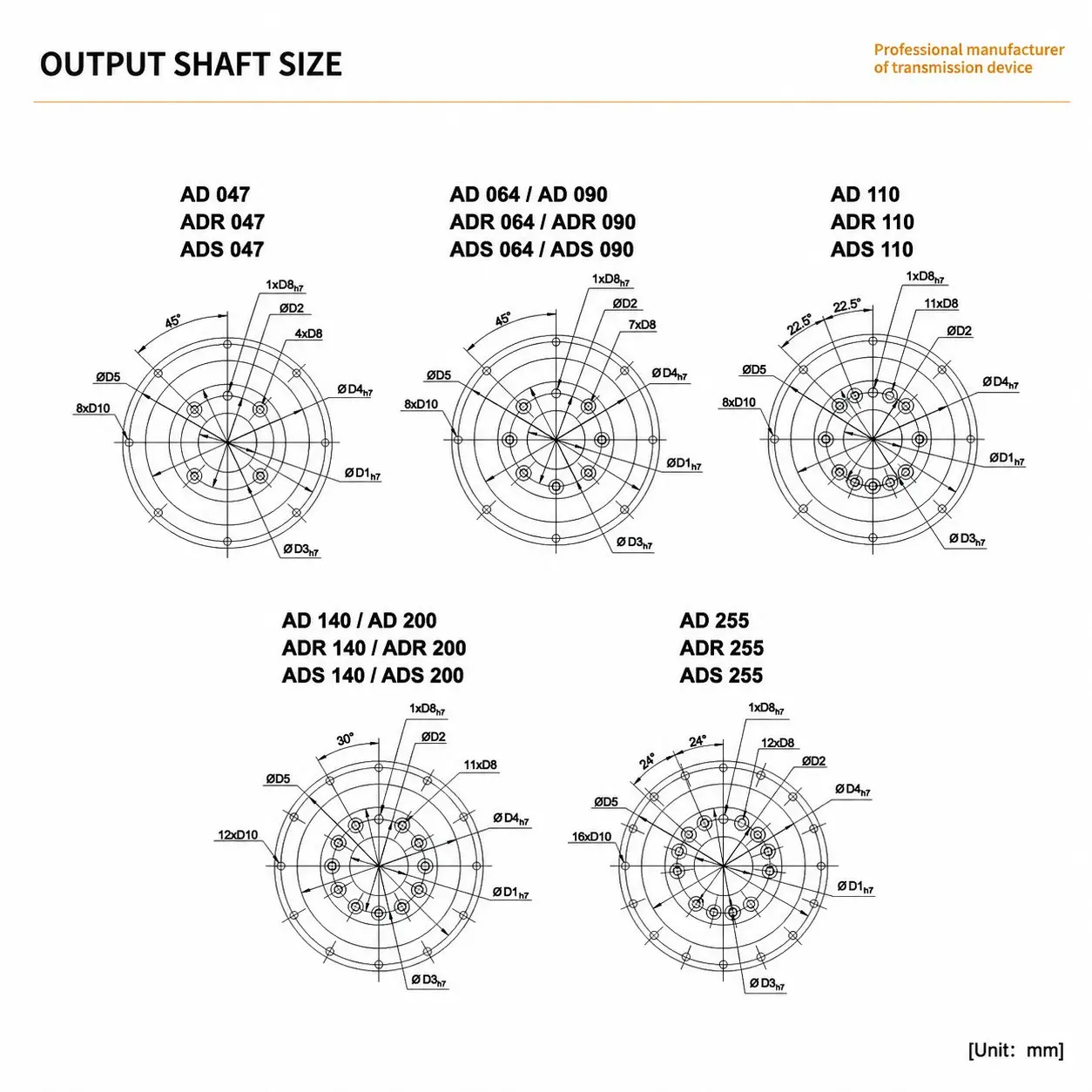
Identical circular bolt-circle output flange to the EP-FAD. Bolt-circle diameter D1 from 12 mm (EP-FADS047) to 100 mm (EP-FADS255), matching mainstream rotary table and actuator body interfaces.
30,000-Hour Design Life
Same upgraded bearing selection and lubrication geometry as the EP-FAD platform. 30,000-hour L10 calculated bearing life under rated conditions — equivalent to roughly 15 years of two-shift operation.
Special Ratios i=16/21/31/61/91
Five non-standard ratios for semiconductor pitch-matching and FPD transport speed applications — available in EP-FADS064 through EP-FADS255. Same special-ratio availability as the EP-FAD, up to i=91.
Higher Input Axial Force Rating
The direct-insert input bore provides stiffer shaft support than a clamp-ring adapter, raising the permissible input axial force (F_ax_in) — up to 12,500 N at EP-FADS255 1-stage. Valuable for vertical-axis direct-mount configurations.
DIN 5 Profile-Ground Gears
Same 5-axis CNC profile-ground helical planetary gearset as the EP-FAD. Efficiency ≥97% (1-stage), ≥94% (2-stage) — identical to the EP-FAD, superior to the bevel-output EP-FADR.
Motor Assembly — Direct-Insert Process
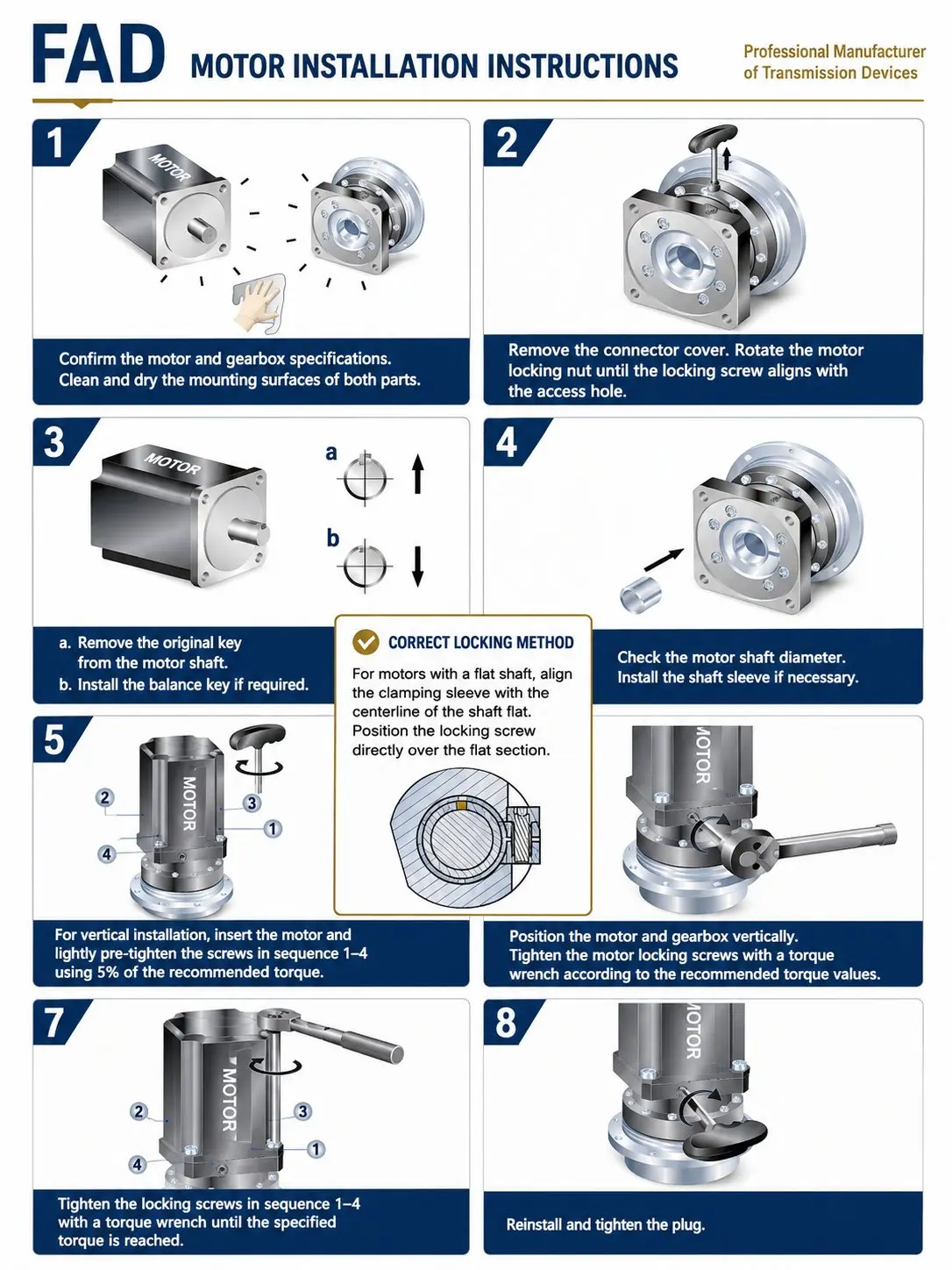
EP-FADS direct-insert input flange and round-output-flange dimensions
Because the EP-FADS uses a direct-insert input bore instead of a clamp-ring adapter plate, the assembly process differs from the EP-FAD at the input end. The output end (round flange) mounts identically to the EP-FAD.
The input bore diameter is machined to match your specified motor shaft diameter. Before ordering, confirm the motor shaft diameter, shaft length, and key/keyway dimensions (if applicable). Korea Ever-Power machines the input bore to the specified tolerance class (typically h6/H7 interference-to-transition fit) at time of manufacture — this cannot be changed in the field.
The motor shaft is retained in the adapting flange bore by a clamping collar and retaining screws. Torque all retaining screws to the specification in the installation manual in a cross pattern. Do not use adhesive bonding — thermal cycling will loosen bonded joints and make disassembly difficult.
The round output flange assembly is identical to the EP-FAD: use dowel pins for initial centring, verify bolt-circle match (D8/D9), and tighten bolts in a cross pattern. Verify minimum 2 mm axial clearance at the output shaft tip after final assembly.
Manufacturing & Quality Assurance

The adapting-flange input bore is precision-ground to the specified motor shaft diameter and tolerance class on a CNC cylindrical grinder. Concentricity of the bore relative to the planetary stage centreline is verified by CMM after machining.
Every EP-FADS unit runs at rated input speed (up to 10,000 rpm for small frames) to confirm bearing pre-load, thermal stability, and oil film formation before backlash measurement.
Backlash measured on every unit with a calibrated torque arm. P0/P1/P2 grade stamped on the nameplate. EP-FADS047 and EP-FADS064 are rated from P1; P0 starts at EP-FADS090.
Pneumatic pressure applied to all dynamic seal interfaces — including the input flange bore seal where the motor shaft enters. Any pressure decay over the 60-second test window triggers rejection and resealing.
Primary Application Areas
Ultra-Compact Semiconductor Axes
Wafer stage theta-axis and die bonder rotary axes where every millimetre of axial length matters. Removing the adapter plate frees space for encoder cables and sensor routing inside the stage housing.
FPD Glass Transport
Glass panel transfer robot joints where special ratios i=21/31 match substrate pitch exactly and the direct-insert input eliminates one potential run-out contributor in the drive chain.
Space-Constrained CNC Axes
4th/5th axis rotary tables where the overall package depth is limited by the machine column clearance. The FADS's shorter axial length can make the difference between fitting inside or outside the column envelope.
Slim-Profile Robot Joints
Collaborative robot (cobot) joints where the link profile must remain within a narrow cross-section for human-robot workspace sharing. Direct-insert input reduces joint axial length and arm reach-to-payload ratio.
Vertical Load-Holding Axes
The higher input axial force rating (F_ax_in up to 12,500 N) suits vertical servo axes where the motor weight rests on the gearbox input shaft — a configuration that can overload the input bearing of a clamp-ring adapter gearbox.
Medical & Lab Automation
Sample handling robot joints and diagnostic instrument axes where the direct-insert design reduces the part count in the drive chain and eliminates the adapter plate as a potential particulate shedding surface near clean areas.

How to Order — EP-FADS Order Code
The EP-FADS order code follows the same structure as the EP-FAD, with one additional required field: motor shaft diameter. This is used to machine the adapting-flange input bore to the correct dimension at the factory.
—
021
—
S1
—
P1
—
Ø14
/
YASKAWA SGMJV-04ADE6S
| Code Field | Options | Notes |
|---|---|---|
| Model | EP-FADS047 / EP-FADS064 / EP-FADS090 / EP-FADS110 / EP-FADS140 / EP-FADS200 / EP-FADS255 | Select by output torque and round-flange bolt-circle requirements |
| Ratio | 1-stage: 4, 5, 7, 10 | Special/2-stage: 16, 21, 31, 61, 91 | 3-digit code: "021" = i=21, "091" = i=91. Max ratio is 91 (vs 100 on EP-FAD) |
| Output Shaft | S1 = smooth round shaft | S2 = splined / clamp shaft | S1 for flexible couplings; S2 for rigid direct connection |
| Precision Grade | P0 = ≤1 arc-min (EP-FADS090+) | P1 = ≤3 arc-min | P2 = ≤5 arc-min | P0 not available for EP-FADS047 and EP-FADS064 |
| Motor Shaft Diameter ★ | Specify motor shaft diameter in mm (e.g. Ø14, Ø19, Ø22) | Required for FADS — input bore is machined to this dimension at the factory. Cannot be changed after manufacture. |
| Motor | Motor manufacturer name + model number | Used to verify shaft diameter and key dimensions |
Complementary Products
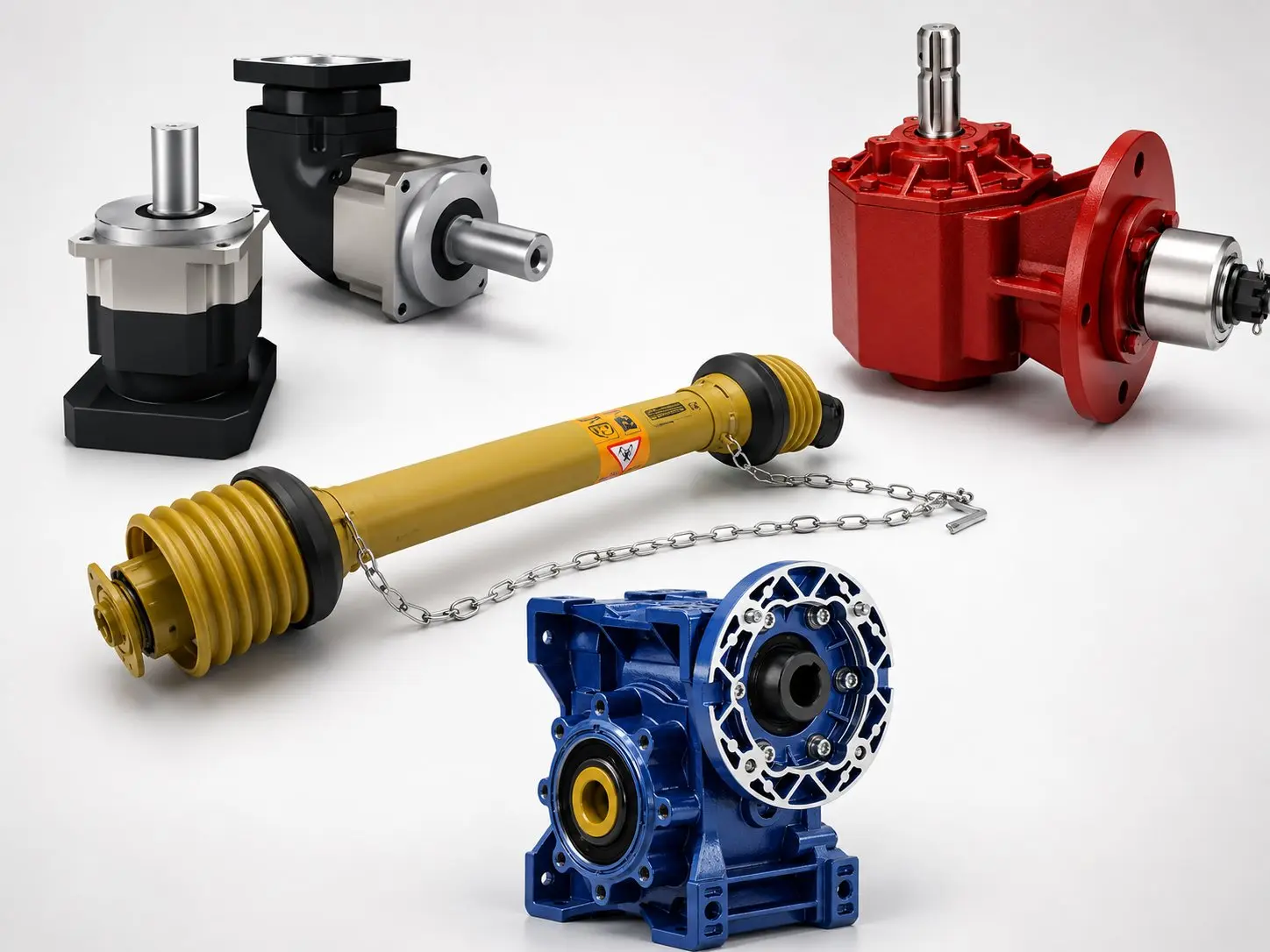
Clamp-ring adapter input, round flange output. Choose when motor model is not fixed or may change during the machine's lifecycle. Ratios up to i=100.
Round flange + 90° right-angle output. When a right-angle drive is needed alongside the round-flange interface, choose the FADR over the FADS.
Square-flange inline gearbox with clamp-ring adapter. For applications where a square-flange interface is standard and the lowest P0 backlash (≤1 arc-min from EP-FAB042) is the priority.
Constant-velocity couplings for connecting EP-FADS round-flange output to articulating or misaligned load shafts in robot joints and AGV drivetrains.
Ready to Specify Your EP-FADS Gearbox?
Provide your motor model and shaft diameter, required output torque, gear ratio, and round-flange bolt-circle requirements. The motor shaft diameter is required to machine the adapting-flange input bore — confirm it before ordering.
Frequently Asked Questions
What Engineers Say About the EP-FADS Series
Feedback from machine builders using the EP-FADS adapting-flange series in compact, high-precision servo axes.
We switched from EP-FAD090 with adapter to EP-FADS090 on our wafer stage theta axis. The 22 mm axial length saving let us route the encoder cable inside the housing without external cable management — a critical improvement for our ISO Class 4 cleanroom where hanging cable loops attract particles. Backlash at P1, running 8,500 rpm for 14 months without issue.

"Our collaborative robot joint needed to fit inside a 95 mm diameter link cross-section. EP-FADS064 at i=16 was the only option in its torque class that fit — the direct-insert input saves 18 mm vs the clamp-ring equivalent. After 10 months of 24/7 operation, zero backlash growth."
"EP-FADS110 on a vertical servo axis with the motor mounted above the gearbox. The higher F_ax_in rating (1,525 N vs ~800 N on the clamp-ring equivalent) safely carries the motor weight as axial input load. One note: confirm shaft diameter carefully — we had to re-order one unit after a motor change. Factor lead time into your schedule for first orders."
"We produce 2,000 units per year of the same 5-axis CNC table and the motor model has been fixed for 8 years. The EP-FADS's shorter axial stack let us reduce the table base casting by 25 mm, saving approximately 1.8 kg of iron per machine — that's 3,600 kg of cast iron per year off our bill of materials."
"We evaluated the EP-FADS047 at i=61 for a sample carousel drive in our diagnostic instrument. The 10,000 rpm capability, ≤56 dB(A) noise, and 22 mm shorter overall length compared to the EP-FAD047 with adapter were the three deciding factors. The adapting-flange bore was machined to our Maxon EC motor shaft in 2 weeks from order — faster than we expected."
Editor: Cxm
Additional information
| Editor | Cxm |
|---|
Related products
-
EP-HAB Series High Rigidity Planetary Gearbox — ≤3 Arcmin Ultra Precision, IP65 Sealed
-
EP-WPBL/WPBF Series High Precision Right-Angle Planetary Gearbox — ≤8 Arcmin, IP65, 90° Output
-
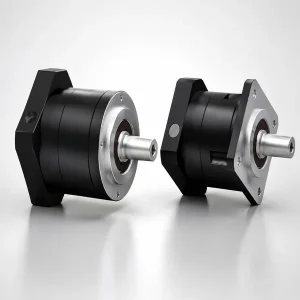
EP-PBL/PBF Series High Precision Planetary Gearbox — ≤5 Arcmin Backlash, IP65 Sealed
-
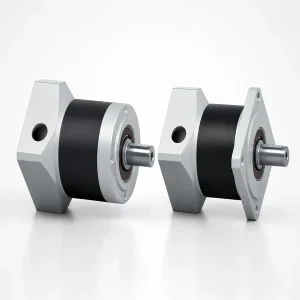
EP-PL/PF Series Standard Precision Planetary Gearbox — Round & Square Flange Inline Output
-
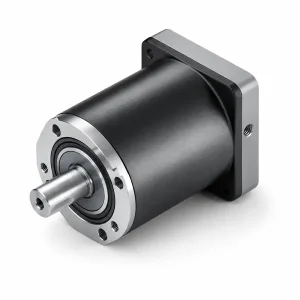
EP-FPG / EP-FPGA Series Economy Planetary Gearbox | Round & Square Housing
-
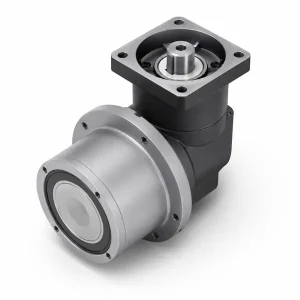
EP-FALR Series Right-Angle Planetary Gearbox with Integrated Timing Belt Pulley
-
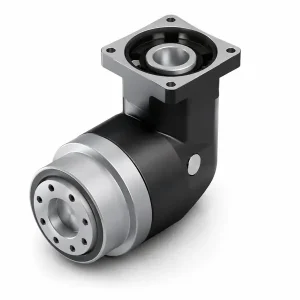
EP-FADR Series Right-Angle High-Speed Planetary Gearbox | Round Flange 90°
-

EP-FAB Series High Precision Planetary Gearbox | Square Flange Inline