Planetary Gearbox for Medical & Laboratory Automation — Surgical Robots, Diagnostic Instruments & Lab Gantry Systems

≤56 dB
Noise Level — EP-FPG040
≤1 아크분
P0 Backlash — FADS Surgical
−22 mm
Axial Saving — FADS vs FAD
ISO 5
Cleanroom — FADS Zero-Particle
IP54
Surgical / Rehab Robot
30,000 시간
Design Life — EP-FAD / FADS

Engineering Context

Why Medical & Lab Automation Demands More Than Precision — Noise, Particles, and Non-Magnetic Compliance

EP-FADS compact planetary gearbox for surgical robot wrist axis — zero lube particles cleanroom ISO Class 5 minimum axial length

Korea Ever-Power EP-FADS P0 — the compact surgical and medical robot wrist gearbox. Direct-insert motor shaft saves 22 mm axial vs. FAD-plus-adapter. NYOGEL 792D sealed lifetime fill produces zero detectable particles in ISO Class 5 cleanroom operation.

Medical and laboratory automation imposes a set of requirements that no other industry combines in the same way. Precision alone — the ≤1 arc-min backlash grade that defines the EP-FADS and EP-FAD P0 series — is necessary but not sufficient. Three additional compliance dimensions determine whether a gearbox is acceptable in medical and laboratory environments, and all three are independent of the precision specification.

The first is acoustic noise. An operating theatre has a mandated ambient noise level below 40 dB during surgical procedures — any powered equipment operating in or near the theatre must be below this threshold. A diagnostic laboratory adjacent to patient care areas has similar constraints under hospital facilities regulations. Rehabilitation robots operating in patient proximity must meet worker health and safety noise limits that industrial robots in a factory never encounter. EP-FPG040 measured at ≤56 dB at rated load, and EP-FAD090 at approximately 55–58 dB, satisfy these requirements where worm gearboxes running at 60–70 dB do not.

The second is particle emission. An ISO Class 5 cleanroom (≤3,520 particles ≥0.5 µm per m³) used in pharmaceutical compounding, semiconductor-grade diagnostic assay production, or surgical implant assembly cannot tolerate lubricant particles from a gearbox with external grease ports or a failed IP seal. NYOGEL 792D in EP-FADS, EP-FAB, and EP-FAD is sealed within the housing with no external access points — in normal rotary operation within the rated temperature range, no detectable particles enter the cleanroom air stream from the gearbox body. EP-FADS eliminates the motor adapter plate that creates crevices around the input end — crevices that can trap biological residue in medical environments.

The third is non-magnetic compatibility. CT and MRI system patient table drives, and any equipment operating in the magnetic field zone of an MRI scanner, must use non-magnetic components to avoid image artefacts. EP-FADS aluminium housing variants are available as a non-magnetic option for these applications — the same gear train, P0 backlash grade, and NYOGEL 792D lubrication in an aluminium housing that does not perturb a magnetic field.

🏥
The EP-FADS Advantage for Surgical Robots: 22 mm and Zero External Interfaces
Minimally invasive surgical robots require the smallest possible wrist joint envelope to maximise instrument access angle through a trocar port. EP-FADS saves 22 mm of axial length at the J4/J5/J6 wrist axes compared to EP-FAD plus a standard motor adapter plate — the motor shaft inserts directly into the gearbox input coupling with no external adapter plate and no crevice between plate and housing. In the context of a surgical robot where the wrist diameter is constrained by the trocar diameter (typically 5–15 mm working channel), and where any external surface must be cleanable to sterilisation standards, the combination of reduced axial length and elimination of the adapter plate crevice addresses both the geometry constraint and the sterile field compliance requirement simultaneously.

Medical & Lab Deployment Zone Compliance Map — Noise, Cleanroom Class, Lubrication & EP-Series

The following map shows the compliance requirements across six medical and laboratory deployment zones, and the EP-series that meets each zone’s combined noise, particle, and lubrication requirements. Use this as the starting point for specification — identify your deployment zone first, then confirm the series from the table in Section 3.

Deployment Zone Max Acceptable
Noise Level
Cleanroom /
Particle Class
Lubrication
Requirement
Non-Magnetic
Required?
Compliant
EP-Series
Typical Application
Operating Theatre
Sterile surgical field
≤40 dB
WHO surgical suite standard
ISO 5–6
≤3,520 particles/m³ ≥0.5µm
Sealed only
No external grease points; no particle emission
No (MRI-free zone)
EP-FADS P0
NYOGEL sealed; no adapter plate crevice; 22mm compact
Surgical robot wrist J4/J5/J6; endoscope drive
ISO 5–6 Cleanroom
Pharma compounding / assay
≤60 dB
Personnel regulation (8hr)
ISO 5–6
Zero-particle emission required
Sealed only
NYOGEL 792D validated; no external ports
No
EP-FADS P0
EP-FAD P0/P1
NYOGEL sealed; ≤58 dB
Drug discovery robot; cell culture arm; sterile compounding robot
Clinical Laboratory
Open lab with personnel
≤65 dB
ISO 11690 lab noise
Unclassified
Contained lube preferred
Sealed preferred
Long maintenance-free interval
No
EP-FAD P1
EP-FPG P1
≤56–58 dB; long service
Diagnostic analyser carousel; lab gantry pipettor; automated liquid handler
Patient Care Area
Ward / rehab / therapy
≤55 dB
Hospital ward night limit
Unclassified
Standard IP54 minimum
Sealed preferred
No external maintenance access
No (standard)
EP-FAD P0
≤56 dB; backdrivable; IP54
Rehabilitation robot joint; exoskeleton; patient positioning table drive
MRI Suite
High magnetic field zone
≤55 dB
Patient environment
Unclassified
Standard sealing
Sealed preferred
Low vibration critical
YES — critical
aluminium housing
EP-FADS P0/P1
Aluminium housing option; non-magnetic; ≤56 dB
MRI-guided robot axis; patient table positioning; RF coil positioning
Radiotherapy Suite
Linear accelerator / proton
≤60 dB
Treatment room standard
Unclassified
IP65 for cleaning protocols
Sealed IP65
Radiation tolerance required
Depends on system
EP-FAB P0
P0 accuracy; IP65; backlash stability
Linac gantry rotation; treatment couch positioning; beam collimator drive

Noise limits are representative regulatory/guideline values for each zone type; actual requirements vary by country, facility type, and specific equipment class. ISO cleanroom class corresponds to ISO 14644-1. Non-magnetic requirement should be confirmed with the MRI system manufacturer for the specific field strength and patient zone. EP-series performance values (noise, particle emission) are based on manufacturer test data for sealed units in normal operating conditions.

Application Scenarios

Six Medical & Laboratory Applications — Series Selection, Engineering Rationale, and Compliance Requirements

Medical and laboratory automation spans the full range of EP-series from precision surgical EP-FADS P0 to economy diagnostic EP-FPG P1 — with noise, particle, and IP requirements that differ by deployment zone. The six scenarios below cover the most common drive applications in medical device OEM engineering, with the compliance rationale for each series selection alongside the performance specification.

01 — Minimally Invasive Surgical Robot Wrist
J4/J5/J6 axes — fixed motor, sterile field
EP-FADS P0
Frame 047–060 mm
ISO 5 cleanroom

Minimally invasive surgical robots require the smallest possible wrist joint diameter and axial length to fit through a trocar port (typically 5–15 mm diameter working channel) while maintaining sub-millimetre positional precision at the instrument tip. Every millimetre of axial length at the J5/J6 wrist joint either reduces the instrument approach angle or increases the trocar size required. EP-FADS saves 22 mm of axial length compared to EP-FAD plus a standard motor adapter plate — the servo motor shaft inserts directly into the gearbox input coupling. This 22 mm difference is often what determines whether encoder signal cables can route inside the hollow wrist link structure rather than externally, which in a sterile field is a clinical safety requirement.

Compliance: NYOGEL 792D sealed — zero particle emission in ISO Class 5 operating theatre environment. No external adapter plate crevices. ≤1 arc-min P0 for sub-mm instrument tip precision at 400 mm reach. IP54 splash resistance for surgical fluid exposure. 30,000 hr design life at 6,000 rpm.

02 — Rehabilitation Robot Joint Drive
Patient-assist exoskeleton / therapy robot
EP-FAD P0
Frame 047–090 mm
≤55 dB ward

Rehabilitation robots and lower-limb exoskeletons operate in direct contact with patients, in patient wards and physiotherapy rooms where hospital noise regulations limit continuous mechanical sound to approximately 55 dB during daytime hours and lower at night. The gearbox must also support safe backdrivability — the ability for the patient (or a therapist overriding the robot) to push the joint against the motor resistance without requiring excessive force. EP-FAD P0 with helical planet gears produces low friction in the backdrive direction: the helical gear geometry is inherently more backdrivable than worm gearing, and the P0 backlash grade minimises the dead zone the patient must overcome before the joint responds. IP54 splash protection covers incidental exposure to cleaning fluids and perspiration.

Compliance: ≤56 dB at rated speed (EP-FAD060); ≤1 arc-min P0; low backdrive friction (helical gears); IP54; NYOGEL 792D sealed; 30,000 hr — no scheduled maintenance within device service life.

03 — CT / MRI Patient Table Drive
Table positioning axis — MRI non-magnetic option
EP-FAD P1 / FADS
Frame 090–110 mm
Non-magnetic option

CT scanner patient tables require smooth, vibration-free positioning over a range of typically 1,500–2,000 mm with ±1 mm repeatability — any vibration in the gantry drive is visible as image artefact in reconstructed cross-sections. EP-FAD P1 helical gears produce the lowest vibration at rated table advance speed. For MRI suite installations, where the gantry drive operates in the 1.5–3.0 Tesla fringe field zone, ferromagnetic components can cause image distortion and present a physical safety hazard. EP-FADS aluminium housing variant provides a non-magnetic option for these installations — same gear train, same P0/P1 backlash grade, same NYOGEL 792D lubrication in an aluminium housing that does not disturb the MRI magnetic field.

Compliance: Low vibration (helical gears); ≤3 arc-min P1; non-magnetic aluminium housing option (FADS); 10–30:1; 3,000 rpm; quiet for patient environment; 30,000 hr maintenance-free.

04 — Radiotherapy Gantry Rotation Drive
Linear accelerator beam head — treatment angle precision
EP-FAB P0
Frame 110–142 mm
Zero backlash growth

Radiotherapy linear accelerator gantry drives rotate the beam head around the patient to deliver treatment arcs at precise angles — angular positioning error directly affects radiation dose accuracy and increases healthy tissue exposure. The regulatory tolerance for beam positioning accuracy in IEC 60601-2-1 is ±1°, but modern VMAT (volumetric modulated arc therapy) techniques require ±0.1° in continuous rotation. This demands ≤1 arc-min P0 backlash grade that does not degrade over the gantry service life: a gearbox that starts at P0 but drifts to P1 after 5,000 hours requires recalibration at a critical medical system. Korea Ever-Power individual backlash grade stamping documents the starting value — enabling service teams to track actual backlash growth by measurement at each maintenance interval.

Compliance: ≤1 arc-min P0 — individual stamp for IEC 60601 traceability; IP65 for treatment room cleaning protocols; 10–50:1; DIN Class 5 gears minimise backlash growth rate; CE documentation support.

05 — Laboratory Gantry Pipettor X/Y Drive
Automated liquid handler — microplate positioning
EP-FAL P1
Frame 070–090 mm
Sub-0.1 mm repeatable

Laboratory gantry pipettors — automated liquid handlers for 96-well, 384-well, and 1536-well microplate formats — require sub-0.1 mm positional repeatability at the pipette tip to hit each well accurately and avoid cross-contamination between wells. At a typical 9 mm well pitch (96-well format), a positioning error of more than 2–3 mm causes the pipette to miss the well entirely. EP-FAL P1 with the integrated belt pulley provides sub-0.1 mm belt-axis repeatability by eliminating the hub eccentricity that introduces a periodic positional error at belt rotation frequency — the same mechanism documented in the laser cutting and packaging applications. Low noise (≤56–58 dB) is essential in laboratory environments where instruments are adjacent to personnel for extended periods.

Compliance: Sub-0.1 mm belt-axis repeatability (integrated pulley); ≤3 arc-min P1; ≤58 dB at rated speed; 5–20:1; NYOGEL 792D no external grease; laboratory chemical-splash IP65 option.

06 — Diagnostic Analyser Sample Carousel
Clinical chemistry / haematology sample rotation
EP-FPG P1
Frame 040–060 mm
Long maintenance-free

Clinical chemistry and haematology analysers use sample carousels to rotate patient blood tubes to the aspiration position at rates of 30–120 stations per minute, 24 hours per day in hospital central laboratories. The gearbox requirement is P1 precision for station-to-station indexing accuracy, extremely low noise (≤56 dB — the analyser may be 2 metres from a clinician’s workstation), and maintenance-free operation for the analyser’s typical 5–7-year service interval without access to the gearbox. EP-FPG P1 (≤3 arc-min P1 economy grade) meets all three requirements at significantly lower cost than EP-FAD — appropriate for the high unit count in analyser OEM production where 50–200 carousel drives per annual production run make unit cost a significant factor.

Compliance: ≤56 dB noise at rated speed; ≤3 arc-min P1; NYOGEL 792D sealed lifetime fill (zero maintenance within 5–7 year service interval); compact FPG040/060; economy tier for high-volume OEM production.

Technical Specifications

EP-Series Medical & Lab Application Specification — Complete Reference Matrix

The table covers the full range from surgical precision (EP-FADS P0) to economy diagnostic (EP-FPG P1), with noise level, IP class, and lubrication columns that reflect the compliance requirements of each deployment zone. All series use the C1–C10 universal motor adapter — a medical device OEM’s qualification of a single servo motor model covers every axis on the device BOM.

Application / Drive Point 시리즈 Frame (mm) Backlash Noise
(typical)
IP Max rpm 수명(시간) Key Medical/Lab Reason
Surgical robot wrist J4–J6 EP-FADS P0 047–060 ≤1 아크분 ≤55 dB IP54 6,000 30,000 −22 mm axial; no adapter plate crevice; zero particle; ISO 5 sterile field
Rehabilitation robot joint EP-FAD P0 047–090 ≤1 아크분 ≤56 dB IP54 4,000 30,000 Low backdrive friction; ≤55 dB ward; IP54; patient proximity safe
CT/MRI patient table EP-FAD P1
or FADS (non-mag)
090–110 ≤3 arc-min ≤56 dB IP54 3,000 30,000 Low vibration (zero image artefact); non-magnetic aluminium option (FADS) for MRI
Radiotherapy gantry rotation EP-FAB P0 110–142 ≤1 아크분 ≤58 dB IP65 3,000 20,000 P0 individual stamp for IEC 60601 traceability; DIN 5 minimises backlash growth; IP65 cleaning
Lab gantry pipettor X/Y EP-FAL P1 070–090 ≤3 arc-min ≤58 dB IP65 opt 5,000 30,000* Sub-0.1 mm belt-axis (integrated pulley); ≤58 dB lab environment; low vibration
Diagnostic analyser carousel EP-FPG P1 040–060 ≤3 arc-min ≤56 dB IP64 3,000 20,000* ≤56 dB at workstation; zero scheduled maintenance within 5–7yr service life; economy OEM
Drug discovery robot arm EP-FAD P1 060–090 ≤3 arc-min ≤58 dB IP65 opt 5,000 30,000 Zero lube particle (cleanroom); NYOGEL 792D; high-cycle compound handling; 30,000hr
Cell culture incubator arm EP-FPG P1 040–060 ≤3 arc-min ≤56 dB IP64 2,000 20,000* Economy; low noise; cleanroom-compatible sealed housing; long maintenance interval

★ FAL: 30,000 hr S5 intermittent (15,000 hr S1). FPG: 20,000 hr S5 (10,000 hr S1). FAD/FADS/FAB: S1 continuous. Noise values are typical at rated load for the referenced frame size — actual values depend on ratio and input speed. C1–C10 motor adapter applies to all series.

FADS −22 mm
Surgical Axial Saving
≤56 dB
FPG040 Rated Load
ISO 5
FADS Zero Particles
Non-Mag
FADS Al Housing
30,000시간
FADS / FAD / FAL
C1–C10
Device BOM Covered

엔지니어링 인사이트

Inside EP-FADS — Four Design Features That Define Medical-Grade Gearbox Performance

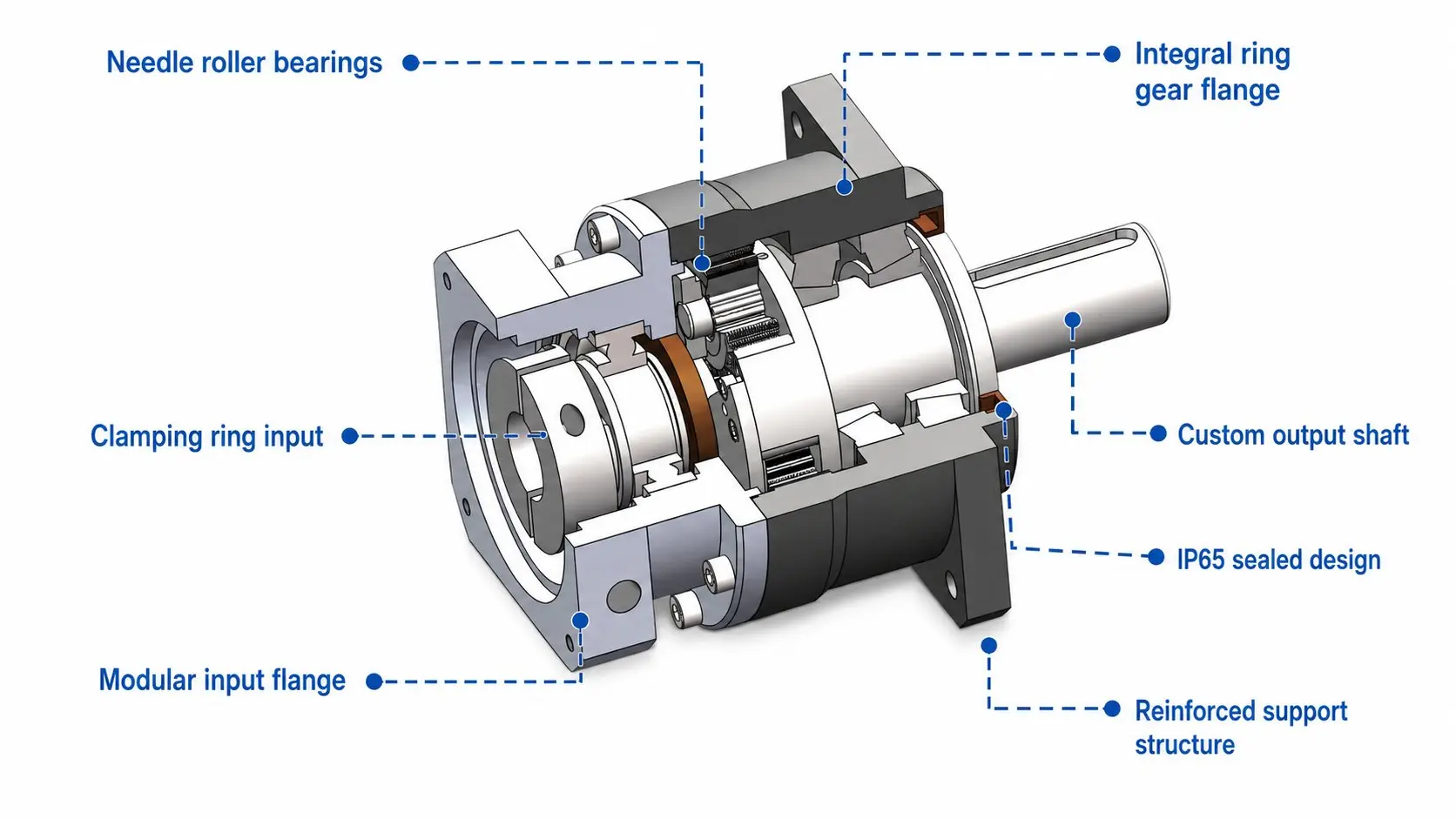
EP-FADS planetary gearbox internal structure — direct-insert motor shaft NYOGEL 792D sealed DIN Class 5 gears for surgical robot and medical automation

−22mm
Axial Saving
ISO 5
Particle Class
≤55dB
Noise Level

EP-FADS cross-section: direct-insert motor input (no adapter plate), DIN Class 5 helical planet gears, NYOGEL 792D sealed lifetime fill, aluminium housing option for non-magnetic MRI applications.

Four Features That Distinguish EP-FADS from a Standard Planetary Gearbox in Medical Use

A standard industrial planetary gearbox and EP-FADS use the same fundamental gear geometry. The difference lies in four design choices that are irrelevant in a factory but critical in a medical or cleanroom environment — and that make EP-FADS the standard-catalogue solution for surgical robot wrist axes rather than a custom specification.

  1. 01
    Direct-Insert Motor Shaft — Eliminates the Adapter Plate and Its Crevice

    The servo motor shaft inserts directly into the gearbox input coupling — no adapter plate, no bolted flange interface between motor and gearbox. This eliminates two things simultaneously: 22 mm of axial length (the adapter plate thickness), and the crevice between the adapter plate and the gearbox input flange. In a sterile surgical field or cleanroom, crevices are contamination traps — biological residue accumulates in recesses that cannot be fully cleaned by surface wiping. EP-FADS has no such recess at the motor-gearbox interface.

  2. 02
    NYOGEL 792D Sealed Lifetime Fill — Zero Particle Emission

    NYOGEL 792D synthetic grease is contained within the sealed housing with no external grease ports, no grease nipples, and no relubrication events within the 30,000-hour design life. In ISO Class 5 cleanroom operation at normal rotary speeds and temperatures, no detectable particles from the lubricant enter the surrounding air stream. This is the standard validated by Korea Ever-Power for EP-FADS in cleanroom applications. For surgical robots operating in an ISO Class 5 operating theatre, this means the gearbox itself is not a particle source — the sterile field constraint is met by design rather than by continuous monitoring of a potentially leaking external lubrication point.

  3. 03
    DIN Class 5 Helical Gears — Low Noise at Low Speed

    Surgical and rehabilitation robots operate at slow joint velocities — typically 10–60 rpm at the joint axis — where gear mesh noise at low speed is the dominant acoustic source rather than bearing noise. DIN Class 5 profile-ground helical gears produce significantly lower transmission error (the primary acoustic excitation mechanism) at low pitch-line velocities than DIN Class 6–7 gears. This is the mechanical basis for the ≤55 dB noise level at rated speed in the 047 and 060 mm frame sizes. In an operating theatre where background noise is below 40 dB during procedures, even a 55 dB gearbox must be evaluated against the specific surgical system noise budget — Korea Ever-Power provides noise measurement reports for specific frame sizes and ratios on request.

  4. 04
    Aluminium Housing Option — Non-Magnetic for MRI Compatibility

    The standard EP-FADS housing is aluminium alloy — already inherently non-magnetic. For MRI-guided robotic systems operating within the 5 Gauss fringe field zone (typically 3–4 metres from the magnet isocentre), standard steel components cause image distortion artefacts and present a projectile risk. EP-FADS aluminium housing option extends this non-magnetic property through the entire housing assembly, combining it with the P0 backlash grade and NYOGEL 792D lubrication that MRI-guided robot designers require. This option is available on request for EP-FADS 047–090 mm frame sizes.

These four features address the four compliance dimensions — geometry (sterile field), contamination (particle emission), clinical safety (noise), and physics (magnetic compatibility) — that medical device engineers must resolve when specifying a gearbox for a robot or instrument operating in a medical environment. EP-FADS resolves all four in a standard-catalogue item at precision P0 grade and 30,000-hour design life.

Selection Guide

Medical & Lab Gearbox Selection Matrix — 5 Questions from Deployment Zone to Correct Series

Medical gearbox selection begins with the deployment zone — not the precision specification. The compliance map in Section 1 determines which zone applies; the five questions below then identify the correct series and grade. For devices with multiple axes in different zones (e.g., a radiotherapy system with a precision gantry drive and an economy table feed), work through the matrix independently for each axis.

Selection Question
Your Answer → Series Implication
Recommended
Q1 — Deployment zone?
Operating theatre / ISO 5 cleanroom → EP-FADS P0 (zero particle, no adapter crevice)  |  Patient care / rehab → EP-FAD P0 (low noise, backdrivable)  |  MRI suite → EP-FADS aluminium housing option  |  Radiotherapy → EP-FAB P0 (IP65, backlash stability)  |  Clinical lab / instrument → EP-FAD P1 or EP-FPG P1 (noise, long service)
Zone first
Q2 — Axis type?
Robot wrist (compact axial, fixed motor) → EP-FADS  |  Robot wrist (adaptable motor) → EP-FADR  |  Robot base / high-torque joint → EP-FAB P1  |  Belt-axis gantry (pipettor, imaging head) → EP-FAL  |  Rotary precision (carousel, gantry rotation) → EP-FAB P0 or EP-FAD P1  |  Economy carousel / incubator → EP-FPG P1
Axis geometry
Q3 — Non-magnetic required?
MRI-guided robot or equipment operating within 5 Gauss fringe field → specify EP-FADS aluminium housing option  |  Radiotherapy (no strong field) → standard housing  |  CT (no static field) → standard housing  |  All other → standard; non-magnetic not required
FADS Al option
Q4 — Service interval?
Device service life ≥5 years, no scheduled gearbox maintenance → sealed lifetime fill required (all EP series with NYOGEL 792D or CASTROL LMX)  |  Diagnostic analyser 5–7 year service interval → FPG P1 sealed 20,000 hr S5 sufficient  |  Surgical robot 30,000 hr → FADS/FAD/FAB  |  Radiotherapy gantry → FAB P0 (20,000 hr S5 at typically low duty cycle)
Life class
Q5 — Documentation?
IEC 60601 / MDR technical file requires gearbox traceability → per-unit backlash stamp, IP test record, material certificates available on request for all EP precision series (FADS, FAB, FAD, FAL)  |  CE declaration for noise data → noise measurement reports available per frame/ratio  |  MRI compatibility confirmation → aluminium housing declaration available on request  |  C1–C10 adapter covers all series with single motor qualification
Documentation

Manufacturing Quality

Korea Ever-Power Production — How Per-Unit Testing Supports Medical Device Qualification

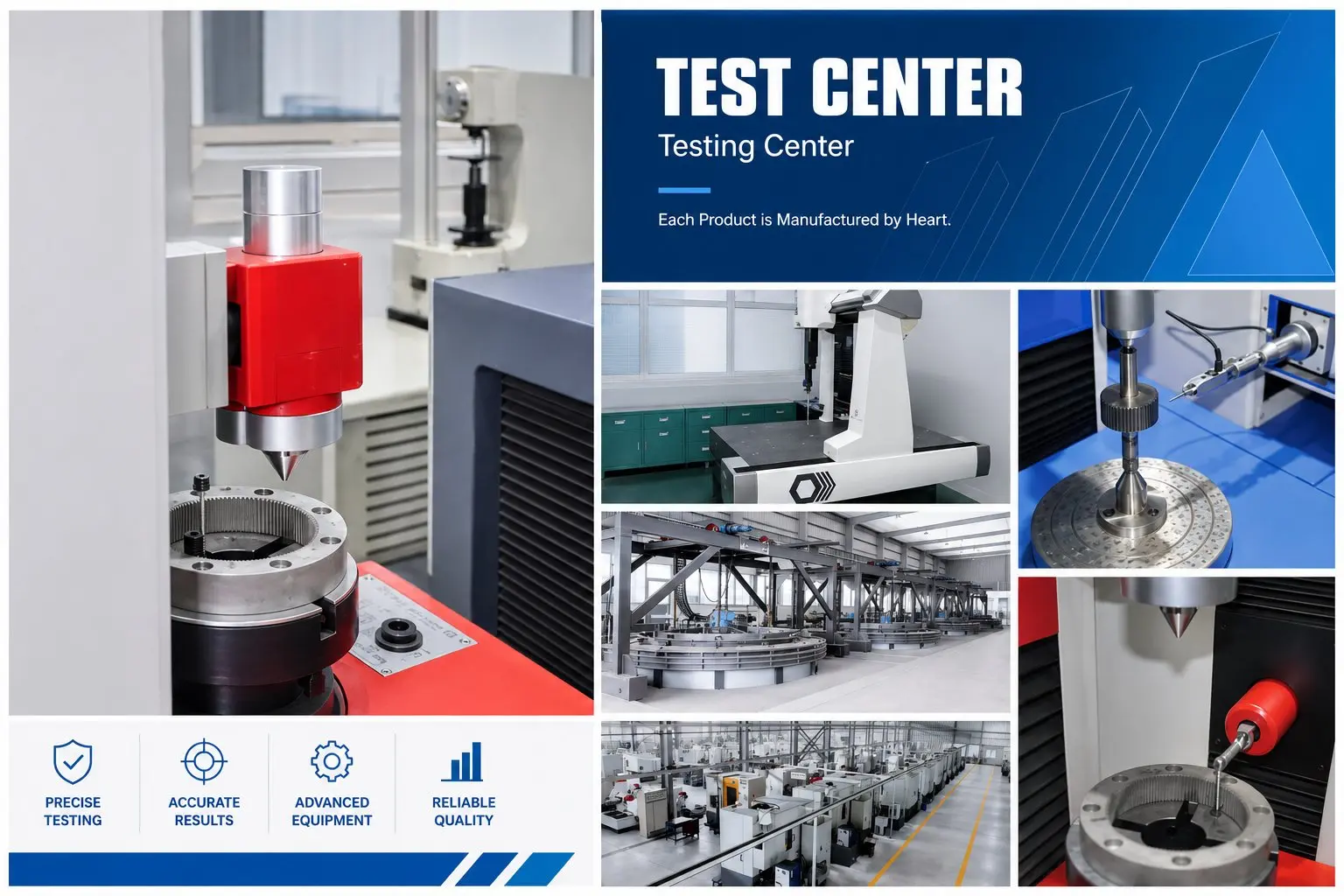
Korea Ever-Power test center — individual backlash measurement and noise testing for EP-FADS and EP-FAD medical robot gearboxes
Korea Ever-Power 5-axis CNC gear grinding workshop — DIN Class 5 profile grinding for EP-FADS and EP-FAD medical automation gearboxes

Test centre (individual backlash, noise measurement, IP seal decay — every unit) and 5-axis CNC gear-grinding workshop, Korea Ever-Power, Ansan-si, Korea.

Medical device manufacturers working under EU MDR, US FDA 21 CFR Part 820, or ISO 13485 quality management systems require supplier documentation that industrial gearbox manufacturers typically do not provide: per-unit traceability, individual test records, and material certificates that link each component in the device bill of materials to a verifiable production record. Korea Ever-Power provides these for EP-FADS, EP-FAB, EP-FAD, and EP-FAL series on request.

Per-unit backlash measurement: Every EP-FADS, EP-FAB, and EP-FAD unit is measured under 2% rated torque load before shipment. The measured grade (P0, P1, or P2) is stamped on the nameplate and stored in the production record. For IEC 60601-2-1 (medical electrical equipment — linear accelerators) and ISO 10218-1 (industrial robots for medical use), the gearbox backlash is a documented design input that must be traceable to actual measured values, not nominal specification. Korea Ever-Power’s per-unit stamp provides this traceability directly from the nameplate — no additional measurement at incoming inspection is required.

Noise measurement reports: In addition to the standard production tests, Korea Ever-Power can provide noise measurement reports for specific EP-series frame sizes and ratios — the measured sound pressure level at 1 metre distance at rated load and speed, conducted on a closed-loop servo dynamometer in a semi-anechoic test chamber. These reports are required by medical device OEMs preparing IEC 60601-1-8 (alarm systems) and EN ISO 11688-2 (noise in machinery) documentation packages for CE technical files.

Material certificates and RoHS declaration: Material certificates for ring gear, planet gear, sun gear, and housing alloys — linking each production batch to its raw material specification and heat treatment records — are available on request. RoHS compliance declarations for EP-FADS, EP-FAB, EP-FAD, and EP-FAL are available as standard. These documents are required by medical device OEMs for EU MDR Annex I General Safety and Performance Requirements and for supplier qualification audits under ISO 13485.

📋
Medical Device Documentation Package — Available on Request
For medical device OEM qualification projects, Korea Ever-Power can supply: (1) Per-unit backlash certificate (measured grade, torque, date, serial number). (2) IP seal pressure test record (pass/fail, test pressure, duration). (3) Noise measurement report for specified frame size and ratio. (4) Material certificates (ring gear, planet gear, housing alloy). (5) RoHS compliance declaration. (6) Non-magnetic aluminium housing declaration (EP-FADS, on request). All documents available within 5 business days of order confirmation. Contact [email protected] with device class, applicable standard, and required document types.

EP-FADS / EP-FAD vs. European Premium — Medical Application Comparison

Attribute European Premium Korea Ever-Power
EP-FADS / EP-FAD
Medical Relevance
Direct-insert (FADS-type) Premium / custom option Standard catalogue item 22 mm axial saving + no adapter-plate crevice: standard item, no premium for medical configuration
Per-unit backlash stamp Yes Yes — every unit Required for IEC 60601, ISO 13485 traceability; same standard as European premium at lower cost
Noise measurement report On request (standard) On request Required for CE technical file noise chapters; same report format and measurement standard
Non-magnetic option Available (some series) FADS aluminium housing MRI-guided robotic systems; required for 5 Gauss fringe field operation; confirmation declaration available
NYOGEL 792D sealed Standard FADS/FAD/FAB standard ISO 5 cleanroom validated; zero particle emission; same lubricant reference as European premium
C1–C10 universal adapter Brand-specific All 8 series Medical device BOM: one motor qualification covers FADS wrist + FAB base + FPG economy carousel
Unit price (P0 grade) 100% benchmark ~60–75% Same technical specification; significant BOM cost saving for medical device with multiple gearbox axes

Korea Ever-Power does not manufacture products identical to named European brands. Comparative data is based on publicly available specifications. Medical device OEMs should conduct their own qualification testing per their applicable quality management system requirements.

고객 피드백

What Medical Device and Lab Automation Engineers Say

★★★★★

“We design a 5 DoF minimally invasive surgical assistant for laparoscopic procedures. The J5 wrist joint was our critical constraint — the trocar port limits the wrist diameter, and our cable routing inside the link housing required 22 mm less axial length than the standard FAD-plus-adapter configuration gave us. EP-FADS was the solution. The direct-insert motor shaft not only saved the 22 mm but eliminated the adapter plate crevice that our sterility team had flagged as a cleaning validation concern. The P0 backlash stamp on the nameplate went straight into our IEC 60601-2-77 design file. 18 months into clinical use, no gearbox issues.”

IK
Im K., Lead Systems Engineer
Surgical Robotics OEM — Seoul, Korea
★★★★★

“Our high-throughput diagnostic analyser uses 12 EP-FPG P1 carousel drives. The noise requirement was the deciding factor — our lab instrument sits 1.5 metres from a clinician’s workstation in an open laboratory, and the hospital facilities team had set a 60 dB limit for all powered equipment in that zone. EP-FPG040 measured at ≤56 dB in our integration test, which gave us comfortable margin. The NYOGEL 792D lifetime seal means we can commit to a 7-year maintenance-free service interval in the instrument manual, which our regulatory affairs team required before CE submission. The per-unit stamp on each gearbox also simplified our incoming quality inspection — we accept on the nameplate grade without additional measurement.”

NJ
Nam J., Principal R&D Engineer
In-Vitro Diagnostic Instrument Manufacturer — Suwon, Korea
★★★★★

“We specify EP-FAD P1 for the patient table drive on our CT system and EP-FADS aluminium housing on the table positioning axis of our MRI-guided biopsy robot. The aluminium housing confirmation document from Korea Ever-Power was exactly what our MRI compatibility team needed — they were satisfied that the gearbox would not cause image artefacts or present a safety risk within the 5 Gauss zone. The fact that the gear train is identical between standard and aluminium housing variants meant our qualification effort covered both products simultaneously, which saved several weeks in our design verification programme.”

CY
Cho Y., Medical Systems Mechanical Engineer
Medical Imaging Systems OEM — Seongnam, Korea

Related EP-Series — Full Medical Device BOM Coverage

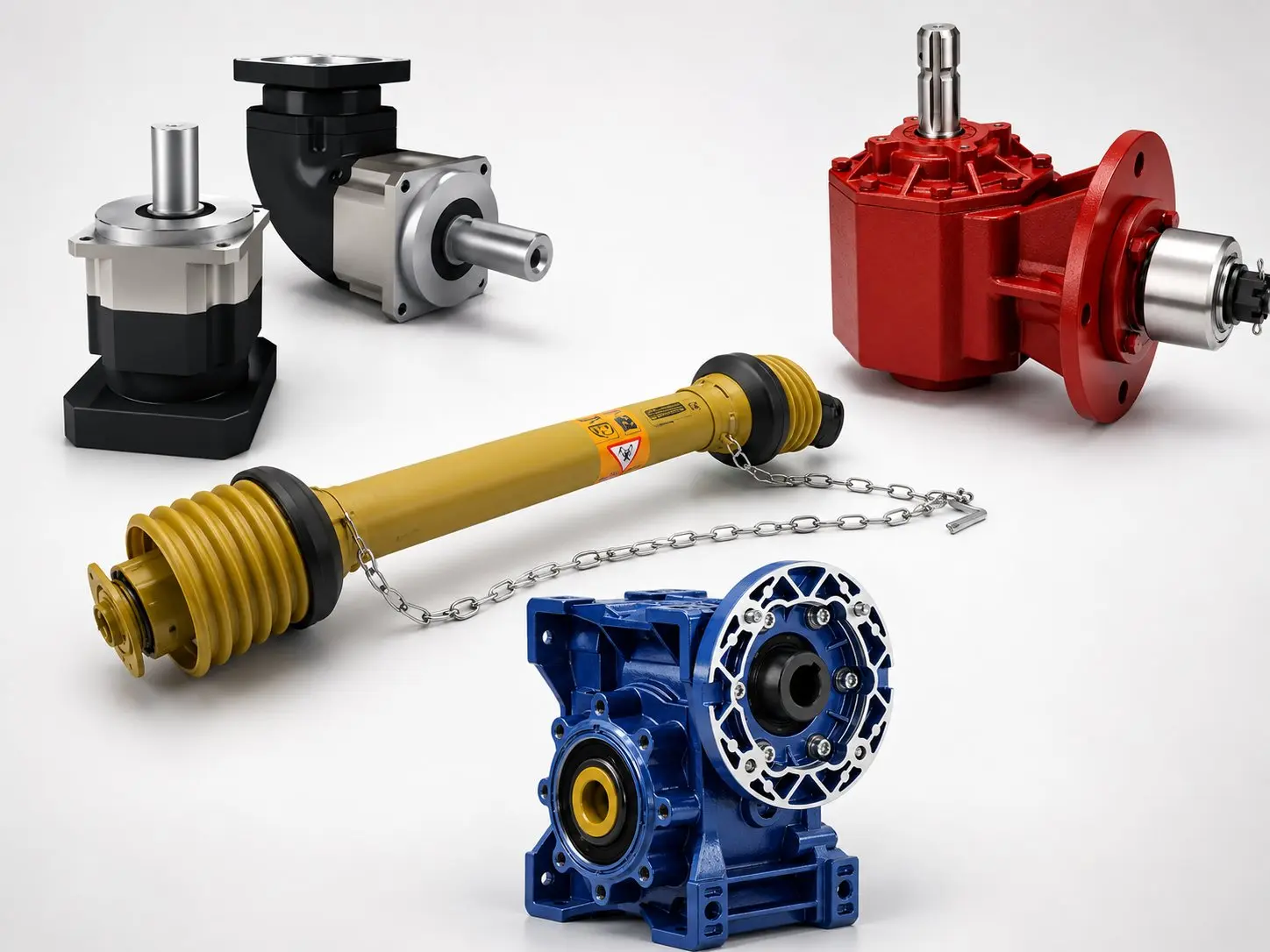
Korea Ever-Power EP series planetary gearbox range — FADS FAD FAB FAL FPG for surgical robot diagnostic instrument lab automation medical

Core medical series: EP-FADS P0 for surgical and cleanroom robot wrist axes (direct-insert, zero particle, non-magnetic option). EP-FAD P0/P1 for rehabilitation robots, CT/MRI tables, drug discovery, and low-noise instruments. EP-FAB P0 for radiotherapy gantry rotation and high-torque imaging drives. EP-FAL P1 for lab gantry pipettors. EP-FPG P1 for diagnostic instrument carousels and economy-tier automation.

Browse the full EP series range. For drive shaft components in medical positioning systems: cvjointdriveshaft.com.

Frequently Asked Questions — Medical & Lab Gearbox Selection

Is NYOGEL 792D in EP-FADS validated for use in an ISO Class 5 operating theatre?
Korea Ever-Power has validated NYOGEL 792D in sealed EP-FADS, EP-FAB, and EP-FAD housings for zero-detectable particle emission in ISO Class 5 cleanroom conditions during normal rotary operation within the rated temperature range (−10°C to +90°C). The validation covers sealed housing operation — no external grease ports, no relubrication events, and no housing seal failure. The sealed housing is the critical condition: if the IP seal is intact (as confirmed by the per-unit IP54 pressure decay test on EP-FADS), lubricant does not migrate out of the gear chamber and into the cleanroom air stream. Medical device OEMs should conduct their own cleanroom validation testing per the applicable ISO 14644-3 test methods for their specific facility and operating conditions, using Korea Ever-Power’s technical data sheet as the input specification. Contact [email protected] for the EP-FADS particle emission test report.
How does the EP-FADS aluminium housing option support MRI compatibility?
The EP-FADS aluminium housing option uses an aluminium alloy housing and associated non-ferrous fasteners, replacing the standard steel housing. Aluminium is diamagnetic — it does not interact with a static magnetic field to any meaningful degree and does not cause image artefacts in MRI systems operating at 1.5–3.0 Tesla field strength. The gear train, NYOGEL 792D lubrication, and backlash grade specification are identical to the standard EP-FADS — only the housing material changes. Korea Ever-Power provides a declaration document confirming the housing material specification for use in MRI compatibility assessment per ASTM F2052 (Standard Test Method for Measurement of Magnetically Induced Displacement Force on Medical Devices in the Magnetic Resonance Environment). The determination of whether the complete assembled robot system is MRI-compatible at a specific field strength and spatial gradient must be made by the device manufacturer and MRI system manufacturer jointly — Korea Ever-Power’s declaration covers only the gearbox component.
What documentation does Korea Ever-Power supply for EU MDR technical file requirements?
For EU MDR Regulation 2017/745 Annex I General Safety and Performance Requirements and supporting technical file documentation, Korea Ever-Power can provide: per-unit backlash test certificate (serial number, measured grade, measurement method, date); IP54/IP65 pressure decay test record (pass/fail, pressure, duration, serial number); noise measurement report for specified series, frame size, and ratio (sound pressure level at 1 m, rated speed, specific ratio); material certificates for ring gear alloy, planet gear alloy, and housing alloy with heat treatment records; RoHS Declaration of Conformity (Directive 2011/65/EU); aluminium housing material declaration for MRI compatibility assessment (EP-FADS only). Lead time for documentation package: 5 business days from order confirmation. For ISO 13485 supplier qualification audit arrangements (including factory inspection at Ansan-si), contact [email protected].
Can EP-FAD support safe backdrivability for rehabilitation robots in patient contact?
EP-FAD P0 helical planetary gears have lower backdrive friction than worm gears (which are typically non-backdrivable) or straight-cut spur gears. The helical meshing geometry produces a favourable force component in the axial/backdrive direction compared to straight gearing. In a rehabilitation robot or exoskeleton, this means a patient can push a joint against the motor resistance with a force proportional to the motor holding torque divided by the gear ratio — the joint does not lock under manual force as it would with a worm gearbox. However, backdrivability is also dependent on the total system friction including motor cogging torque, seal friction, and bearing preload — Korea Ever-Power can provide backdrive torque measurement data for specific frame sizes and ratios on request. The determination of whether a specific rehabilitation robot axis design is safely backdrivable per IEC 60601-1 Clause 9.2 (patient forces) must be made by the device manufacturer through biomechanical analysis and clinical risk assessment — the gearbox backdrive friction data is one input to this analysis.
How does the 7-year maintenance-free claim for diagnostic analyser gearboxes work?
EP-FPG P1 is rated for 20,000 hours S5 intermittent design life with CASTROL LMX sealed lifetime fill — no external lubrication ports, no scheduled relubrication. For a diagnostic analyser carousel operating in a hospital central laboratory at a typical duty cycle of 8–12 hours per day, 250 operating days per year, the annual operating hours are approximately 2,000–3,000 hours S5. At this duty cycle, 20,000 hours S5 corresponds to 7–10 years of operation before the statistical L10 bearing life is reached. The “maintenance-free” claim applies specifically to lubrication maintenance — the sealed CASTROL LMX fill does not require top-up or replacement within this interval. Mechanical wear of gears and bearings is a separate consideration: Korea Ever-Power recommends that device manufacturers include a backlash measurement check at their planned maintenance interval (typically 3–5 years for diagnostic instruments) using the instrument’s built-in calibration routine, comparing against the nameplate-stamped starting backlash value to monitor wear progression. Contact [email protected] for FPG P1 life calculation data specific to your carousel speed and duty cycle profile.

Specify EP-FADS, EP-FAD, or EP-FPG for Your Medical or Lab Automation Application
Send your deployment zone, axis configuration, and motor model — Korea Ever-Power will provide series recommendation, noise data, and documentation package availability within 24 hours. MRI aluminium housing option, ISO 13485 supplier documents, and IEC 60601 traceability certificates all available.

Request Medical Gearbox Specification →

편집자: Cxm