What Differs Between Inline and Right-Angle Configurations?
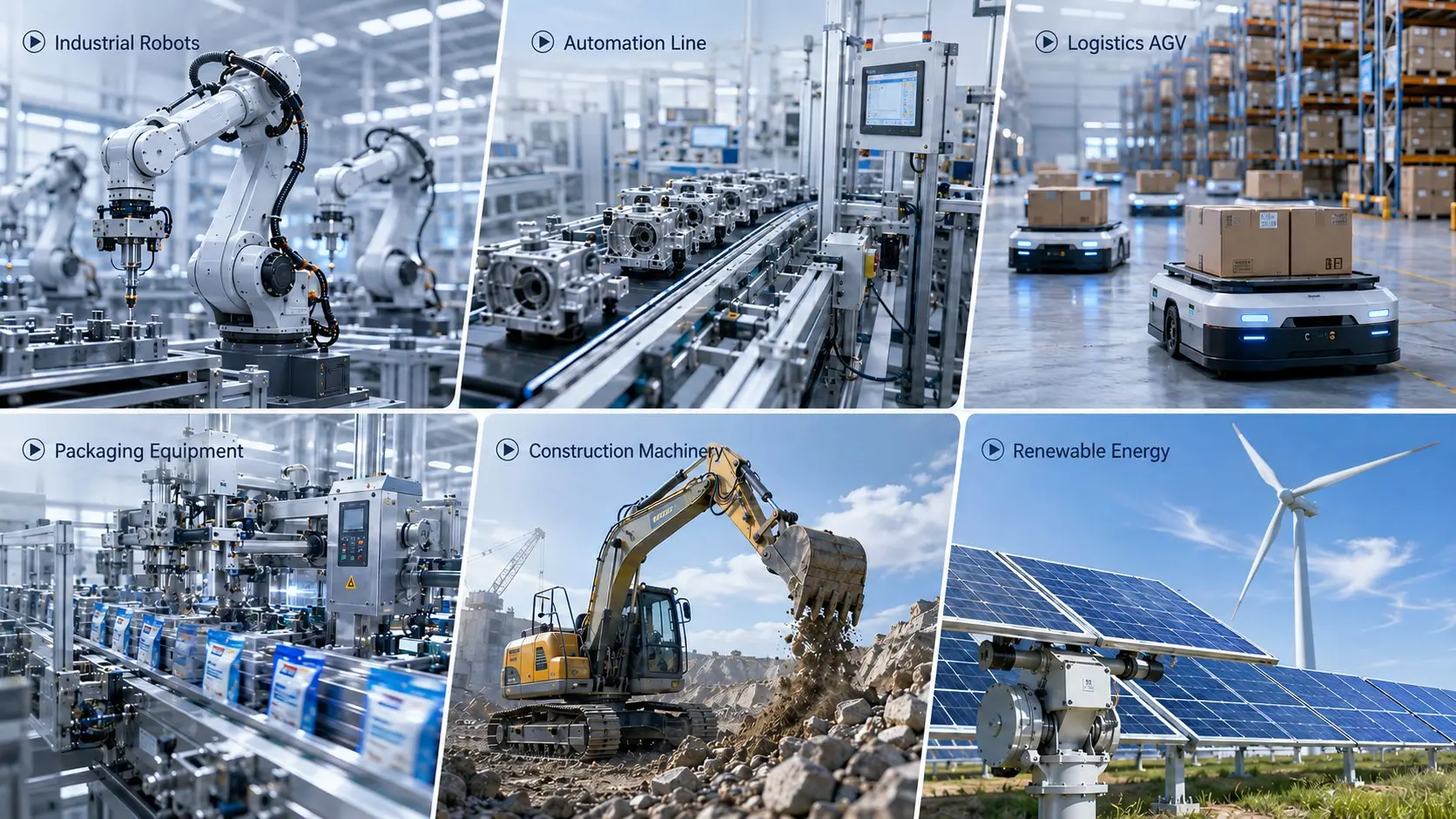
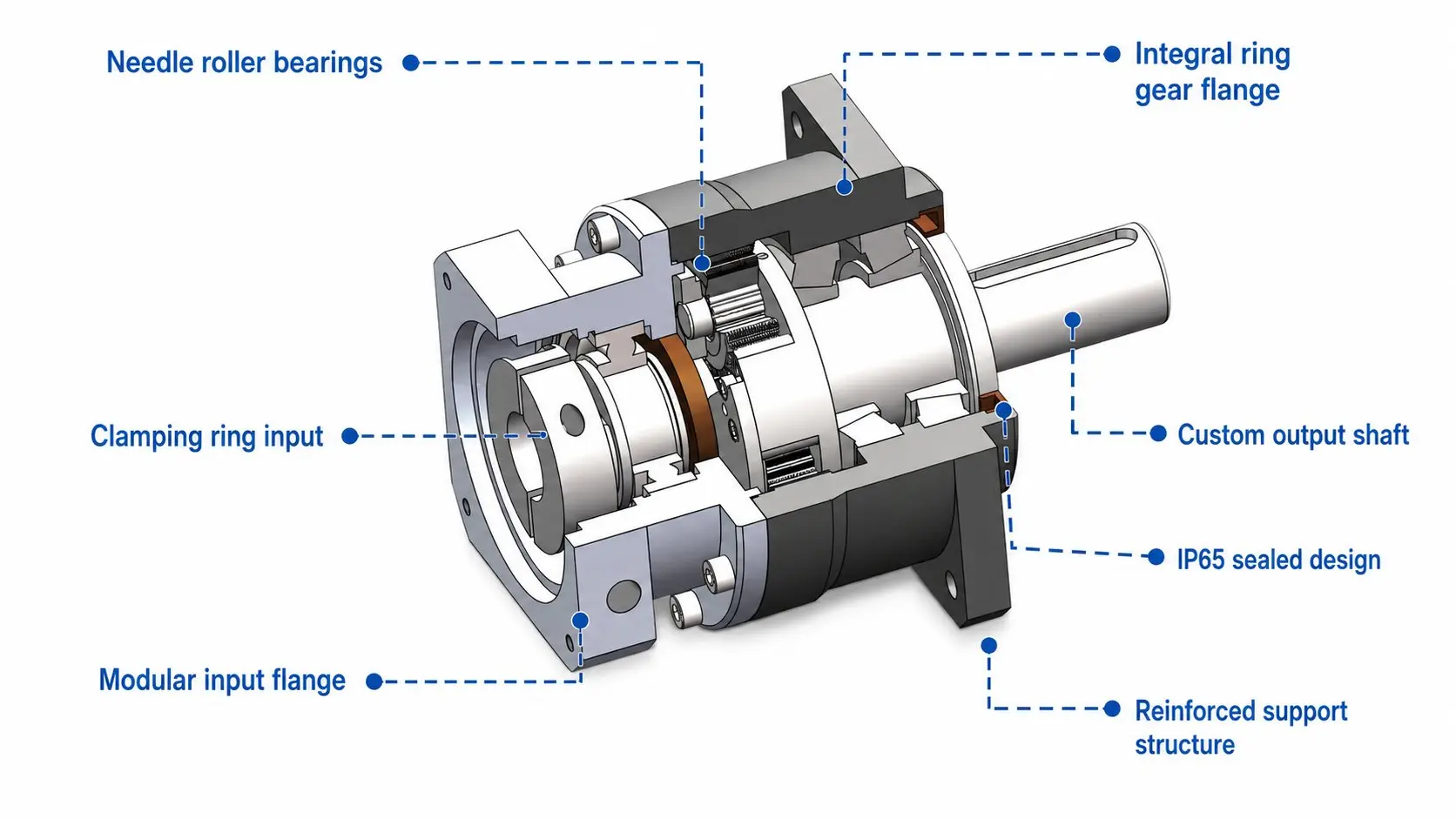
Both configurations use the same fundamental planetary gear train — sun gear, planet gears, ring gear, and carrier. The difference is what happens at the input side of the assembly. This distinction seems minor on paper, but it cascades into meaningful differences in efficiency, backlash, noise, weight, cost, and installation envelope that determine whether each configuration is suitable for your specific application.
The spiral-bevel gear pair in the right-angle configuration is the source of every performance trade-off discussed in this article. It adds approximately 3 arcmin of angular play (stacking with the planetary backlash), reduces efficiency by about 2% per stage, increases noise by 5–10 dB(A), and adds 15–30% to the unit weight compared to the equivalent inline model. These are fundamental physics consequences of adding an additional gear mesh — they apply to all right-angle planetary gearbox designs regardless of manufacturer.
The critical question is not “which configuration is better?” but “does the installation space constraint justify accepting these trade-offs?” The answer depends entirely on the physical dimensions available in your machine frame.
Installation Depth — The Primary Decision Driver
The reason engineers specify a right-angle planetary gearbox is almost always physical space. The chart below compares the axial depth (from output face to motor end-cap) of Korea Ever-Power inline versus right-angle models at each frame size, assuming a typical 400–750 W servo motor.
Depth measured from output flange face to motor end-cap. Typical 400–750 W servo motor. Values are approximate and depend on specific motor model.
The depth reduction is not marginal — it is transformative for machine design. A Frame 120 inline assembly extending 430 mm behind the output face may be impossible to fit in a conveyor frame, an AGV chassis, or a panel-mounted actuator housing. The right-angle variant at 210 mm solves the installation constraint entirely.
Efficiency and Precision — What the Bevel Stage Costs You
The spiral-bevel input stage in a right-angle unit is a precision-ground gear mesh that redirects the motor torque by 90 degrees. It is well-engineered and durable, but it is still an additional gear contact that was not present in the inline variant. Here is exactly what it costs across the key performance parameters:
| Parameter | 인라인 | 직각 | Difference |
|---|---|---|---|
| Efficiency (1-stage) | ≥96% | ≥94% | ~2% |
| Efficiency (2-stage) | ≥94% | ≥92% | ~2% |
| Backlash (standard, 1-stg) | ≤8 arcmin | ≤13–16 arcmin | +5–8 arcmin |
| Backlash (precision, 1-stg) | ≤5 arcmin | ≤8 arcmin | +3 arcmin |
| Noise (Frame 80) | ≤60 dB(A) | ≤73 dB(A) | +10–13 dB(A) |
| Weight (Frame 80, 2-stg) | 2.2 kg | 5.0 kg | +127% |
| Cost (same frame & ratio) | Baseline | +20–40% | — |
Data from Korea Ever-Power EP-PL/PF (inline) vs EP-WPL/WPF (right-angle) standard series. Precision series: EP-PBL/PBF (inline) vs EP-WPBL/WPBF (right-angle).
When to Specify Inline
Choose the inline planetary gearbox as the default starting point for every new specification. Switch to right-angle only when a specific installation constraint forces it. Inline wins on every performance metric — efficiency, precision, cost, weight, and noise. The only parameter where the right-angle configuration has an advantage is installation depth. This means inline should be your default assumption during early machine design; only change to right-angle if the detailed layout drawing reveals an installation space conflict that cannot be resolved by repositioning the motor or adjusting the machine frame.
Ball-screw driven X/Y/Z axes have ample depth behind the drive end for an inline motor-gearbox assembly. The EP-PL/PF inline planetary gearbox at ≤8 arcmin or the EP-HAB at ≤3 arcmin delivers the tightest precision at the lowest cost for these applications.
High-speed theta-axis drives and linear gantry axes benefit from the inline unit’s lower weight and inertia. Reduced reflected inertia enables faster settle times and higher throughput. The efficiency advantage reduces heat generation, which is critical in enclosed machine frames.
Wafer handling, beam steering, and precision dispensing demand the tightest backlash available. The inline EP-PBL/PBF at ≤5 arcmin or EP-HAB at ≤3 arcmin is the natural choice. Switching to right-angle would add 3–8 arcmin of bevel-stage backlash that may push the total beyond the allowable positioning error budget.
Every 2% of efficiency lost to the bevel stage translates into additional heat and wasted energy. In a 2 kW drive running 16 hours daily, the 2% difference amounts to approximately $47/year per drive. For facilities with dozens of drives, inline selection across the board yields meaningful energy savings.
When to Specify Right-Angle
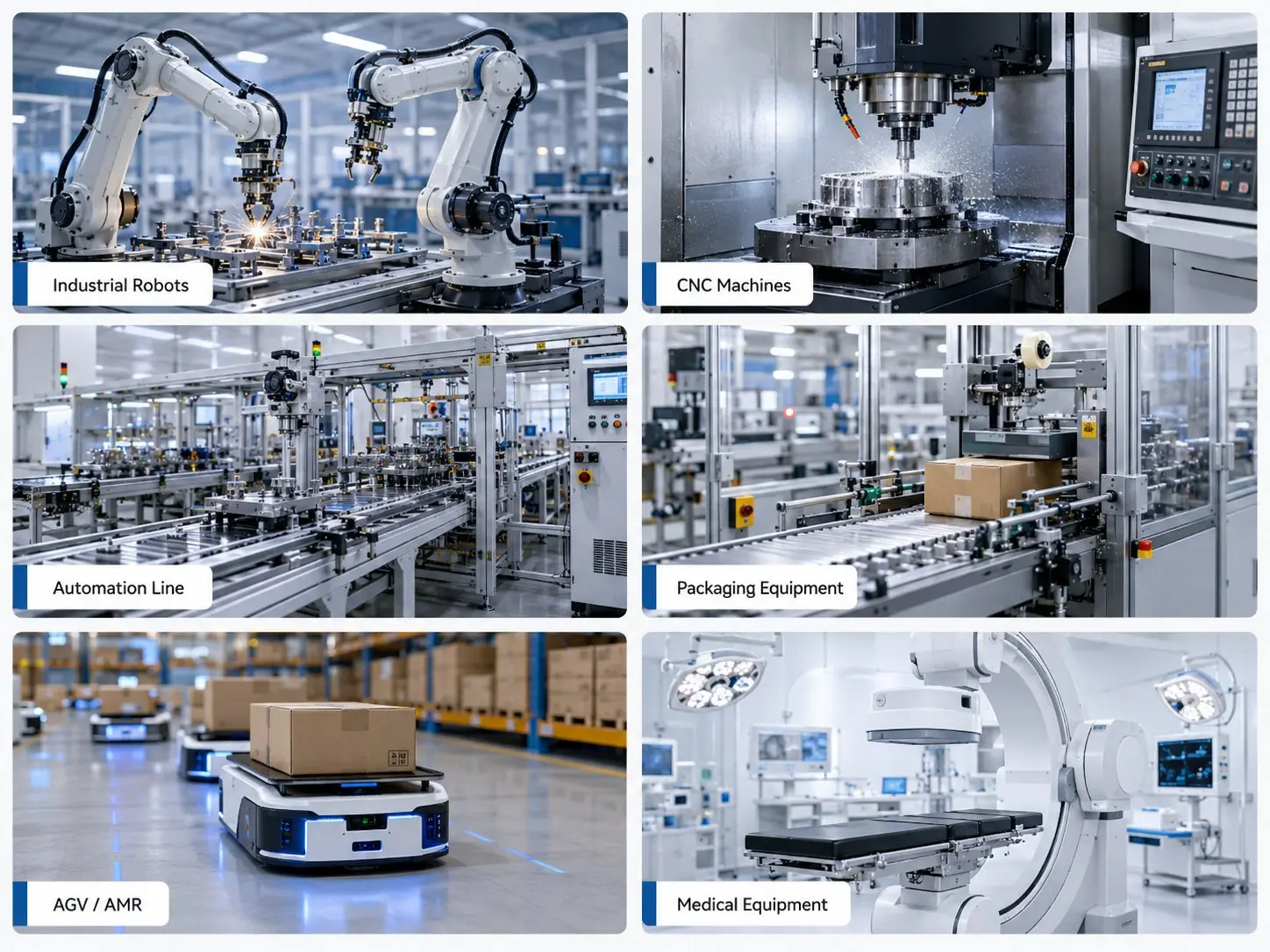
The right-angle planetary gearbox is the correct choice only when the installation physically cannot accommodate the inline assembly length, or when the motor must be oriented perpendicular to the output for a specific engineering reason. In our experience working with machine builders across CNC, robotics, packaging, and AGV applications, approximately 30% of planetary gearbox installations genuinely require right-angle output — the remaining 70% are best served by inline. The four scenarios below represent the most common legitimate reasons for specifying a right-angle configuration.
The servo motor must sit at wheel-hub height within the vehicle chassis, not extending vertically above the wheel. The EP-WPL/WPF right-angle planetary gearbox routes the motor horizontally inside the chassis frame, keeping the centre of gravity low and the payload deck clear.
Packaging conveyors that run against walls or through machine frames leave no depth behind the drive roller. The right-angle unit mounts the motor parallel to the belt, within the available frame width. This is the most common application for the EP-WPF square-flange variant.
Winding shafts, vertical indexing tables, and Z-axis lifters benefit from a horizontally mounted motor for easier cable routing and heat dissipation. The right-angle unit redirects the horizontal motor torque to a vertical output shaft without needing additional couplings or brackets.
In food processing and pharmaceutical lines where the operator side must remain clear, a right-angle configuration routes the motor away from the access zone. This also facilitates motor replacement during scheduled maintenance without disconnecting the gearbox from the driven load. Pair with a drive shaft for articulating connections where needed.
Noise and Vibration — How the Bevel Stage Affects Acoustics
The spiral-bevel input stage in a right-angle planetary gearbox introduces an additional gear mesh frequency that the inline variant does not produce. This manifests as a measurable increase in acoustic noise, particularly at higher input speeds. The comparison below uses Korea Ever-Power test data at 3,000 rpm input speed, measured at 1 metre distance.
Frame 80: ≤60 dB(A)
Frame 120: ≤65 dB(A)
Source: Planet gear mesh frequency only
Frame 80: ≤73 dB(A)
Frame 120: ≤75 dB(A)
Source: Planet mesh + bevel mesh frequencies
The 10–13 dB(A) increase may seem modest as a number, but in acoustics, a 10 dB increase represents a perceived doubling of loudness. In noise-sensitive environments such as cleanrooms, medical facilities, or operator workstations where the planetary gearbox runs within 2 metres of personnel, this difference can determine whether the installation meets workplace noise regulations. For these environments, the inline configuration should be the first choice whenever physically possible.
Cost Comparison — Purchase Price and Lifetime Energy
The right-angle planetary gearbox costs more to purchase and more to operate than its inline equivalent. The dual cost penalty comes from two independent sources:
The cost conclusion is clear: if your installation accommodates inline mounting, you save on both the purchase price and the lifetime operating cost. Reserve the right-angle planetary gearbox premium for installations where the depth constraint genuinely demands it.
Korea Ever-Power Series — Inline and Right-Angle Pairs
Each inline planetary gearbox series in the Korea Ever-Power portfolio has a direct right-angle counterpart that shares the same internal planetary gear train with an added spiral-bevel input stage. This consistent pairing simplifies specification: if you know which inline series meets your precision and protection grade requirement, the right-angle partner is the corresponding 90-degree variant with predictable performance trade-offs.
| Tier | Inline Series | Right-Angle Series | Backlash (1-stg) | IP |
|---|---|---|---|---|
| Standard | EP-PL/PF | EP-WPL/WPF | ≤8′ → ≤13–16′ | 54 |
| Precision | EP-PBL/PBF | EP-WPBL/WPBF | ≤5′ → ≤8′ | 65 |
| Flagship | EP-HAB | (no RA variant) | ≤3′ | 65 |
5-Point Decision Checklist
Frequently Asked Questions
Send us your motor model, available installation depth, and required backlash tolerance. Our engineers will confirm the optimal configuration and series within one business day — no obligation.
편집자: Cxm