How These Two Reducer Types Differ
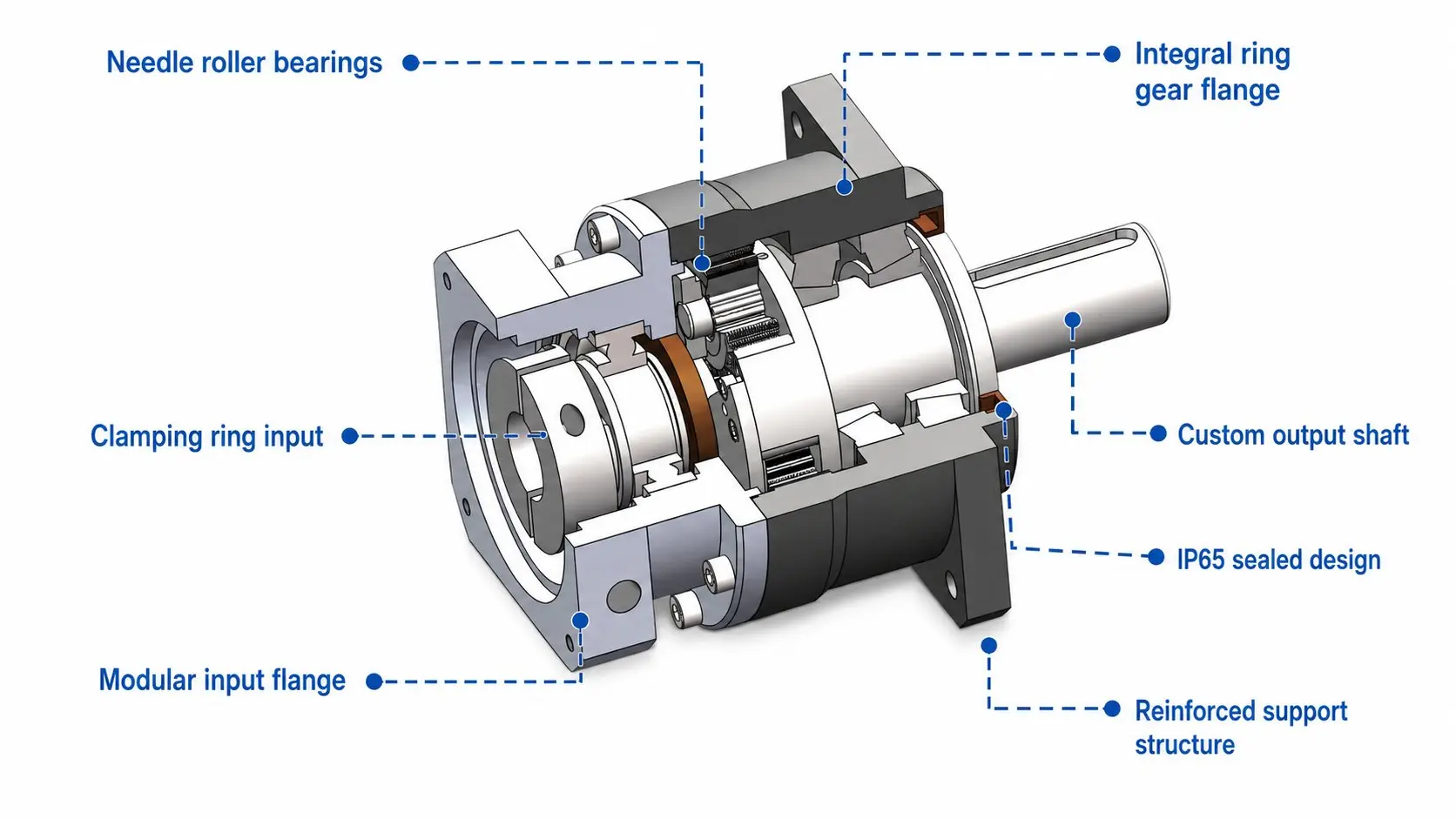
Both a planetary gearbox and a worm gearbox reduce speed and multiply torque, but their internal mechanics are fundamentally different. Understanding the structural difference is essential before comparing any performance parameter, because the contact type between gear teeth — rolling in a planetary, sliding in a worm — determines almost every downstream characteristic including efficiency, heat, noise, wear rate, and achievable precision.
These structural differences cascade into every performance metric that matters for equipment design: efficiency determines energy cost and heat generation, gear contact type determines noise and wear rate, and self-locking capability determines whether a separate brake is needed for vertical loads.
The critical insight is that neither design is universally superior. A planetary gearbox excels in continuous-duty, precision, and energy-sensitive applications. A worm drive excels in applications requiring inherent self-locking, very high single-stage ratios, or lowest initial purchase cost. The following sections quantify each difference with engineering data so you can match the right type to your specific requirements.
Efficiency — The Biggest Performance Gap
Efficiency is where the planetary gearbox vs worm gearbox comparison produces the most decisive numbers. The difference is not marginal — it is rooted in the fundamental physics of rolling versus sliding gear contact.
A precision planetary gearbox maintains 96–98% efficiency per stage because involute gear teeth roll against each other with minimal sliding. Even at three-stage, 512:1 ratio, the overall efficiency remains approximately 90%. A worm drive relies on sliding friction between the worm thread and wheel teeth. At a typical 60:1 ratio, efficiency drops to 58–70%. At lower ratios (10:1–20:1), worm-type efficiency improves to 82–90%, but it never matches a planetary unit at any ratio.
| Gear Ratio | Planetary Efficiency |
Worm Efficiency |
Efficiency Gap |
|---|---|---|---|
| 10:1 | 96–98% | 82–90% | 8–16% |
| 30:1 | 94–96% | 68–78% | 18–28% |
| 60:1 | 94–96% | 58–70% | 26–38% |
| 100:1 | 90–94% | 50–62% | 32–44% |
Values represent typical ranges across industry manufacturers. Exact efficiency depends on gear quality, lubrication, load level, and operating temperature.
The gap widens as ratio increases because higher worm ratios require a lower lead angle on the worm thread, which increases the sliding component. In a planetary architecture, adding a second stage to reach higher ratios costs only approximately 2% efficiency per stage — a fraction of the worm penalty.
What That Efficiency Gap Actually Costs You
Efficiency percentages become real financial losses when multiplied by operating hours and electricity rates. The calculation below uses a common industrial scenario to quantify the annual cost difference between these two reducer types.
Daily energy waste: 0.75 × 8 = 6 kWh
Annual energy waste: 6 × 250 = 1,500 kWh
Daily energy waste: 5.25 × 8 = 42 kWh
Annual energy waste: 42 × 250 = 10,500 kWh
At $0.12/kWh × 250 working days. A plant with 10 worm-geared conveyors could save over $10,000/year by switching to planetary units.
When a Worm Gearbox Is the Better Choice

Hoists, scissor lifts, and vertical conveyors must hold the load when motor power is removed. At ratios above ~40:1, the worm’s low lead angle creates a mechanical self-lock that prevents back-driving. A planetary unit cannot self-lock and requires a separate brake — adding cost, complexity, and a potential failure point. For lifting equipment where a brake failure could endanger personnel, the inherent self-locking of a worm drive provides a genuine safety advantage.
A worm unit achieves 60:1 or even 100:1 in one compact stage. The planetary architecture is limited to approximately 10:1 per stage, requiring two stages for 60:1 and three for 100:1. If total axial length and part count must be minimised, a single-stage worm solution is structurally simpler. However, the efficiency penalty scales directly with the ratio — at 100:1, worm efficiency may drop below 50%.
Worm units are typically 30–50% less expensive than planetary units at the same torque class. For drives operating only a few hours per day or on short intermittent cycles, the annual energy penalty may never exceed the purchase price difference over the equipment lifetime. In this case, the worm option is economically rational — the payback period for a planetary upgrade simply never arrives.
At output speeds below 10 rpm, the continuous sliding contact of a worm mesh can generate less audible noise than the periodic tooth engagement frequency of a planetary gear train. In noise-sensitive environments — theatre stage machinery, hospital bed lifts, laboratory positioning — this smooth acoustic profile can be a valid selection criterion, even though the worm is louder at higher speeds.
Noise, Backlash, and Positioning Precision
Beyond efficiency, the comparison diverges sharply on two parameters that determine suitability for servo-driven and precision-motion applications: acoustic noise and backlash.
At normal servo input speeds (1,000–3,000 rpm), a precision planetary unit measures 56–70 dB(A) while a worm unit at equivalent power measures 60–80 dB(A). The planetary is consistently quieter in this operating range because rolling gear contact generates less broadband noise than sliding worm contact. Helical-cut planet gears further reduce noise by maintaining multiple teeth in contact during each mesh cycle, spreading the acoustic energy across a wider frequency band rather than concentrating it at a single tooth-engagement frequency. Below 100 rpm output, the comparison reverses — the worm’s continuous sliding produces a smooth, low-frequency hum with less audible tooth-mesh content, which can be preferable in quiet environments such as theatre stage lifts and hospital equipment.
A precision planetary unit achieves backlash as low as ≤3 arcmin (0.05 degrees), enabling sub-millimetre positioning at practical arm radii. At a 200 mm output arm, 3 arcmin translates to just 0.17 mm of positional uncertainty at the tool tip during direction reversals. Worm units typically exhibit 10–30 arcmin when new — producing 0.58–1.74 mm of uncertainty at the same arm length — and this value increases progressively as the softer bronze wheel wears against the hardened steel worm over time. After several thousand operating hours, worm backlash can double from its original specification. For any application requiring repeatable positioning — CNC feed axes, robotic end-effectors, automated assembly, laser cutting heads — a precision planetary gearbox is the definitive solution.
Heat Generation and Thermal Consequences
Every percentage point of efficiency loss is converted directly into heat. At a 15 kW motor driving a 60:1 worm unit at 65% efficiency, the drive generates 5.25 kW of continuous thermal output — equivalent to a small space heater running inside your machine frame. This heat has cascading consequences:
◆ Reduced bearing life — bearing L10 life decreases exponentially with temperature. A 15°C rise above the design ambient can halve the calculated bearing service life.
◆ Thermal expansion of housing and shafts — in precision applications, thermal growth of the output shaft can introduce positional errors that exceed the mechanical accuracy of the gear train itself.
◆ Motor derating — the motor must deliver more power to compensate for the worm’s friction losses, which may push the motor into a higher frame size or require forced cooling to avoid overheating the motor windings.
A planetary unit generating only 0.75 kW of heat at the same operating point eliminates all four of these thermal concerns. This is why planetary drives dominate in continuous-duty, enclosed-frame, and thermally sensitive applications.

Can You Retrofit a Worm Drive with a Planetary Unit?
In many continuous-duty industrial applications — conveyors, mixers, extruders, fans — replacing an existing worm drive with a planetary reducer delivers immediate energy savings and extended service life. The retrofit also eliminates the worm’s progressive backlash degradation: while a worm wheel’s bronze teeth wear measurably over 5,000–8,000 operating hours (increasing backlash from the original 15 arcmin to 30+ arcmin), a properly loaded planetary gear train exhibits negligible backlash growth over its full 20,000-hour service life because the hardened steel planet gears wear at a fraction of the rate. Two engineering differences must be addressed in the retrofit specification:
A worm drive has 90-degree shaft arrangement. A standard planetary is coaxial. Use a right-angle planetary unit or add a bevel adaptor to maintain the original shaft configuration. For agricultural gearbox retrofits, right-angle planetary units are available in frame sizes that match common worm housings.
If the original worm provided self-locking for vertical loads, you must add a mechanical holding brake to the planetary installation. This is standard practice in servo systems but must not be overlooked during specification. Size the brake for at least 150% of the maximum static load torque.
Full Specification Comparison
| Parameter | Planetary | Worm |
|---|---|---|
| Shaft Arrangement | Inline (coaxial) | Right-angle (90°) |
| Efficiency (60:1 ratio) | 94–96% | 58–70% |
| Backlash (precision grade) | ≤3–8 arcmin | 10–30 arcmin |
| Self-Locking Capability | No | Yes (>40:1) |
| Single-Stage Ratio Range | 3:1 – 10:1 | 5:1 – 100:1 |
| Torque Density | High | Moderate |
| Noise (servo speed range) | 56–70 dB(A) | 60–80 dB(A) |
| Heat Generation | Low | High |
| Initial Purchase Cost | Higher | 30–50% lower |
| Lifetime Cost (continuous duty) | Lower | Higher |
7-Point Quick Decision Guide
Frequently Asked Questions
Korea Ever-Power manufactures nine series of precision planetary gearbox from ≤3 to ≤16 arcmin, inline and right-angle, IP54 and IP65. Tell us your application and we will confirm the optimal series and frame size within one business day.
Contact Our Application Engineers →
편집자: Cxm