Technology Comparison
Three Precision Gear Reduction Technologies Compared — How RV Cycloidal, Planetary P0, and Harmonic Drive Each Win in Specific Applications
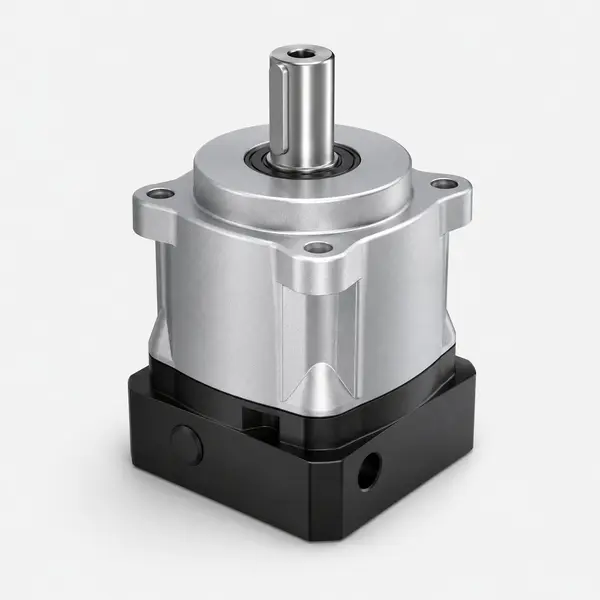
Three-Technology Comparison Matrix — RV Cycloidal, Planetary P0, and Harmonic Drive
The matrix below extends the Planetary vs Harmonic Drive comparison from article 20 by adding the RV cycloidal reducer as a third column. Read each row independently. The column header colour indicates relative advantage: the technology whose cell has the strongest highlight wins that parameter. Where parameters are closely matched, both or all three cells are highlighted equally. This matrix is the definitive single-reference comparison for engineers selecting between the three technologies for each joint in a precision servo system.
| Parameter | RV Cycloidal Reducer Nabtesco / Sumitomo class |
EP-FAD / EP-FAB P0 Korea Ever-Power planetary |
Harmonic Drive Standard / ultra-precision |
Selection guidance |
|---|---|---|---|---|
| Torsional stiffness Ct |
800–1,200 N·m/arc-min
(multi-tooth simultaneous engagement)
★ HIGHEST
|
45–180 N·m/arc-min
(FAB, depends on frame 090–220mm)
|
30–80 N·m/arc-min
(flexspline compliance element)
|
RV wins for heavy robot J1/J2. Calculate Ct_min = T/δ. If >200 N·m/arc-min: RV required. If <200 N·m/arc-min: planetary FAB or FAD adequate. |
| Service life (design) |
6,000–12,000 hr
(cycloidal disc and pin wear — progressive)
|
30,000 hr S1
(L10 bearing fatigue — Korea Ever-Power EP-FAD)
★ HIGHEST (2.5–5× RV)
|
5,000–15,000 hr
(flexspline fatigue — consumable)
|
Planetary wins decisively. RV disc wear and HD flexspline fatigue require scheduled replacement. Planetary bearing L10 at 30,000 hr requires no scheduled consumable. Over 10 years, RV requires 2–3 disc replacements; HD 2–4 flexspline replacements; planetary 0. |
| Efficiency at rated torque |
75–90%
(pin/disc friction, multiple seals)
|
97–99%
(DIN Class 5 rolling contact)
★ HIGHEST
|
70–85%
(flexspline deformation loss)
|
Planetary wins significantly. At 100W output: RV wastes 10–25W, HD wastes 15–30W, planetary wastes 1–3W. Critical for mobile robots, cobots, battery-powered systems. |
| Backlash (arc-min) |
≤1 arc-min (std)
≤0.5 (precision) (disc-pin clearance)
|
≤1 arc-min P0
(0.78 typical, measured & stamped)
|
<0.1 arc-min
(ultra-precision; near-zero)
★ LOWEST (HD ultra)
|
RV ≈ Planetary P0 for backlash. HD ultra wins if <0.1 arc-min required. For robot J1/J2: backlash grade is secondary to torsional stiffness — both RV and planetary P0 achieve ≤1 arc-min. |
| Shock load tolerance |
Very high
(60–70% teeth engaged; peak 3–5× rated)
★ HIGHEST
|
High
(3 planets share load; peak 2–3× rated)
|
Low
(thin flexspline; cumulative fatigue under shock)
|
RV wins for highest shock. Heavy palletising, welding robots with emergency stops, press tending: RV shock tolerance is the decisive advantage alongside stiffness. |
| Weight (per unit torque) |
Heavy
(dense two-stage structure)
|
Light-medium
(aluminium housing, compact design)
|
Lightest
(thin disc form, fewest parts)
★ LIGHTEST
|
HD wins for minimum weight. Planetary is intermediate. RV is heaviest — a concern for arm-mounted robot axes where weight adds to the load that J1 must carry. |
| Axial compactness |
Compact disc form
(hollow shaft through-bore available)
|
Moderate
(EP-FADS saves 22mm vs standard)
|
Thinnest disc
(15–30mm axial depth possible)
★ THINNEST
|
RV and planetary both available in through-bore hollow shaft configurations for cable routing. HD thinnest axially for ultra-compact wrist. EP-FADS closes the gap for most wrist J4 applications. |
| Temperature range |
0°C to +60°C
(RV grease; disc material sensitivity)
|
−40°C to +125°C
(NYOGEL 792D sealed)
★ WIDEST
|
0°C to +70°C
(standard HD; flexspline below 0°C)
|
Planetary wins for temperature range. Cold storage, outdoor, arctic: planetary is the only viable choice. Both RV and HD are limited to 0°C minimum in standard specification. |
| Unit cost (relative) |
200–400%
(+ disc replacement every 5–8 yr)
|
100%
(benchmark; no consumable replacement)
★ LOWEST (unit + lifecycle)
|
150–300%
(+ flexspline replacement every 5–10 yr)
|
Planetary wins on total cost of ownership. RV premium justified only at J1/J2 heavy payload where Ct requirement forces the selection. All other joints: planetary cost advantage is decisive. |
| Maintenance requirement |
Cycloidal disc replacement
(every 6,000–12,000 hr; robot disassembly)
|
Condition-based only
(backlash measurement; no scheduled consumable)
★ LOWEST MAINTENANCE
|
Flexspline replacement
(every 5,000–15,000 hr; wrist disassembly)
|
Planetary wins decisively. Both RV and HD require scheduled consumable replacement that involves partial robot disassembly. Planetary uses condition-based replacement via backlash measurement only. |
Engineering Deep Dive
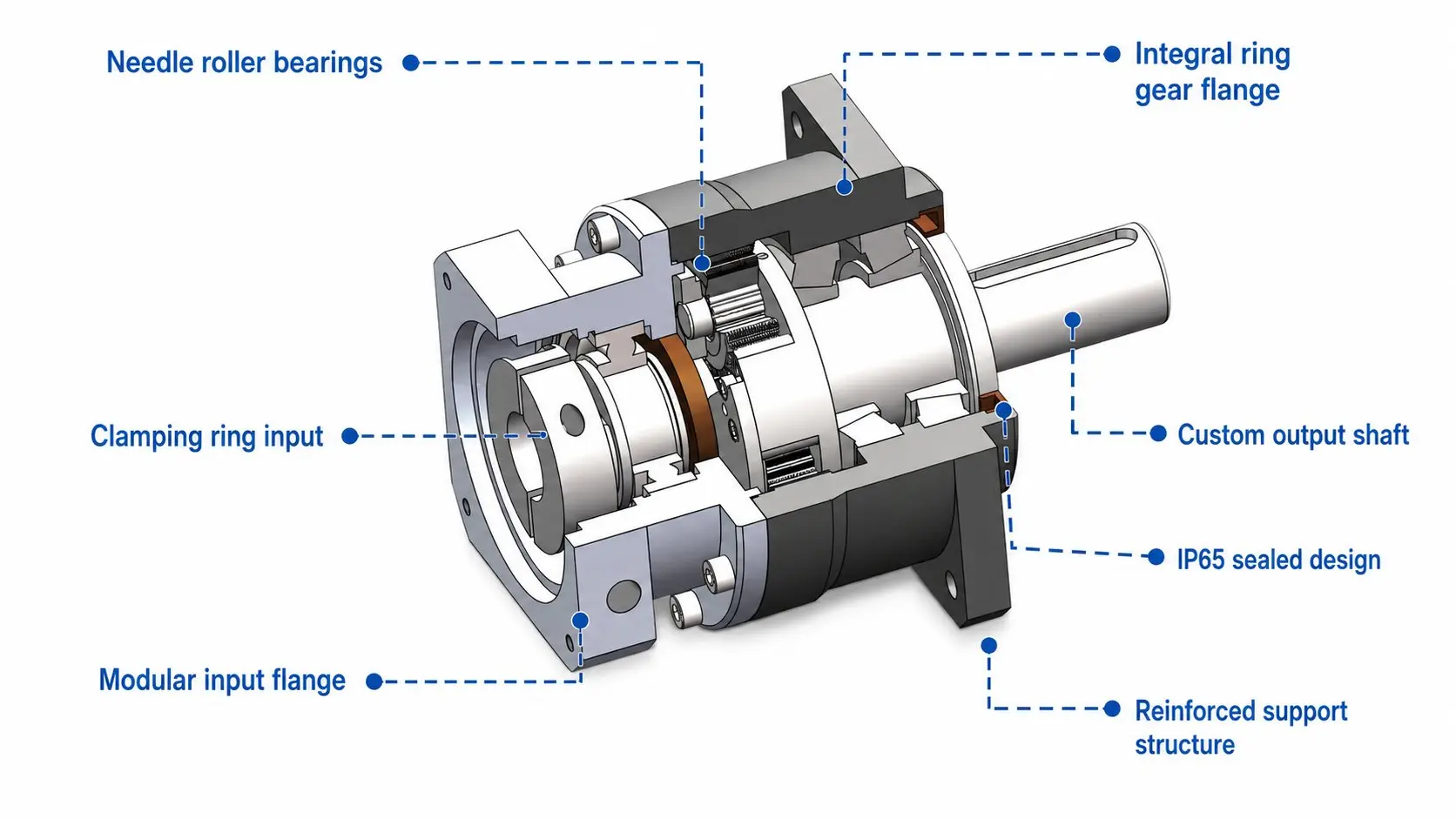
The Physics of Cycloidal Multi-Tooth Engagement — Why RV Stiffness Is 4–20× Higher Than Planetary at the Same Frame
Practical Design Strategy
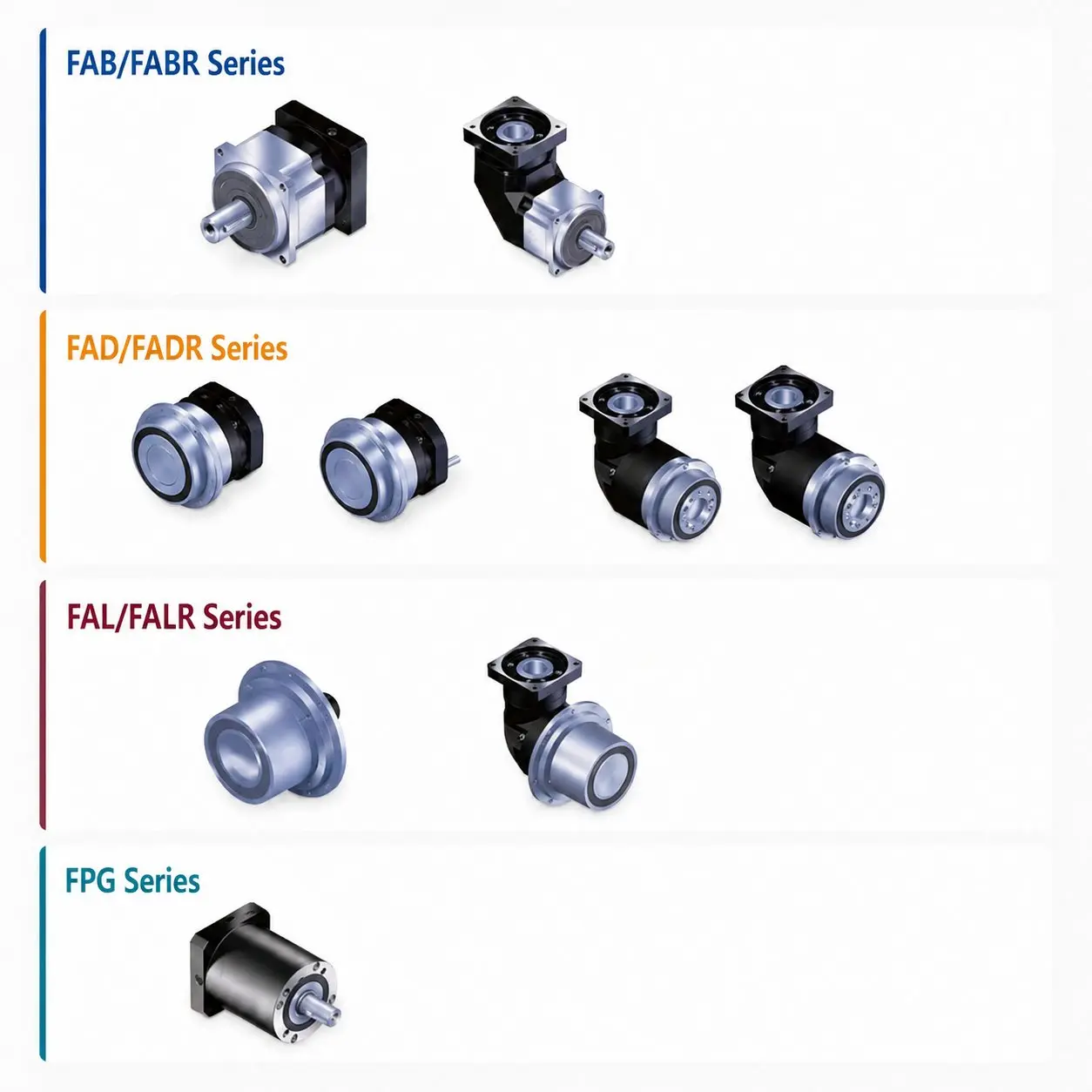
The Optimal Mixed Architecture — RV at J1/J2 Only, Planetary Everywhere Else
Honest Comparison
Six Application Scenarios Where Planetary P0 Is Definitively Better Than RV — Not a Competition
Just as the RV reducer guide above establishes where RV wins honestly, this section establishes where planetary P0 wins so definitively that the RV comparison is irrelevant. For these six scenarios, no specification analyst who runs the numbers would choose RV over planetary P0 — the performance gap is too large, the cost premium too high, and the maintenance burden too significant for the application requirements. These six scenarios cover the majority of precision servo automation volume: the total number of RV-appropriate J1/J2 heavy-payload robot joints in global production is a small fraction of the total planetary gearbox market. For every heavy robot base joint that genuinely needs RV, there are 50–100 lighter robot joints, SCARA joints, CNC axes, medical device drives, and logistics automation drives where planetary P0 is the correct choice and RV would be a waste of budget and maintenance capacity. Understanding both boundaries — where RV is the only viable option, and where planetary decisively wins — is what allows a machine design engineer to allocate technology spending rationally across a complete robot or automation system.
SCARA robots and 6-axis robots below 10kg payload have J1/J2 Ct requirements that EP-FAD or EP-FAB P0 at 090–110mm meets comfortably. The RV premium — 250–400% higher cost, 6,000–12,000hr life, progressive disc wear maintenance — is completely unjustified. Every SCARA in production should use planetary gearboxes throughout. The SCARA article on this site confirms the Ct calculation for typical light-payload SCARA configurations.
Cobots operate at low speed, low payload (typically 3–20kg), and must be back-driveable for human safety. Planetary gearboxes at moderate ratios (i=10–30) are back-driveable with moderate force — a safety characteristic that makes them better suited to cobots than RV (which is harder to back-drive) or HD (also low back-driveability). The cobot’s efficiency requirement (battery-powered or thermally constrained) further favours planetary at 97–99% vs RV at 75–90%. For cobots: planetary throughout, all joints.
Both RV and HD are limited to 0°C minimum operating temperature in standard specification. EP-FAD with NYOGEL 792D operates to −40°C. For any application requiring sub-zero operation — cold storage logistics, outdoor agriculture, arctic exploration, construction in northern climates — planetary gearboxes are the only viable technology among the three. This is an absolute constraint, not a performance preference.
CNC machine tool axes (rotary tables, B-axis, tool changers) do not require the torsional stiffness of RV reducers because the machine structure provides the primary stiffness, and the gearbox drives a precision bearing-supported axis rather than carrying a cantilevered arm load. EP-FAB P0 with the correct frame size meets CNC requirements at much lower cost and with 5× longer service life. No CNC machine tool application in this guide series requires RV.
Semiconductor handlers and medical robots require ultra-low particle emission and the cleanroom-validated NYOGEL 792D lubricant confirmed in Korea Ever-Power’s guide series. RV reducers use different lubrication systems (typically oil-bath mineral oil) not typically validated for ISO Class 5 cleanroom particle emission. Planetary with NYOGEL 792D is the technically correct choice for cleanroom-rated applications.
As established in the Logistics guide, sortation drives require gear tooth endurance at 50–250 million cycles over 5 years. RV’s cycloidal disc wear mechanism would produce unacceptable backlash growth at these cycle counts — the disc replacement interval of 6,000–12,000 hr would trigger multiple replacements within the sortation system’s maintenance-free service interval. Planetary gearboxes with DIN Class 5 gears are the only viable technology for high-cycle logistics drives.
Frequently Asked Questions — RV vs Planetary Selection
편집자: Cxm