Planetary Gearbox for Textile & Film Converting — Winding Machines, Slitters & High-Volume Textile Drives

180:1
Single Unit — EP-FALR
±1.2%
Tension Uniformity — EP-FALR
30,000시간
Design Life — EP-FALR S5
≥97%
Efficiency — EP-FPG Economy
IP65
Steam & Chemical — FPGA
C1–C10
Universal Motor Adapter

Engineering Context

Roll Quality Starts at the Gearbox — Why Winding Tension Uniformity Is a Drive-Train Problem

EP-FALR right-angle planetary gearbox on film winding machine mandrel drive — 180:1 single unit no tandem coupling tension uniformity

Korea Ever-Power EP-FALR — 180:1 ratio, right-angle motor layout, integrated belt pulley output. A single sealed unit replaces the tandem gearbox arrangement on film and electrode winding mandrel drives.

In film and textile converting, roll quality is defined by winding tension uniformity. A roll wound with ±1% tension variation from core to surface and from one revolution to the next produces a tight, dimensionally consistent product. A roll wound with ±8% tension variation — with periodic peaks at mechanical rotation frequency — produces a product with streaks, layer shifts, and telescoping that downstream processes cannot compensate. The difference between these two outcomes is not the tension controller algorithm. It is the mechanical precision of the winding drive train.

Winding machines for film, foil, and electrode substrate typically require 80–180:1 gear ratio at the mandrel with the motor perpendicular to the winding axis — the motor drives a right-angle input, the planetary stages deliver the ratio, and a belt connects the gearbox output to the mandrel. The conventional solution to this geometry is a tandem arrangement: a right-angle gearbox stage (10:1) coupled by belt to an inline planetary stage (10:1), giving 100:1 total. Each inter-stage coupling — the belt between the two gearboxes, the hub-to-shaft interface at each pulley — introduces torsional compliance and backlash. These two mechanical properties manifest identically at the mandrel: periodic torque fluctuation at belt rotation frequency that the tension controller interprets as a real tension error and corrects with a torque command — which then interacts with the next periodic fluctuation. The result is the ±8% tension oscillation that characterises tandem-coupled winding drives in service.

EP-FALR integrates the right-angle bevel input stage, two-stage helical planetary ratio, and timing belt pulley output in one sealed unit. At 180:1 maximum ratio, it covers the entire range of film and electrode winding requirements without a tandem arrangement. The absence of an inter-stage coupling eliminates the torsional compliance and backlash accumulation at that interface. Documented result in a Korean electrode coating machine: winding tension oscillation amplitude reduced from ±8% to ±1.2% of set tension after replacing the tandem arrangement with EP-FALR. The tension controller parameters were not changed.

🧵
The Full Factory View: FALR for Winders, FPG/FPGA for Everything Else
A textile or film converting factory contains winding machines at both ends of the line (unwind and rewind) plus a large number of process drives in between — calender rolls, stenter transport, loom warp beams, knitting machine feeds — where ≤8 arc-min economy-grade precision is adequate. EP-FALR handles the winding precision problem. EP-FPG/FPGA economy series handles the process drive volume. Both use the C1–C10 universal motor adapter, so a single servo motor qualification covers the entire factory BOM. This is the same economic logic as packaging machinery — but at textile scale, where a single weaving shed may have 200–400 servo-driven axes across all machines.

Roll & Fabric Defect Origin Map — From Symptom to Gearbox Root Cause

When a winding, slitting, or converting machine produces defective product, the symptoms appear in the roll or fabric but the root cause is often in the drive train. The following map connects observable defect types to their mechanical origin and to the correct EP-series solution. This is a first-pass diagnostic guide — use it to identify whether a gearbox change can resolve the defect before exploring process parameter adjustments.

Defect / Symptom Mechanical Origin
(drive-train cause)
Gearbox Mechanism Detectable
by Controller?
EP-Series
Solution
Expected Result
Periodic tension bands
Visible streaks at fixed spacing in web or film
Inter-stage torsional compliance in tandem gearbox arrangement Belt compliance between two-stage tandem gearboxes causes periodic torque variation at belt rotation frequency; appears as tension ripple at mandrel Partially — controller over-corrects and amplifies EP-FALR P1 Single-unit 180:1 eliminates inter-stage coupling; tension oscillation: ±8% → ±1.2%
Periodic registration error
Print colour offset at fixed interval in roll-to-roll printing
Hub eccentricity at print roller drive shaft Separate pulley hub on roller drive gearbox output; hub bore/shaft TIR of 0.05–0.12 mm produces periodic registration error at roller rotation frequency No — periodic, fixed frequency EP-FAL P1 Integrated pulley eliminates hub eccentricity; periodic registration error: 0.08 mm → ≤0.015 mm
Layer shift / telescoping
Wound layers displaced axially — roll unusable
Backlash at mandrel drive during tension reversal or speed change transient Backlash accumulation in tandem gearbox (each stage contributes separately) creates dead zone during speed ramp; mandrel momentarily free to advance under inertia Partially — at transients only EP-FALR P1
or upgrade to P0
Single-unit gearbox eliminates tandem backlash stack; ≤2 arc-min P1 significantly reduces transient dead zone
Winding hardness variation
Roll hard in some zones, loose in others on same diameter
Backlash growth in ageing gearbox — torque dead zone increases with wear As gear tooth surfaces wear, backlash increases progressively; tension controller compensation cannot keep up with slowly growing dead zone; winding hardness becomes non-uniform No — gradual drift, not detected EP-FALR P1
DIN Cl-5 grade-stamped
DIN Class 5 gears start with lower backlash; larger wear budget before P1 → P2 degradation; per-unit stamp documents starting value for condition monitoring
Slitting width variation
Slit web width inconsistent across rewind shafts
Differential speed error between rewind shafts due to backlash mismatch between individual gearboxes In multi-shaft slitting machines, gearboxes without per-unit backlash measurement may have different actual backlash values within the “P1” batch — differential torque delivery between shafts causes speed divergence and web width variation Partially — by tension feedback EP-FALR P1
individual stamp
Per-unit backlash stamp confirms matched values across all rewind shaft gearboxes; batch-to-batch consistency maintained
Yarn tension irregularity
Knitting / weaving: uneven stitch/pattern density
Backlash in feed drive gearbox causing cyclic yarn speed error In closed-loop tension control, large backlash (≥10 arc-min, typical worm) causes hunting in the tension controller — high-frequency torque commands that exceed the motor’s ability to respond, manifesting as yarn feed rate variation Partially — controller hunts EP-FPG P2
≤5 arc-min
FPG P2 (≤5 arc-min) vs worm (≥10 arc-min) reduces controller hunting amplitude; stable closed-loop tension control restored
Gearbox overheating
Worm gearbox too hot to touch at rated production speed
Worm gear sliding-contact efficiency loss (≤65%) converted to heat in lubrication chamber In a 300 W motor with worm gearbox at 65% efficiency: 105 W dissipated as heat. In a continuous-duty textile drive running 16 hr/day, this heat load raises lubricant temperature beyond the rated range of standard mineral-oil worm gearbox grease Yes — thermal trip EP-FPG/FPGA
≥97% efficiency
≥97% efficiency: same 300 W motor dissipates only 9 W — 92% heat reduction; no thermal trip at rated production speed
IP seal failure / lubricant contamination
Dye or steam entering gearbox on stenter/dyeing machine
Inadequate IP protection — batch-sample-tested seals allow ingress in field Steam at 120°C thermal cycling causes gearbox seal expansion/contraction; seals tested to IP65 on batch samples may fail on individual production units; dye ingress accelerates gear corrosion and backlash growth Yes — at late stage (black grease visible) EP-FPGA IP65
every unit tested
IP65 pneumatic decay test on every unit (not batch sample) eliminates the marginal-seal population before shipment

Tension oscillation values (±8% vs ±1.2%) documented in Korean electrode coating machine application. Registration error values (0.08 mm → 0.015 mm) documented in Korean CNC router application with same integrated pulley mechanism. Other values are representative engineering estimates based on typical drive-train parameters.

Application Scenarios

Six Textile & Film Converting Applications — Engineering Rationale and Series Selection

Textile and film converting encompasses winding precision at one end (EP-FALR for tandem elimination) and high-volume process drives at the other (EP-FPG/FPGA for economy). The six scenarios below span this range, with engineering rationale for each series selection and the specific mechanical problem each resolves.

01 — Film / Foil / Electrode Winding Machine
Mandrel drive — primary wind and rewind
EP-FALR P1
Frame 110–190 mm
80–180:1 single unit

Film and foil winders wind materials ranging from 5 µm polyester film to 100 µm aluminium foil at speeds of 200–600 m/min, with the tension set point varying from a few Newtons for thin films to hundreds of Newtons for heavy foils. The winding ratio requirement — 80–180:1 with the motor perpendicular to the mandrel axis — is what makes EP-FALR the only standard-production solution: no other Korean-manufactured planetary gearbox provides this ratio in a single unit with an integrated belt pulley output. The right-angle motor layout is essential because the mandrel runs horizontally and motor space is at the side or top of the machine frame, not in front of the mandrel end.

Key spec: Single-unit 180:1 — no tandem coupling; integrated belt pulley — no hub eccentricity; ≤2 arc-min P1; F_rad 34,200 N for wide winding belt; 30,000 hr S5 life; NYOGEL 792D or CASTROL LMX (confirmed by application).

02 — Slitting Machine Rewind Shaft Drive
Multi-shaft slit web rewinding — tension-controlled
EP-FALR P1
Frame 090–150 mm
50–100:1

Slitting machines cut a wide parent roll into multiple narrower slit rolls on individual rewind shafts driven by separate servo drives. A slitting machine typically has 4–24 rewind shafts, each requiring a gearbox. The key requirement is matched backlash across all shaft gearboxes — if individual shafts have different actual backlash values within a nominal “P1” batch, differential torque delivery causes slit width variation as faster shafts draw the web slightly. Korea Ever-Power’s per-unit backlash measurement and nameplate stamp confirms that each gearbox in a slitting machine set has a documented, matching backlash grade.

Key spec: Per-unit backlash stamp ensures matched values across multi-shaft sets; right-angle compact for tight shaft spacing; 50–100:1 single unit; 30,000 hr S5; IP65 for solvent/chemical slitting environments.

03 — Roll-to-Roll Printing / Coating Roller Drive
Print cylinder / anilox / impression roller — registration
EP-FAD P1
Frame 090–110 mm
Low vibration

Roll-to-roll printing machines for flexible packaging, labels, and decorative films require print cylinder speed synchronisation across all colour stations within ±0.05% at speeds of 50–400 m/min. Vibration from the gearbox drive at any colour station manifests as print registration error in the finished product — a repeating offset pattern at gear mesh frequency. EP-FAD P1 with helical planet gears delivers significantly lower vibration than straight-cut gear designs at equivalent pitch-line velocity: approximately 60% lower vibration amplitude at 5,000 rpm input. Low noise (≤58 dB at FAD090) also matters in printing environments where operators are present at the press throughout the shift.

Key spec: Low vibration — helical gears ~60% lower than straight-cut; ≤3 arc-min P1; 5–16:1; 5,000 rpm; thermal stability NYOGEL 792D −10°C to +90°C; 30,000 hr; IP65 solvent wash.

04 — Knitting Machine Yarn Feed / Take-Up
Positive feed drive — circular knitting, warp knitting
EP-FPG / FPGA
Frame 060–090 mm
18% cost vs FAB

Knitting machine positive feed drives control the rate at which yarn is delivered to the needles — the key parameter determining stitch density and fabric hand feel. The gearbox requirement is ≤8 arc-min backlash for stable closed-loop tension control, low noise (production hall with multiple machines running), and economy pricing for high-volume OEM supply (a circular knitting machine may have 48–120 individual feed drives, each powered by a small servo motor through a planetary gearbox). EP-FPG round-housing press-fits into the feed roller hub without an adapter bracket; EP-FPGA flat-mounts on the machine frame. Both at 18% lower cost than EP-FAB at the same frame size.

Key spec: Economy tier; ≤8 arc-min (≤5 arc-min P2 option); ≤56 dB noise (FPG040); CASTROL LMX lifetime sealed; IP64 standard; C1–C10 same adapter as precision axes if machine is upgraded.

05 — Weaving Loom Warp Beam Drive
Warp let-off — fabric tension control, long service
EP-FPG P2
Frame 060–120 mm
Long service interval

Weaving loom warp beam let-off drives control the rate at which warp yarn is unwound from the beam to maintain constant warp tension throughout the weaving cycle. The gearbox requirement is moderate precision (≤5 arc-min P2 sufficient for closed-loop tension control), long maintenance-free interval (looms run continuously; any maintenance access requires loom stopping and relayering), and economy pricing for multi-machine installations. EP-FPG P2 sealed with CASTROL LMX lifetime fill requires no relubrication within the 20,000-hour S5 design life — aligning with typical loom overhaul intervals rather than creating an additional maintenance task.

Key spec: ≤5 arc-min P2; zero scheduled lubrication within 20,000 hr S5; economy OEM pricing; IP64; 10–50:1; 3,000 rpm; matches loom overhaul interval.

06 — Dyeing / Stenter Frame Transport Drive
Fabric transport — steam, dye, high-temperature chain
EP-FPGA
Frame 060–100 mm
IP65 steam/chemical

Stenter frames and dyeing machines transport fabric through steam-heated chambers at temperatures of 80–200°C, with dye chemicals, steam condensate, and process water present at the drive chain environment. The gearbox must survive sustained thermal cycling, chemical exposure, and occasional wash cycles — making IP65 the minimum acceptable protection. EP-FPGA square housing flat-mounts on the stenter frame structure; the CASTROL LMX grease is rated for the high-temperature environment. Efficiency matters here: stenter frames may run 6,000–8,000 hours per year — a 35% efficiency difference between planetary and worm at 300 W per drive translates to measurable electricity savings across a multi-drive stenter line.

Key spec: IP65 steam/chemical; square housing flat-mount; CASTROL LMX 0–90°C; ≥97% efficiency (vs ≤65% worm); economy tier; 10–30:1; 3,000 rpm; long service interval.

Technical Specifications

EP-Series Textile & Film Converting Specification Matrix

The table below spans from the highest-precision winding application (EP-FALR P1 for film winders) to the economy process drives (EP-FPGA for stenter transport). All series share the C1–C10 universal motor adapter — a single motor qualification covers the entire factory BOM regardless of which series is specified at each drive point.

Drive Point / Machine Type 시리즈 Frame (mm) Backlash Ratio Max rpm IP 수명(시간) Key Selection Reason
Film / foil winder mandrel EP-FALR P1 110–190 ≤2 arc-min 80–180:1 3,000 IP65 30,000* Single-unit 180:1; no tandem; integrated belt pulley; tension ±8% → ±1.2%
Electrode coating winder EP-FALR P1 110–150 ≤2 arc-min 80–120:1 3,000 IP65 30,000* Right-angle; motor ⊥ roll; cleanroom-compatible; precision tension
Slitting machine rewind shaft EP-FALR P1 090–150 ≤2 arc-min 50–100:1 3,000 IP65 30,000* Per-unit stamp ensures matched backlash across multi-shaft sets; compact R/A
Roll-to-roll print / coating roller EP-FAD P1 090–110 ≤3 arc-min 5–16:1 5,000 IP65 30,000 Low vibration (helical gears); thermal stability; registration accuracy; solvent IP65
Knitting machine yarn feed EP-FPG/FPGA 060–090 ≤8 arc-min 10–30:1 3,000 IP64 20,000* Economy; 18% lower cost than FAB; 48–120 feeds per machine; ≤56 dB noise
Weaving loom warp beam EP-FPG P2 060–120 ≤5 arc-min 10–50:1 3,000 IP64 20,000* Zero relubrication within life (matches loom overhaul interval); economy OEM pricing
Non-woven calender roll drive EP-FPGA 090–120 ≤8 arc-min 10–40:1 3,000 IP64 20,000* Square housing; OEM volume pricing; reliable torque density; long service
Dyeing / stenter transport EP-FPGA 060–100 ≤8 arc-min 10–30:1 3,000 IP65 20,000* IP65 steam/dye chemical; ≥97% efficiency vs ≤65% worm; economy tier

★ FALR/FPG: S5 intermittent life shown; S1 continuous = 15,000 hr (FALR) / 10,000 hr (FPG). FAD values are S1 continuous. C1–C10 applies to all series.

FALR 180:1
No Tandem — Single Unit
±1.2%
Tension Uniformity
≥97%
FPG/FPGA Efficiency
30,000시간
FALR S5 Life
IP65
Every Unit Tested
C1–C10
One Factory BOM

엔지니어링 인사이트

Inside EP-FALR — Why Eliminating the Tandem Coupling Changes Winding Quality

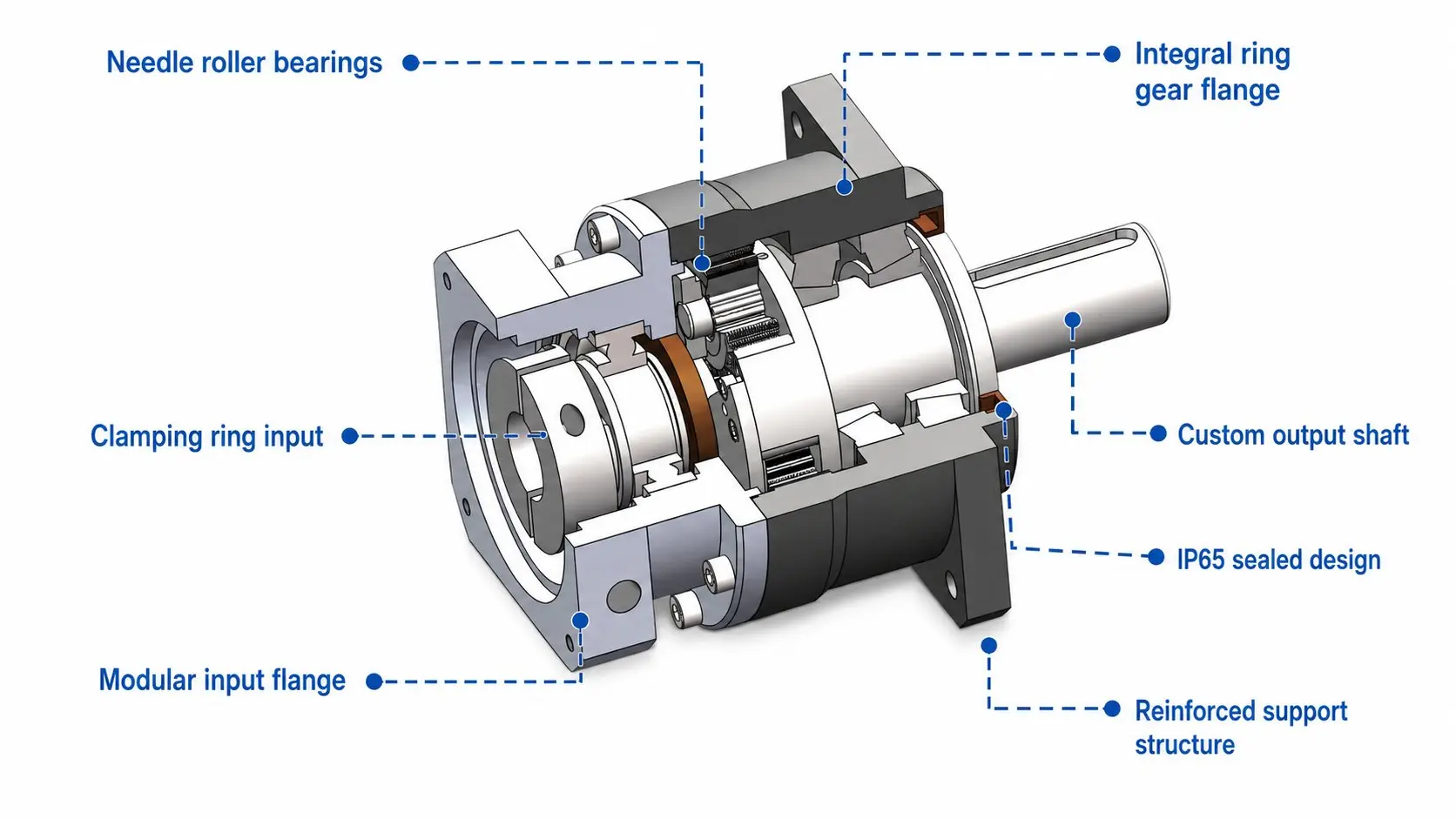
EP-FALR right-angle planetary gearbox internal structure — bevel input stage helical planetary integrated belt pulley for film winding machine

180:1
Single Unit Max
±1.2%
Tension Uniformity
34.2kN
Belt Force

EP-FALR three-stage architecture: bevel input → two-stage helical planetary → integrated belt pulley output. One sealed unit, zero inter-stage coupling, 180:1 maximum ratio.

The Three Stages and What Each Eliminates

The tandem gearbox arrangement — a right-angle first stage coupled by belt to an inline second stage — was the default solution for winding mandrel drives because no single gearbox provided all three required functions: 90° direction change, high ratio, and belt-pulley output. EP-FALR integrates all three in one sealed housing. Each stage eliminates a specific class of tension error:

  1. 01
    Bevel Input Stage — Motor at 90°, Zero Added Backlash to Tandem

    The bevel input stage changes the motor shaft direction by 90° with a precisely ground bevel gear pair. This is the function the right-angle first-stage gearbox in a tandem arrangement provides — but in a tandem, the output of this stage then needs a belt coupling to the inline second stage, which introduces the inter-stage compliance. In EP-FALR, the bevel stage output shaft is directly internal to the same housing as the planetary stages — no external coupling, no inter-stage belt, no interface backlash or torsional spring between the two ratio stages.

  2. 02
    Two-Stage Helical Planetary — High Ratio, Low Heat, 30,000 hr Life

    The two planetary stages deliver the bulk of the ratio — up to 180:1 total from the FALR unit — using helical planet gears in rolling contact throughout. This is the same gear geometry as the premium EP-FAD series: DIN Class 5 profile-ground, NYOGEL 792D or CASTROL LMX sealed, rated for 30,000 hours S5. Winding machines run at low input speed (typically 500–3,000 rpm) with moderate torque — well within the thermal operating window of sealed NYOGEL 792D without any relubrication requirement.

  3. 03
    Integrated Belt Pulley — Zero Hub Eccentricity at Mandrel Drive

    The timing belt pulley is machined integral to the planetary output shaft — the same single-piece forging. There is no hub-to-shaft interface between the gear output and the belt pitch circle. This eliminates the hub eccentricity (0.05–0.12 mm TIR) that, in conventional winding drive designs, creates a periodic winding tension variation at belt rotation frequency. At a typical winding speed of 200 m/min with a 100 mm belt pulley diameter, this eccentricity repeats at approximately 10 Hz — a frequency the winding tension controller sees as a real tension error and corrects, creating the characteristic ±8% tension oscillation. Removing the hub-shaft interface removes this excitation source entirely.

The measurable result: tension oscillation amplitude from ±8% (tandem + separate hub) to ±1.2% (EP-FALR, documented in Korean electrode coating machine application). The tension controller parameters were not changed — the improvement came entirely from removing the mechanical excitation sources.

Selection Guide

Textile & Film Converting Gearbox Selection — 5 Questions from Defect Symptom to Correct Series

The selection logic for textile and film converting splits at Q1 between winding/converting precision drives (FALR path) and process drives (FPG/FPGA economy path). The defect map earlier in this article can serve as a first-pass diagnostic — if you’ve identified a roll quality defect, work backwards from the symptom to confirm whether the drive-train is the root cause before proceeding with Q1.

Selection Question
Your Answer → Series Implication
Recommended
Q1 — Drive type?
Winding / rewind / slitting mandrel drive (high ratio, right-angle motor, belt output) → FALR path: Q2W  |  Print / coating roller, precision tension roller → EP-FAD P1  |  All other process drives (knitting, loom, calender, stenter) → Economy path: Q2E
Split path
Q2W — Winding ratio required?
80–180:1 right-angle with belt output → EP-FALR P1 (single unit; no tandem; integrated pulley)  |  50–80:1 → EP-FALR P1 lower ratio range  |  Need more than 180:1 → two EP-FALR units in series or contact application engineering
EP-FALR P1
Q3W — Multi-shaft matching?
Slitting machines only: Number of rewind shafts × individual FALR units. Per-unit backlash stamp confirms matched values across the shaft set. Contact Korea Ever-Power with shaft count and target backlash grade — matched-set supply available. For single-shaft winders, standard stock FALR is sufficient.
Matched set
Q2E — Housing geometry?
Economy path: Press-fit into roller hub bore → EP-FPG (round housing)  |  Flat-mount on machine frame face → EP-FPGA (square housing)  |  IP65 required (steam, dye, chemical environment) → specify IP65 option on FPGA  |  Standard indoor textile hall → IP64 standard sufficient
FPG / FPGA
Q4 — Volume / motor system?
High unit count (knitting: 48–120 feeds; stenter: 20–60 transport drives): contact Korea Ever-Power for OEM volume pricing with BOM. C1–C10 universal motor adapter: one qualification covers FALR + FPG + FPGA on the same factory BOM — Siemens, Yaskawa, Mitsubishi, Panasonic all covered by the same adapter ring for a given motor model.
OEM / C1–C10

Manufacturing Quality

Korea Ever-Power Production — Three Quality Standards That Matter for Winding and Textile Applications

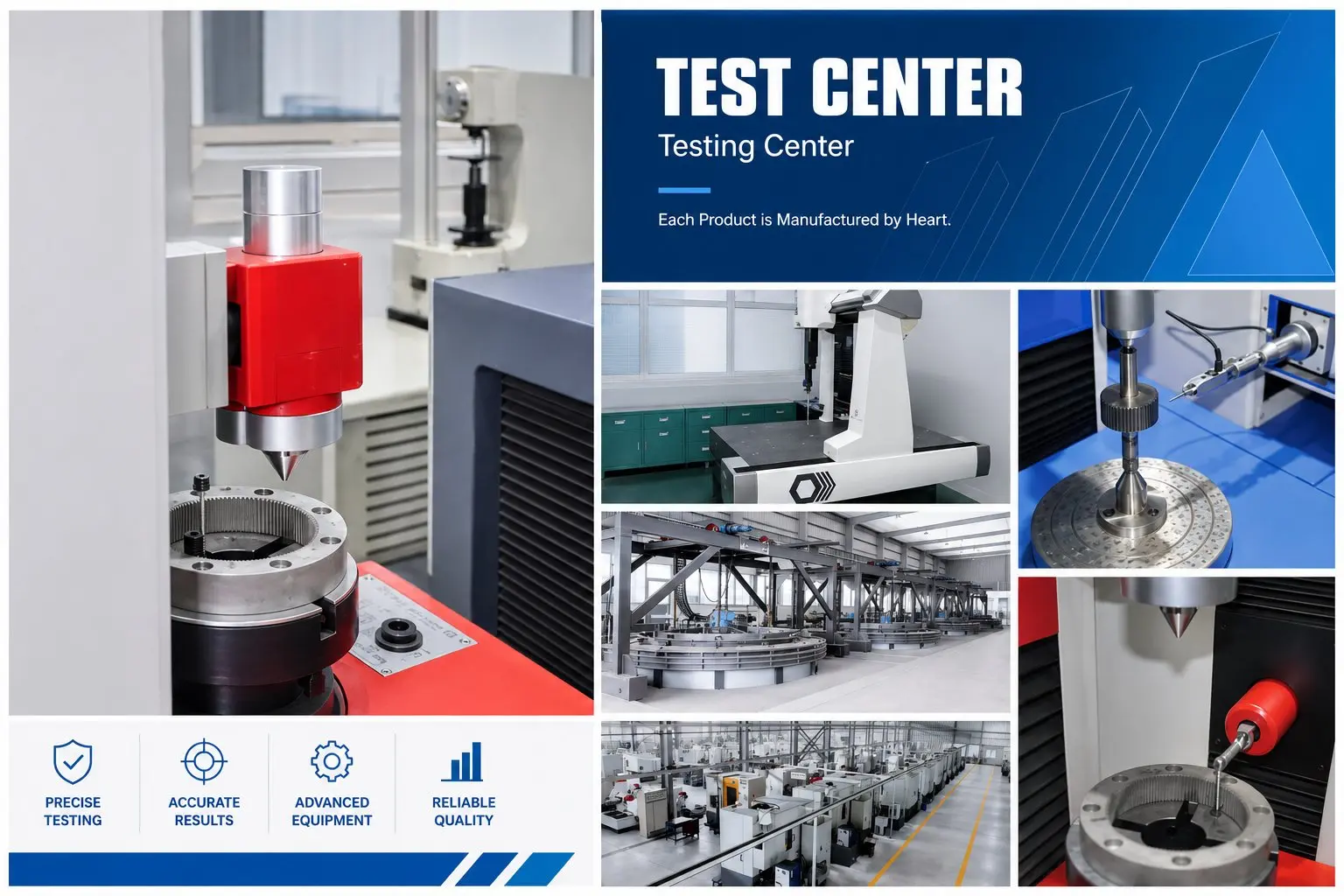
Korea Ever-Power test center — individual backlash measurement and IP65 seal pressure testing for EP-FALR and EP-FPG textile film converting gearboxes
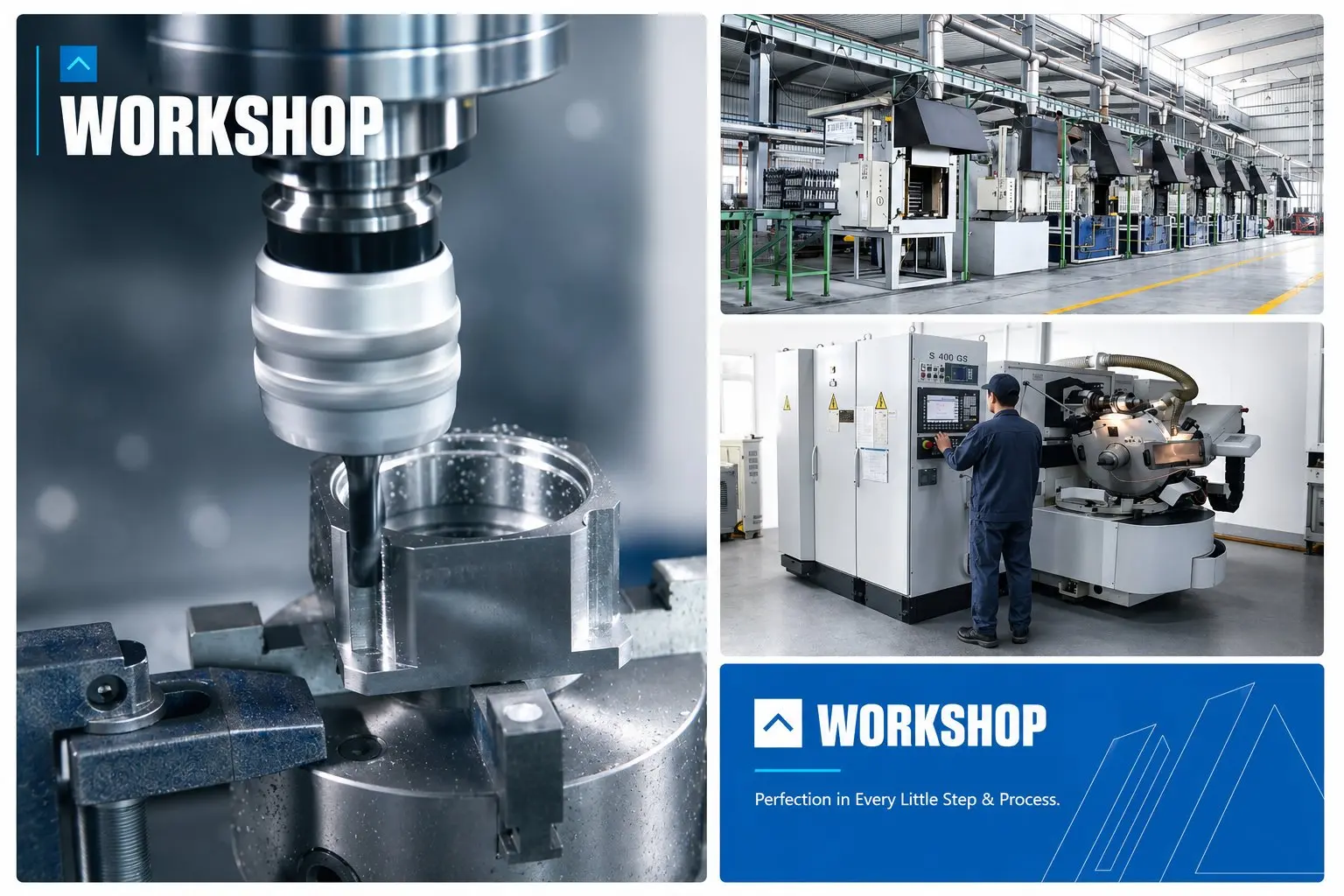
Korea Ever-Power 5-axis CNC gear grinding workshop — DIN Class 5 profile grinding for EP-FALR and EP-FPG series planetary gearboxes

Test centre (backlash measurement, IP65 pressure decay — every unit) and gear-grinding workshop, Korea Ever-Power facility, Ansan-si, Gyeonggi-do, Korea.

For winding and textile applications specifically, three production quality standards determine real-world performance over a multi-year production run. These are not marketing claims — they are engineering decisions made at the component design and production process level that have measurable consequences in the field.

Per-unit backlash stamp — critical for slitting machines and multi-shaft winders: In a slitting machine with 12 rewind shafts, all 12 gearboxes must have matching backlash to maintain uniform tension across the web width. If backlash values vary within the nominal P1 grade — which is possible without individual measurement, since P1 allows anything from 1.0 to 3.0 arc-min — the faster shaft draws the web slightly, causing slit width variation. Korea Ever-Power’s per-unit backlash stamp documents the exact measured value for each gearbox. For matched-set orders (multi-shaft slitting machines), Korea Ever-Power can supply units sorted by measured backlash within a narrow sub-range (e.g., all units within 0.3 arc-min of each other) on request.

IP65 per-unit pressure test — critical for stenter, dyeing, and chemical environments: Stenter frames and dyeing machines operate with steam condensate, dye chemicals, and periodic wash cycles. A gearbox with a marginal IP seal — one that passed a batch-sample test but not an individual unit test — allows chemical ingress within the first thermal cycling of the seal. Steam at 120°C causes the seal lip to expand; cooling pulls it back; any micro-gap in the seal lip geometry allows ingress on each cycle. The pneumatic pressure decay test on every EP-FPGA unit identifies seals with micro-gaps before they ship. In a stenter frame with 40 transport drives, this test eliminates the risk of multiple field IP failures occurring in the first production month.

CASTROL LMX lifetime seal — critical for long maintenance interval in textile machinery: Weaving looms and knitting machines are difficult to access for maintenance — stopping a loom to service a gearbox requires re-threading the entire warp, which takes hours. CASTROL LMX sealed lifetime fill in EP-FPG/FPGA requires no relubrication within the 20,000-hour S5 design life. At typical textile machine duty cycles (1–2 shifts per day), 20,000 hours S5 corresponds to 8–12 years of operation — spanning the natural overhaul cycle of the machine itself.

📊
Matched-Set Supply for Slitting Machines — Available on Request
For slitting machine orders requiring uniform backlash across all rewind shaft gearboxes, Korea Ever-Power can supply EP-FALR units from the same production batch, sorted by measured backlash to within a specified sub-range. This service — available from 4 units minimum — ensures that all shafts in a slitting machine start with matching drive-train precision, eliminating the source of differential tension between shafts that causes slit width variation. Contact [email protected] with shaft count, target ratio, and required backlash sub-range to request a matched-set quotation.

EP-FALR vs. Tandem Gearbox Arrangement — Technical Comparison for Winding Applications

Attribute Tandem Gearbox
(R/A stage + inline stage + belt hub)
EP-FALR
(single sealed unit)
Impact on Winding Quality
Number of components 3–4 (2 gearboxes + belt + hub) 1 (single sealed unit) Fewer components = fewer failure modes; shorter assembly time; simpler BOM
Inter-stage coupling Belt + hub: torsional compliance + eccentricity None — internal shaft only Eliminates periodic tension excitation at belt rotation frequency
Tension oscillation amplitude ±8% typical (documented) ±1.2% (documented) 6.7× improvement — eliminates periodic band defects in wound roll
Max ratio (single arrangement) Limited by inter-stage belt — typically 80–100:1 180:1 standard catalogue Covers all practical winding ratios without adding a third stage
Maintenance intervals Multiple: belt tension, hub fasteners, two lube points None within 30,000 hr S5 Sealed lifetime fill; no belt re-tensioning; no hub fastener torque checks
Per-unit backlash stamp Not standard — two separate gearboxes, each batch-sampled Single unit, single stamp Enables matched-set supply for slitting machines; single traceability document per shaft

Tension oscillation values documented in Korean electrode coating machine application; same mechanism applies to film and foil winding. Component count comparison is for a standard tandem arrangement (right-angle gearbox + inter-stage belt + inline gearbox + belt hub to mandrel).

고객 피드백

What Textile and Film Converting Machine Engineers Say

★★★★★

“We build film winding machines for the flexible packaging market and had a persistent tension band problem — a repeating streak pattern at a fixed spacing in the wound rolls that our tension controller couldn’t tune out. After diagnostic measurement we traced it to the inter-stage belt in our tandem gearbox arrangement. Switched to EP-FALR 120:1. The tension oscillation amplitude dropped from about ±7% to under ±1.5%. The band pattern disappeared completely. We’ve rebuilt our standard winder drive around EP-FALR and haven’t had a roll quality reject on that machine since.”

CW
Choi W., R&D Mechanical Engineer
Film Winding Machine Manufacturer — Gyeonggi-do, Korea
★★★★★

“Our slitting machine has 16 rewind shafts. We’d been getting slit width variation of ±0.5 mm across the web — within specification, but at the limit. After investigating, we suspected unequal backlash between rewind shaft gearboxes. Korea Ever-Power supplied 16 FALR units from a matched set — all measured within 0.25 arc-min of each other. Slit width variation dropped to ±0.2 mm. The per-unit backlash stamps on the nameplates also went straight into our quality documentation system. Small details that make a real difference in a precision slitting operation.”

LY
Lee Y., Production Engineering Manager
Precision Slitting Machine OEM — Daejeon, Korea
★★★★★

“We replaced worm gear drives on 60 stenter transport zones with EP-FPGA. IP65 was non-negotiable — the stenter environment has steam and dye chemicals and we’d had worm gearbox seal failures every 6–9 months on the previous design. Since switching to FPGA with the per-unit IP65 test, we’ve had zero seal failures in 18 months of 2-shift operation. The efficiency improvement was also significant — the motor drives are noticeably cooler at rated speed, and electricity consumption on that line dropped measurably. The C1–C10 adapter was the same as our knitting machine yarn feed drives, so one motor qualification covered both lines.”

PK
Park K., Engineering Director
Textile Finishing Equipment Manufacturer — Daegu, Korea

Related EP-Series — Full Textile Factory Coverage

Korea Ever-Power EP series planetary gearbox range — FALR FAD FPG FPGA for textile film converting winding slitting knitting loom stenter

The core textile series are EP-FALR (winding mandrel drives, 80–180:1, right-angle, integrated pulley) for film, foil, electrode, and slit-rewind applications, and EP-FPG/FPGA (economy tier, ≤8 arc-min, ≥97% efficiency) for knitting, weaving, calender, and stenter drives. For inline belt-drive applications (roll-to-roll coating, some winding configurations): EP-FAL. For print roller and coating roller drives requiring low vibration: EP-FAD P1.

Browse the full EP series product range, or explore related mechanical transmission components at agriculturalgear-boxes.com. For worm reducer comparison in high-volume textile process drives: worm-reducers.xyz.

Frequently Asked Questions — Textile & Film Converting Gearbox Selection

Why does a tandem gearbox cause tension oscillation, and why can’t the controller compensate?
A tandem winding gearbox — a right-angle first stage coupled to an inline second stage by a belt — introduces two mechanical imperfections between the motor and the mandrel. The first is torsional compliance: the belt between the two stages stretches and recovers under varying torque, acting as a torsional spring. The second is hub-to-shaft eccentricity at the belt pulleys: the separate hub mounted on each gearbox output shaft has a concentricity error of 0.05–0.12 mm, which causes the belt to advance and retard at pulley rotation frequency. Both effects manifest at the mandrel as periodic torque variation — which the tension controller sees as a real tension error and tries to correct. However, because the variation is periodic and repeating at a fixed frequency, the controller correction itself adds a torque component at the same frequency — and the interaction of the two periodic signals produces the characteristic ±8% tension oscillation that creates band defects in the wound roll. EP-FALR eliminates both excitation sources: there is no inter-stage belt (the bevel and planetary stages share one housing) and no separate hub (the belt pulley is machined onto the output shaft). The tension controller then operates against a mechanically stable torque source, and oscillation amplitude drops to ±1.2%.
Can EP-FALR be supplied in matched sets for slitting machines with multiple rewind shafts?
Yes. Korea Ever-Power can supply EP-FALR units as a matched set for slitting machine multi-shaft installations, sorted by measured backlash within a specified sub-range. The standard P1 grade covers a range from 1.0 to 3.0 arc-min. For a matched-set order, Korea Ever-Power selects and measures units from the same production batch and supplies only those units whose measured backlash falls within a narrower sub-range — for example, all units between 1.5 and 1.8 arc-min. This ensures that all rewind shafts start with matching drive-train precision, eliminating the source of differential torque delivery between shafts that causes slit width variation. Minimum matched-set order is 4 units. Specify: frame size, ratio, required backlash sub-range (e.g., ±0.3 arc-min), and number of shafts when contacting [email protected].
Is EP-FPG/FPGA suitable for stenter frame drives in 120°C steam environments?
EP-FPG/FPGA with CASTROL LMX grease is rated for continuous operating temperatures of 0°C to +90°C inside the gearbox housing. At 120°C ambient (stenter chamber temperature), the gearbox housing will reach a steady-state temperature below the ambient level, provided the gearbox is not directly immersed in steam — the thermal resistance of the aluminium/steel housing keeps the internal lubricant temperature within the rated range at typical textile machine duty cycles. For stenter applications where the gearbox is exposed to direct steam impingement (not just elevated ambient temperature), specify the IP65 option and confirm that the housing temperature in steady-state operation remains below +90°C. If steady-state housing temperature exceeds +90°C due to direct steam exposure, contact Korea Ever-Power application engineering for a high-temperature lubrication option. Most stenter transport drive installations in Korea and Europe operate within the standard CASTROL LMX temperature rating — the IP65 seal prevents steam condensate from entering the housing, which is the primary failure mode.
What is the maximum winding speed achievable with EP-FALR at different ratios?
EP-FALR maximum input speed is 4,000 rpm (all frame sizes, all ratios). Maximum output speed = input speed ÷ ratio. At i=180:1: max output = 22.2 rpm. At i=100:1: max output = 40 rpm. At i=50:1: max output = 80 rpm. The usable winding mandrel speed depends on the belt pulley diameter and belt ratio between the FALR output pulley and the mandrel pulley. For a typical 100 mm FALR output pulley diameter with a 1:1 belt to a 100 mm mandrel, the mandrel peripheral speed at i=100:1 and 3,000 rpm input = (3,000 ÷ 100) × π × 0.1 = 9.4 m/min. For higher winding speeds (100–600 m/min typical for film), a larger belt ratio between FALR output and mandrel is used — the gearbox provides the torque multiplication and the correct mandrel speed is set by the belt/pulley geometry. Korea Ever-Power provides winding speed calculations for specific mandrel diameters, motor speeds, and target winding velocities — contact [email protected] with your parameters.
How does the C1–C10 motor adapter system cover both EP-FALR and EP-FPG on the same factory BOM?
The C1–C10 adapter ring geometry is identical across all eight EP-series for a given servo motor model. In practice, this means: a textile factory using Yaskawa SGMJV servo motors qualifies the Yaskawa SGMJV interface once — using the C-adapter ring appropriate for that motor’s pilot diameter and bolt circle. That same adapter ring, from the same Korea Ever-Power catalogue item, fits EP-FALR (winding machine mandrel drives), EP-FPG (knitting machine feed drives), EP-FPGA (stenter transport drives), EP-FAD (print roller drives), and any other EP-series specified in the factory. When the factory upgrades a knitting machine from EP-FPG to EP-FAD for a higher-specification model, the motor interface does not change — only the gearbox body is replaced. This makes EP-series gearboxes the correct choice for a factory or equipment supplier that wants to standardise motor procurement across product lines of differing precision requirements.

Specify EP-FALR and EP-FPG/FPGA for Your Textile or Film Converting Line
Send your winding ratio, mandrel configuration, and process drive count — Korea Ever-Power will provide FALR and FPG/FPGA recommendations within 24 hours. Matched-set supply for slitting machines available on request.

Request Textile Gearbox Specification →

편집자: Cxm